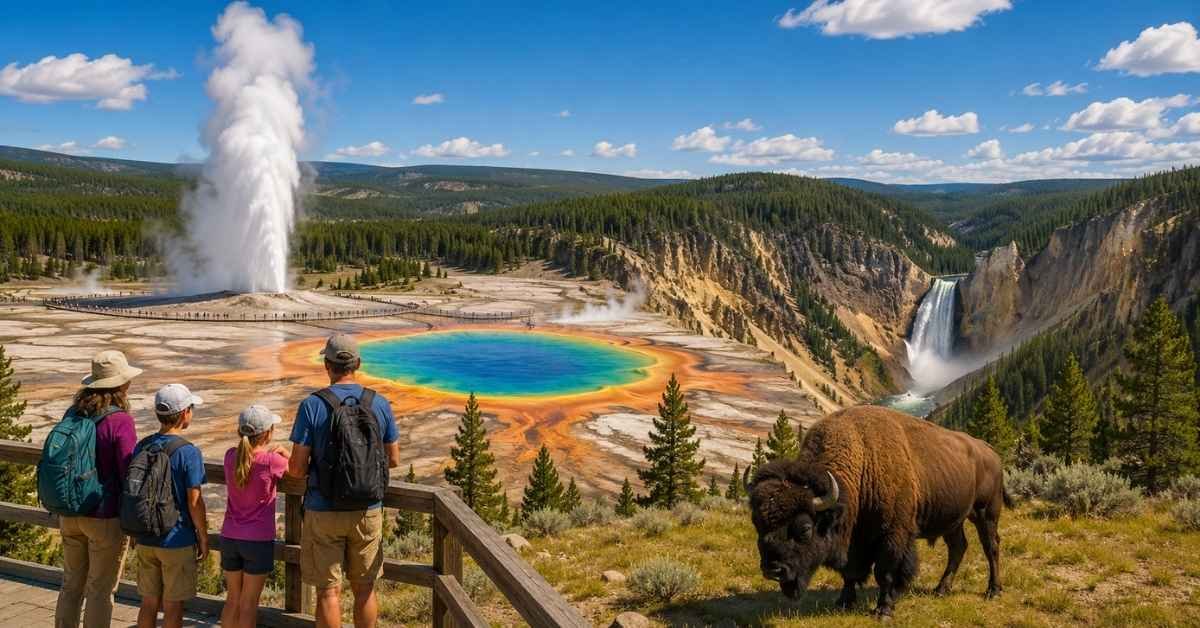
top 10 things to do in yellowstone include watching Old Faithful erupt, seeing Grand Prismatic Spring from above, exploring the Grand Canyon of the Yellowstone, searching for wolves in Lamar Valley, walking the terraces at Mammoth Hot Springs, visiting Norris Geyser Basin, driving through Hayden Valley, seeing Yellowstone Lake and West Thumb, exploring Fountain Paint Pot, and taking at least one scenic Yellowstone hike.
Those are the experiences that best represent Yellowstone’s remarkable combination of geysers, waterfalls, wildlife, lakes and volcanic landscapes. However, the park covers more than 2.2 million acres, so fitting them into a holiday requires more than copying ten locations into a navigation app.
This guide explains why each place deserves your time, when to visit, how long to stay, what parking is like and which attractions work best for families or limited-mobility travellers. It also includes honest drawbacks, realistic itineraries and the mistakes that can turn an unforgettable Yellowstone trip into a week of traffic and full car parks.
Yellowstone’s Top 10 at a Glance
| Rank | Yellowstone experience | Best for | Best time | Time needed | Walking |
|---|---|---|---|---|---|
| 1 | Old Faithful and Upper Geyser Basin | First-time visitors | Based on eruption prediction | 2–3 hours | Easy–moderate |
| 2 | Grand Prismatic Spring | Iconic scenery | Warm late morning | 1–2 hours | Easy–moderate |
| 3 | Grand Canyon and Lower Falls | Waterfalls and viewpoints | Morning | 2–3 hours | Easy–strenuous |
| 4 | Lamar Valley | Wolves and wildlife | Dawn or dusk | 2–4 hours | Minimal |
| 5 | Mammoth Hot Springs | Geology and history | Morning or evening | 1–2 hours | Easy–moderate |
| 6 | Norris Geyser Basin | Geothermal variety | Early morning | 1–2 hours | Moderate |
| 7 | Hayden Valley | Bison and central scenery | Dawn or dusk | 1–2 hours | Minimal |
| 8 | Yellowstone Lake and West Thumb | Lakeside scenery | Morning | 1–2 hours | Easy |
| 9 | Fountain Paint Pot | Compact thermal experience | Early morning | 45–90 minutes | Easy |
| 10 | A Yellowstone hike | Active exploration | Morning | 1–5 hours | Varies |
The busiest attractions are not always best at the earliest possible hour. Grand Prismatic Spring, for example, is quieter early in the morning, but cold air can create enough steam to hide its colours. The best time depends on whether your priority is photography, parking or avoiding crowds.
Understand Yellowstone Before Planning Your Route
Yellowstone is not a compact attraction park. Its five entrances connect to a vast network of valleys, forests, lakes and thermal basins spread across Wyoming, Montana and Idaho.
A route that looks simple on a map can take considerably longer because of:
- Bison walking along the road
- Wildlife-viewing traffic
- Full parking areas
- Roadworks
- Slow recreational vehicles
- Sudden weather changes
- Unplanned scenic stops
Add a 20–30% Yellowstone delay buffer to ordinary driving estimates. Scheduling every hour of the day leaves no room for the unexpected moments that often become the most memorable part of the trip.
Think of Yellowstone as Three Touring Zones
The easiest way to organise the park is to divide it into three areas.
Southwest thermal zone: Old Faithful, Upper Geyser Basin, Grand Prismatic Spring, Fountain Paint Pot and Firehole Lake Drive.
Central canyon, lake and wildlife zone: Grand Canyon of the Yellowstone, Hayden Valley, Mud Volcano, Yellowstone Lake and West Thumb.
Northern thermal and wildlife zone: Norris Geyser Basin, Mammoth Hot Springs, Tower-Roosevelt and Lamar Valley.
Trying to move repeatedly between these zones wastes time. Group nearby Yellowstone attractions into the same touring day.
Check Current Conditions Every Morning
Yellowstone’s roads, trails and boardwalks can close because of snow, wildlife, construction or changing hydrothermal activity.
For 2026, important planning issues have included:
- Boiling River remains unavailable for swimming
- Access around Biscuit Basin continues to be affected by hydrothermal activity
- Firehole swimming access is condition-dependent
- Roads and visitor services have different seasonal operating dates
- Geyser predictions change throughout the day
Check the official road status, weather, geyser activity and current conditions before leaving your accommodation.
1. Watch Old Faithful and Explore Upper Geyser Basin
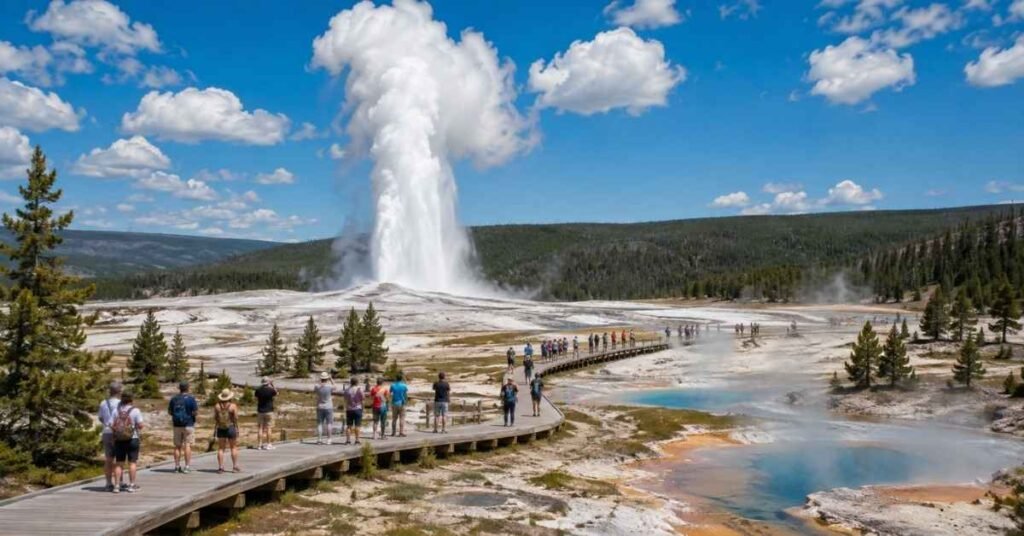
Old Faithful is Yellowstone’s most famous geyser, but treating it as a five-minute roadside stop is one of the most common first-time mistakes.
The geyser does not erupt at an exact fixed time. Rangers calculate a predicted window based partly on the duration of the previous eruption. The current median interval is roughly 102 minutes, although individual intervals vary.
Check the latest prediction through the visitor centre, posted information or the NPS App. Arrive early enough to find a comfortable viewing position, particularly during summer.
After the eruption, resist the temptation to return immediately to your vehicle. Old Faithful sits inside the Upper Geyser Basin, which contains the greatest concentration of geysers in the world.
The boardwalk network leads towards:
- Castle Geyser
- Grand Geyser
- Daisy Geyser
- Riverside Geyser
- Morning Glory Pool
- Numerous hot springs and fumaroles
Not every geyser erupts frequently or predictably, but the Upper Geyser Basin makes the entire stop far more rewarding.
Allow time for the Old Faithful Visitor Education Center, especially when travelling with children. Its exhibits explain the underground processes behind Yellowstone’s hydrothermal features, while Junior Ranger and Young Scientist activities give families something constructive to do between eruptions.
The nearby Old Faithful Inn, completed in the early twentieth century, is also worth entering even if you are not staying there. Its enormous log interior is one of the defining examples of rustic national-park architecture.
Best strategy: Allow two to three hours. Watch Old Faithful, explore part of Upper Geyser Basin and visit the inn or education centre.
Honest drawback: The main viewing area can feel busy and commercial. The quieter boardwalks beyond the geyser often provide the more memorable experience.
2. See Grand Prismatic Spring From Two Perspectives
Grand Prismatic Spring is Yellowstone’s largest hot spring and one of the most recognisable natural features in the United States. Its blue centre and bands of yellow, orange and rust are created partly by heat-loving microorganisms living at different water temperatures.
There are two ways to experience it, and they should not be confused.
Grand Prismatic Boardwalk
The boardwalk begins at Midway Geyser Basin and passes Excelsior Geyser Crater before circling near Grand Prismatic.
This route puts you close to the spring, allowing you to see the steam, runoff channels and textures around its edges. However, the spring is so large that the complete shape is difficult to appreciate from ground level.
The walking route is relatively short and manageable, but the parking area is notorious for congestion.
Grand Prismatic Overlook
The elevated view seen in most Yellowstone photographs comes from the Grand Prismatic Overlook, reached from the Fairy Falls trailhead.
The walk is longer than the boardwalk and includes an uphill section near the viewpoint. From above, you can finally understand the spring’s scale and see its colour bands clearly.
| Factor | Boardwalk | Overlook |
|---|---|---|
| Perspective | Close, ground-level view | Elevated full view |
| Access | Midway Geyser Basin | Fairy Falls trailhead |
| Walking | Short boardwalk loop | Longer walk with incline |
| Best for | Thermal detail | Iconic photographs |
| Main drawback | Limited full-spring view | More walking |
When Should You Visit Grand Prismatic?
Early morning generally provides easier parking, but cold air can cause heavy steam. Warmer late-morning or midday conditions may reveal stronger colours, particularly on a sunny day, but this is also when congestion becomes most difficult.
A practical compromise is to visit the overlook in mid-to-late morning and arrive with a backup plan if the trailhead is full.
Best strategy: Choose the overlook when you have time for only one view. Do both when you have two hours and parking conditions are manageable.
Honest drawback: The small overlook can become crowded, and the spring may look less colourful in cold, cloudy or heavily steamy conditions.
3. Experience Lower Falls and the Grand Canyon of the Yellowstone
The Grand Canyon of the Yellowstone provides a dramatic change from the park’s geyser basins. The Yellowstone River cuts through yellow, orange and reddish canyon walls before dropping over the 308-foot Lower Falls.
You could spend half a day visiting every viewpoint, but most first-time travellers need only two or three carefully selected stops.
Artist Point
Artist Point on South Rim Drive provides the classic distant view of Lower Falls framed by the canyon. It is one of Yellowstone’s most rewarding viewpoints and requires relatively little walking from the parking area.
Morning often provides better light and fewer people, although weather and seasonal conditions affect visibility.
Lookout Point
Located on the North Rim, Lookout Point offers a strong middle-distance view of Lower Falls. It provides a useful alternative perspective without requiring the strenuous descent associated with some canyon trails.
Brink of the Lower Falls
The trail to the brink leads much closer to the waterfall, where you can hear and feel the force of the river.
The descent may feel manageable, but the steep climb back to the rim is demanding. It is not the right choice for everyone, particularly visitors affected by altitude, heat or limited mobility.
Upper Falls
Upper Falls is shorter than Lower Falls but still impressive. Add it if you have sufficient time rather than rushing past your preferred Lower Falls viewpoints.
Best strategy: Combine Artist Point with one North Rim viewpoint. Add Brink of the Lower Falls only when your fitness, weather and schedule allow.
Honest drawback: Stopping at every overlook becomes repetitive and consumes valuable time. Two strong viewpoints are usually more satisfying than six rushed ones.
4. Look for Wildlife in Lamar Valley
Lamar Valley is Yellowstone’s leading destination for dedicated wildlife watching. Broad grasslands, the Lamar River and open sightlines create opportunities to observe animals from a responsible distance.
Possible sightings include:
- American bison
- Grey wolves
- Elk
- Pronghorn
- Coyotes
- Grizzly bears
- Black bears
- Bald eagles
Bison are common, but wolves and bears are never guaranteed. Anyone promising a certain sighting is setting unrealistic expectations.
Wildlife activity is often strongest around dawn and dusk. Arrive before sunrise with warm clothing, water and breakfast. Stop only in established pullouts, and never block the road because other visitors have seen an animal.
Binoculars are useful, but a spotting scope can make a major difference because wolves may remain far across the valley. Travellers for whom wolves are a priority should consider a naturalist-led wildlife tour. Experienced guides understand recent animal movement and usually provide high-powered optics.
Lamar Valley is most convenient for visitors staying around Cooke City, Silver Gate, Gardiner or the northern part of the park. It requires a considerable detour from Old Faithful and the South Entrance.
Best strategy: Dedicate a complete early morning to the valley rather than briefly driving through at midday.
Honest drawback: Lamar may consume half a day without producing a major predator sighting. The valley itself remains beautiful, but wildlife viewing always requires patience and luck.
5. Walk the Terraces at Mammoth Hot Springs
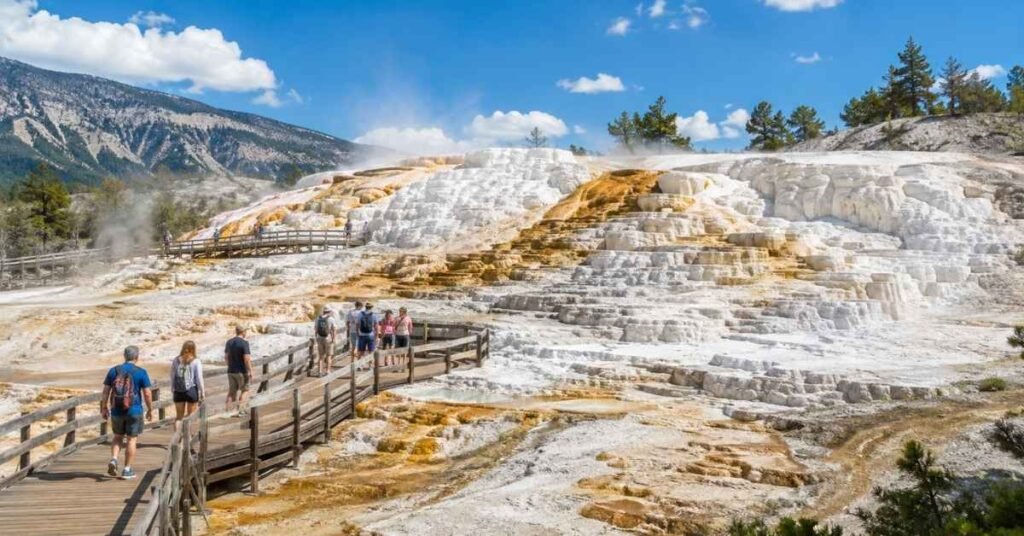
The white, cream and orange terraces at Mammoth Hot Springs look different from Yellowstone’s better-known geyser basins.
Here, thermal water travels through limestone, dissolves calcium carbonate and deposits it as travertine. The result resembles a cave formation turned inside out across a hillside.
The area has two main sections.
Lower Terraces
The boardwalks around the Lower Terraces provide close views of formations such as Palette Spring. Routes vary in incline, so you can choose a shorter section or explore more of the terrace complex.
Upper Terrace Drive
The Upper Terrace area can be explored by vehicle when the road is open. It provides additional formations and perspectives without requiring visitors to walk the entire hill.
The appearance of Mammoth changes continuously. A terrace flowing with water during one visit may be dry during another because underground pathways shift. This is a natural process, not evidence that the attraction is disappearing.
Mammoth is also close to:
- Albright Visitor Center
- Historic Fort Yellowstone
- The Yellowstone Tribal Heritage Center
- The North Entrance
- Gardiner, Montana
Elk are frequently seen around the developed area, but they remain wild animals and require plenty of space.
Best strategy: Spend an hour on the Lower Terraces and add the Upper Terrace Drive or historical area if time permits.
Honest drawback: Mammoth may appear less colourful or active than edited photographs suggest. Its value comes from understanding how quickly the formations change.
6. Explore Norris Geyser Basin
Norris Geyser Basin is Yellowstone’s hottest and one of its most dynamic thermal areas. Its acidic springs, steaming ground and constantly changing features give it a more untamed appearance than Old Faithful.
The basin contains two main walking areas.
Porcelain Basin
Porcelain Basin is the shorter option. Its exposed landscape contains vivid mineral colours, steaming vents and an otherworldly collection of thermal features.
Choose this section when your time or walking ability is limited.
Back Basin
Back Basin follows a longer route through woodland and thermal clearings. It contains Steamboat Geyser, the world’s tallest active geyser.
Steamboat can produce enormous eruptions, but its major activity is unpredictable. Visit because the basin is fascinating, not because you expect to see a record-breaking eruption.
Norris is more physically demanding than some visitors expect. Boardwalks contain changes in grade, and the exposed sections can feel extremely hot during summer afternoons. Shade and benches are not consistently available exactly when you want them.
Parking also becomes difficult during peak periods. An early arrival improves both the walking conditions and the chance of finding a space.
Best strategy: Walk Porcelain Basin when you have less than an hour. Explore both areas when you can allow at least 90 minutes.
Honest drawback: Visitors with limited mobility or sensitivity to heat may find Norris tiring. West Thumb or Fountain Paint Pot may provide an easier thermal experience.
Learn More: 29 Best Free Things to Do in San Francisco in 2026
7. Drive Through Hayden Valley at Dawn or Dusk
Hayden Valley is Yellowstone’s most convenient major wildlife area because it lies between Canyon Village and Yellowstone Lake.
Large bison herds regularly move through the valley. Depending on timing and luck, visitors may also see elk, coyotes, bears, wolves and waterfowl.
Hayden and Lamar valleys serve different itineraries.
| Factor | Lamar Valley | Hayden Valley |
|---|---|---|
| Best known for | Wolves and dedicated wildlife watching | Bison and central convenience |
| Best time | Dawn or dusk | Dawn or dusk |
| Route location | Northern Yellowstone | Central Yellowstone |
| Time commitment | Half day | One or two hours |
| Main challenge | Long detour | Heavy roadside congestion |
Hayden Valley works particularly well when combined with the Grand Canyon of the Yellowstone, Mud Volcano or Yellowstone Lake.
Do not judge the area after one quick midday drive. Wildlife may be less active, and heavy traffic can make the valley feel like a route between attractions rather than an experience of its own.
If you stop, use a designated pullout and keep the road clear. Bison sometimes walk along or cross the roadway, creating delays that cannot be avoided.
Hiking in the surrounding area requires more caution than roadside viewing. Carry bear spray, understand how to use it and avoid surprising wildlife.
Best strategy: Drive through shortly after sunrise or before sunset, allowing extra time for bison jams.
Honest drawback: Hayden is easier to reach than Lamar, but its popularity can create congestion and crowded pullouts.
8. Combine Yellowstone Lake With West Thumb Geyser Basin
Yellowstone Lake provides breathing room after several days of geysers and busy boardwalks. The high-elevation lake stretches across a vast area of the park and creates a cooler, more open landscape.
One of the best places to experience it is West Thumb Geyser Basin, where thermal features sit directly beside the shoreline.
The boardwalk passes:
- Abyss Pool
- Fishing Cone
- Lakeside hot springs
- Dormant geyser cones
- Views across the West Thumb of Yellowstone Lake
The thermal basin sits within a smaller caldera formed by volcanic activity inside the larger Yellowstone volcanic system. That relationship between lake, caldera and hydrothermal features makes West Thumb more interesting than a simple scenic stop.
The loop is relatively short and provides a high reward for limited walking. This makes it useful for families, older travellers and anyone entering from Grand Teton National Park through Yellowstone’s South Entrance.
Nearby possibilities include Grant Village, Lake Hotel, Fishing Bridge and the Storm Point Trail.
Best strategy: Visit in the morning while travelling between the South Entrance, Old Faithful and Yellowstone Lake.
Honest drawback: West Thumb may be a lower priority for a one-day visitor entering from Gardiner or West Yellowstone because reaching it adds considerable driving.
9. See Four Types of Thermal Features at Fountain Paint Pot
Fountain Paint Pot is one of the best educational stops in Yellowstone because its compact boardwalk introduces all four major hydrothermal features:
- Geysers
- Hot springs
- Fumaroles
- Mudpots
The trail passes features such as Red Spouter, Clepsydra Geyser and Fountain Paint Pot. Changes in seasonal water levels affect the mudpots, which may look thick and slow or wetter and more active.
The area belongs to the Lower Geyser Basin, which releases an extraordinary volume of hot water. Understanding this makes the basin more meaningful than treating it as another quick boardwalk.
When open, nearby Firehole Lake Drive leads past additional thermal features, including Great Fountain Geyser. Its eruptions are much less frequent than those of Old Faithful, so current prediction information is useful.
Fountain Paint Pot is especially helpful for travellers who want geothermal variety without walking the longer loops at Norris or Upper Geyser Basin.
Best strategy: Arrive early, walk the loop in 45–60 minutes and continue towards Grand Prismatic or Old Faithful.
Honest drawback: It can feel less spectacular than Grand Prismatic unless you understand the differences among geysers, springs, fumaroles and mudpots.
10. Take One Yellowstone Hike Beyond the Boardwalks
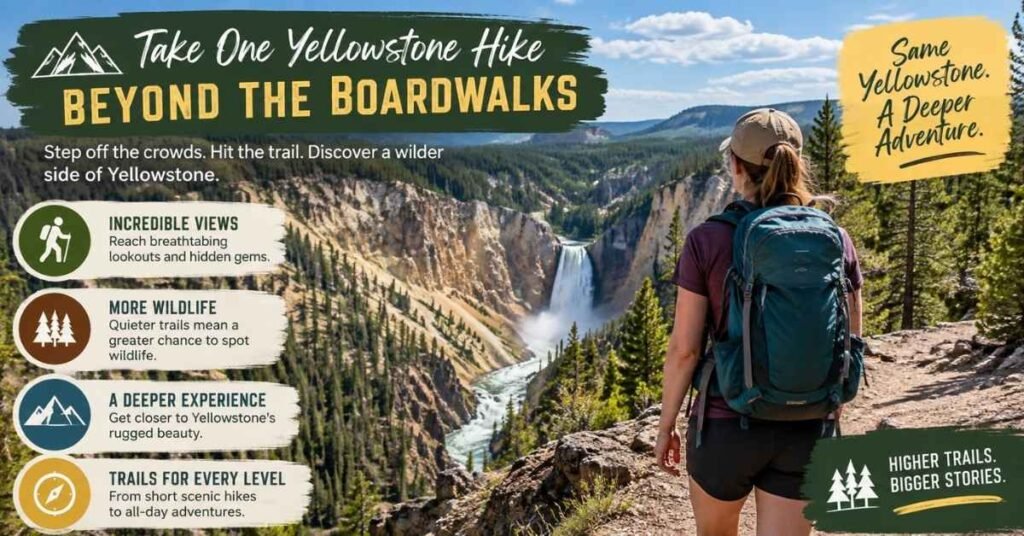
Yellowstone’s famous viewpoints are accessible by road, but hiking provides a different sense of the park’s scale. You do not need an advanced backcountry expedition. Choose one route that matches your ability and available time.
Storm Point Trail
Storm Point is a manageable choice near Yellowstone Lake. It combines forest, meadow and shoreline scenery without requiring an entire day.
Wildlife may be present, so hikers should still carry bear spray and remain alert.
Fairy Falls Trail
The mostly gentle Fairy Falls Trail combines naturally with the Grand Prismatic Overlook. Continue beyond the overlook when you have enough time and want a longer break from busy boardwalks.
Mosquitoes can be persistent during warmer months, particularly around wetter sections.
Mystic Falls Trail
Mystic Falls provides a waterfall-focused hike near the Upper Geyser Basin area. Access routes and trailheads can be affected by current closures, especially around Biscuit Basin, so verify conditions before setting out.
Mount Washburn
Mount Washburn is the advanced choice. The route climbs to a high viewpoint with broad panoramas across Yellowstone.
The elevation, exposure and rapidly changing weather make this unsuitable for a rushed afternoon. Start early and avoid exposed ridges when thunderstorms threaten.
| Trail | Difficulty | Allow | Best for |
|---|---|---|---|
| Storm Point | Easy | 1–2 hours | Families and lake scenery |
| Fairy Falls | Easy–moderate | 2–4 hours | Grand Prismatic combination |
| Mystic Falls | Moderate | 2–3 hours | Waterfall scenery |
| Mount Washburn | Moderate–strenuous | 3–5 hours | Panoramic views |
Best strategy: Select one hike rather than squeezing several trails between major attractions.
Honest drawback: Every longer hike replaces something else in your itinerary. A hike is worthwhile only when it matches your priorities, fitness and weather.
What Should You Skip When Time Is Limited?
“Skip” does not mean an attraction is bad. It means the stop may not justify the time required during a short first visit.
Consider reducing or removing:
- Repetitive minor geyser basins after visiting two or three major thermal areas
- Every viewpoint along the Yellowstone canyon
- Lamar Valley during a one-day Lower Loop itinerary
- A major hike on an already crowded sightseeing day
- Both Lamar and Hayden valleys in the middle of the day
- Distant gateway-town activities before seeing Yellowstone’s main attractions
- Small roadside waterfalls when parking is difficult
Do not spend the entire trip chasing a longer list. Yellowstone is more memorable when you give its best places enough time.
Yellowstone Itineraries for One, Two or Three Days
One Day in Yellowstone
Do not attempt the complete top ten. Choose one geographically sensible route.
Lower Loop From West Yellowstone
- Grand Prismatic Spring
- Old Faithful and part of Upper Geyser Basin
- West Thumb if time permits
- Hayden Valley
- Grand Canyon and Lower Falls
This will still be a long day. Remove West Thumb if delays build.
Northern Route From Gardiner
- Mammoth Hot Springs
- Lamar Valley
- Tower-Roosevelt area
- Grand Canyon of the Yellowstone if time permits
This route works better for travellers prioritising wildlife over famous geysers.
Two Days in Yellowstone
Day One: Thermal Yellowstone
- Grand Prismatic Spring
- Old Faithful
- Upper Geyser Basin
- Fountain Paint Pot
- West Thumb where convenient
Day Two: Canyon and Wildlife
- Grand Canyon of the Yellowstone
- Hayden Valley
- Norris Geyser Basin
- Mammoth or Lamar, depending on accommodation
Two days allow the main highlights, but mornings should begin early.
Three Days in Yellowstone
Day One: Southwest Thermal Features
Visit Grand Prismatic, Old Faithful, Upper Geyser Basin and Fountain Paint Pot.
Day Two: Canyon, Hayden Valley and Yellowstone Lake
Start with the canyon, continue through Hayden Valley and finish around Yellowstone Lake or West Thumb.
Day Three: Northern Yellowstone
Explore Norris, Mammoth Hot Springs and Lamar Valley. Arrange the route so Lamar falls near dawn or dusk.
Three days provide the best balance for a first visit. You can see the defining attractions without treating every stop as a race.
Choose Your Route According to Your Entrance
| Starting area | Best first stop | Main advantage | Main disadvantage |
|---|---|---|---|
| West Yellowstone | Grand Prismatic or Old Faithful | Fast thermal-area access | Busy entrance traffic |
| Gardiner | Mammoth or Lamar Valley | Strong northern access | Far from West Thumb |
| Cooke City | Lamar Valley | Excellent dawn wildlife access | Long drive to Old Faithful |
| Cody | Yellowstone Lake or Canyon | Scenic East Entrance | Lengthy approach |
| Jackson or Grand Teton | West Thumb | Natural south-to-north route | Heavy summer traffic |
Accommodation location affects the trip more than many visitors expect. Saving money on a distant hotel can be a poor trade if it adds several hours of daily driving.
See More: 25 Fun Things to Do in Curacao for Every Traveller
Best Yellowstone Experiences by Traveller Type
Families With Children
Prioritise:
- Old Faithful
- Visitor Education Center
- West Thumb
- Fountain Paint Pot
- Artist Point
- Junior Ranger activities
Keep children close around thermal boardwalks. The ground beyond marked routes may contain thin crust over dangerously hot water.
Wildlife Lovers
Prioritise Lamar Valley, Hayden Valley and the Mammoth area. Schedule more than one wildlife session because animal sightings are never predictable.
Photographers
The strongest locations include:
- Grand Prismatic Overlook
- Artist Point
- Lamar Valley
- Mammoth Hot Springs
- Yellowstone Lake
- Old Faithful from the Upper Geyser Basin boardwalk
Carry a telephoto lens for wildlife and never approach an animal to improve a photograph.
Visitors Avoiding Long Hikes
Many of Yellowstone’s best attractions require only short walks. Consider:
- Old Faithful
- Grand Prismatic boardwalk
- Artist Point
- Hayden Valley
- West Thumb
- Selected Mammoth terraces
Active Travellers
Add Mount Washburn, Fairy Falls, Mystic Falls or Storm Point. Begin early enough to avoid afternoon storms and protect the rest of the itinerary.
Best Time to Visit Yellowstone
Summer
Summer offers the widest road access, operating facilities and ranger programmes. It also brings the largest crowds.
Begin before ordinary day-trip traffic enters the park. Yellowstone received 958,706 recreational visits in July 2026, illustrating why parking strategy matters.
Afternoon thunderstorms are common, and nights can remain cold even after warm days.
September and Early Autumn
September often provides a strong balance of open roads, wildlife activity and lighter crowds. Nights become colder, and snow remains possible.
Restaurants, lodges and services may begin reducing their hours later in the season.
Spring
Spring brings newborn wildlife, changing snow conditions and fewer visitors. However, roads open in stages, trails may be muddy and sudden snowfall can interrupt plans.
Maintain greater distance from animals with young.
Winter
Most Yellowstone roads close to regular vehicles during winter. Visitors explore selected areas through snowcoach, snowmobile, skis or snowshoes.
A winter Yellowstone holiday requires a completely different itinerary from the top-ten summer route.
Parking, Food, Fuel and Mobile Service
Yellowstone Parking Strategy
The most difficult parking areas commonly include:
- Grand Prismatic Spring
- Fairy Falls trailhead
- Norris Geyser Basin
- Popular canyon viewpoints
- Wildlife pullouts
If a car park is full, do not block traffic or create an unsafe roadside space. Continue to a nearby attraction and return later.
Old Faithful has a larger parking area, but crowds still build around predicted eruption times.
Carry Food and Water
Restaurant queues can disrupt a carefully planned day. Pack breakfast for wildlife mornings and carry enough water for exposed boardwalks.
Food must be stored responsibly. Never leave it unattended where wildlife can reach it.
Keep the Fuel Tank Healthy
Fuel is available in several developed parts of the park, but stations are separated by long distances. Refuel before the tank becomes low rather than relying on the next station being nearby or open.
Download Maps Before Entering
Mobile reception is inconsistent. Before entering Yellowstone:
- Download offline maps
- Save the park map
- Download NPS App content
- Screenshot accommodation details
- Save current road information
- Write down essential directions
Do not depend entirely on live navigation.
Yellowstone Safety Every Visitor Should Know
Stay on Boardwalks in Thermal Areas
Yellowstone’s thermal ground can be thin and unstable. Water temperatures are capable of causing fatal burns.
Never:
- Step beyond a boardwalk
- Touch thermal water
- Allow children to run ahead
- Retrieve an object that falls into a spring
- Swim in a thermal feature
Maintain Wildlife Distance
Remain at least:
- 100 yards from bears and wolves
- 25 yards from bison, elk and other wildlife
These are minimum distances, not targets. Move farther away when an animal changes direction, looks disturbed or approaches you.
Bison may appear calm but can run much faster than a person.
Carry Bear Spray on Trails
Bear spray is valuable only when it is accessible and you know how to use it. Do not bury it inside a backpack.
Hike in groups where possible, make noise in areas with limited visibility and follow current trail notices.
Prepare for Mountain Weather
Yellowstone mornings can be cold even in summer. Carry:
- Warm layer
- Waterproof jacket
- Sun protection
- Drinking water
- Suitable walking shoes
Leave exposed trails when thunderstorms approach. High ridges such as Mount Washburn are not safe places to wait out lightning.
Frequently Asked Questions
What is the number-one thing to do in Yellowstone?
For most first-time visitors, the number-one experience is watching Old Faithful and exploring Upper Geyser Basin. Grand Prismatic Spring may be more visually impressive, but the Old Faithful area provides a broader introduction to Yellowstone’s geysers and history.
What should you not miss in Yellowstone?
Do not miss Old Faithful, Grand Prismatic Spring, Lower Falls, one wildlife valley and either Mammoth or Norris Geyser Basin.
How many days do you need in Yellowstone?
Three days provide a balanced first visit. Two days can cover the main highlights with early starts, while one day requires strict prioritisation.
Can you see Yellowstone in one day?
You can see several major attractions in one day, but not the full top ten. Choose either a Lower Loop highlights route or a northern wildlife route.
Is Old Faithful worth visiting?
Yes, especially when combined with Upper Geyser Basin, Old Faithful Inn and the Visitor Education Center. Watching the eruption and immediately leaving provides an incomplete experience.
Is Grand Prismatic better from the boardwalk or overlook?
The overlook provides the best complete view and photographs. The boardwalk is better for seeing thermal details up close.
Is Lamar Valley or Hayden Valley better?
Lamar Valley is generally better for dedicated wildlife watching and potential wolf sightings. Hayden Valley is easier to combine with the canyon and Yellowstone Lake.
Which Yellowstone entrance is best?
There is no universally best entrance. West is convenient for geyser basins, North for Mammoth, Northeast for Lamar Valley, South for Grand Teton and East for Yellowstone Lake.
Do you need a reservation to enter Yellowstone?
Yellowstone does not normally require a timed-entry reservation simply to enter. Lodging, campsites, tours, horseback rides and some activities may require advance booking.
What is the least crowded time to visit Yellowstone?
Late spring and autumn are generally quieter than July and August, but road access and services may be reduced. During summer, sunrise and evening provide the quietest conditions.
Can you visit Yellowstone without hiking?
Yes. Old Faithful, Artist Point, Hayden Valley, West Thumb and many thermal features are accessible through viewpoints or relatively short walks.
Is Yellowstone suitable for young children?
Yes, but long driving days and thermal boardwalks require planning. Keep children within reach near hot springs and include visitor centres, short walks and regular breaks.
Do you need bear spray in Yellowstone?
Bear spray is strongly recommended for hiking in bear country. It is less relevant when remaining inside developed areas or viewing wildlife from a vehicle, but you must still maintain safe distances.
Can you visit Yellowstone and Grand Teton together?
Yes. The parks connect naturally through Yellowstone’s South Entrance. Allow at least five days for a useful combined trip, with more time for hiking or wildlife watching.
Final Thoughts
The best top 10 things to do in Yellowstone are not meant to be rushed through in a single exhausting day. Yellowstone rewards travellers who explore geographically, begin early and leave space for wildlife, weather and unexpected delays.
For a first visit, prioritise Old Faithful, Grand Prismatic Spring, the Grand Canyon of the Yellowstone, one wildlife valley and a major thermal basin. Add Yellowstone Lake, a second wildlife area and a scenic hike as your available time increases.
The goal is not to return home with the longest checklist. It is to stand beside an erupting geyser, watch bison cross a valley and hear Lower Falls thunder into the canyon without worrying constantly about reaching the next car park.










1 thought on “Top 10 Things to Do in Yellowstone for First-Time Visitors”