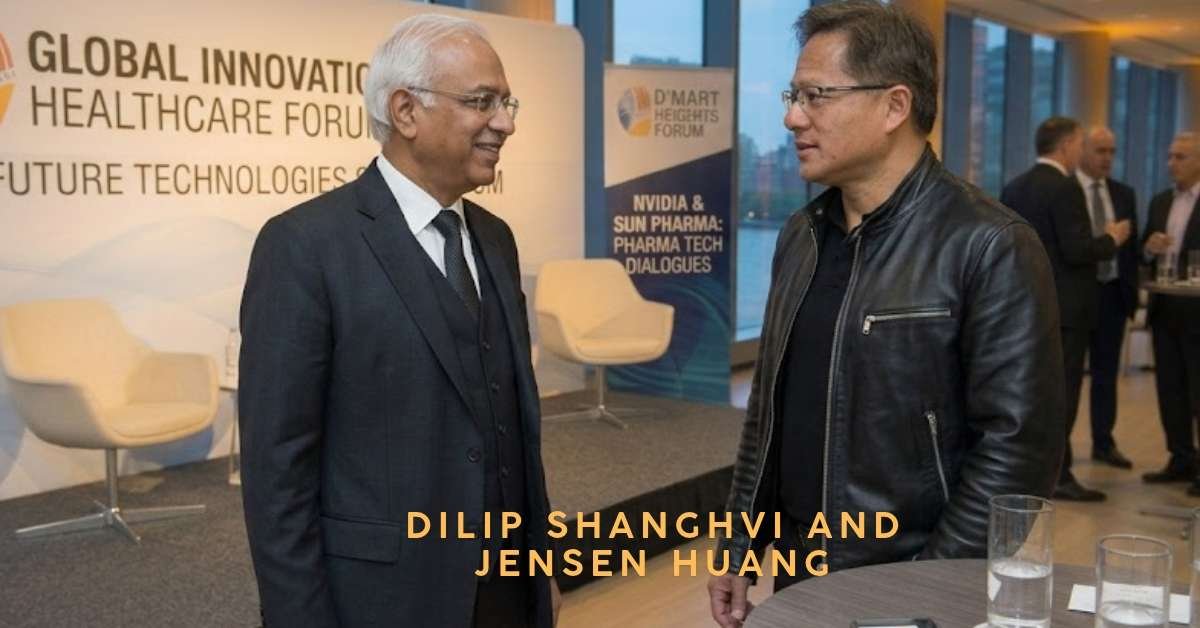
Dilip Shanghvi and Jensen Huang are two successful billionaire entrepreneurs who built globally influential companies in completely different industries. Dilip Shanghvi is the founder and Executive Chairman of Sun Pharmaceutical Industries, while Jensen Huang is the co-founder, President, and CEO of NVIDIA. Although their names often appear together in business comparison searches, there is no publicly verified evidence that they are business partners, relatives, or direct collaborators.
Both entrepreneurs demonstrate how long-term vision, strategic decisions, innovation, and business development can create extraordinary success. However, their journeys are quite different. Shanghvi built his fortune through pharmaceuticals, international expansion, and acquisitions, whereas Huang transformed NVIDIA from a graphics technology company into a global leader in artificial intelligence and accelerated computing.
Dilip Shanghvi and Jensen Huang: Quick Comparison
The following table highlights their backgrounds, companies, industries, and professional achievements.
| Detail | Dilip Shanghvi | Jensen Huang |
|---|---|---|
| Full Name | Dilip Shantilal Shanghvi | Jensen Huang |
| Birthplace | Amreli, Gujarat, India | Taipei, Taiwan |
| Nationality | Indian | American |
| Profession | Entrepreneur and business leader | Entrepreneur and technology executive |
| Company | Sun Pharmaceutical Industries | NVIDIA |
| Position | Executive Chairman | President and CEO |
| Founded Company | 1983 | 1993 |
| Industry | Pharmaceuticals | Semiconductors and computing |
| Education | Commerce graduate, University of Calcutta | Electrical engineering degrees from Oregon State University and Stanford University |
| Main Business Focus | Generic and specialty medicines | GPUs, AI, and accelerated computing |
Although their professional backgrounds are different, both entrepreneurs have spent decades building companies with international influence.
Are Dilip Shanghvi and Jensen Huang Connected?
There is no verified public evidence establishing a direct personal or professional relationship between Dilip Shanghvi and Jensen Huang.
They are not publicly documented as business partners, relatives, or founders of a shared company. Their respective businesses also operate in completely different industries.
Shanghvi is associated with the pharmaceutical industry through Sun Pharma, which develops and manufactures medicines for international markets. In contrast, Huang leads NVIDIA, a technology company known for graphics processing units, computing platforms, and artificial intelligence infrastructure.
So, why do people search for their names together?
The most reasonable explanation is their shared status as influential billionaire entrepreneurs. Both founded companies that expanded beyond their original markets and became important players in the global economy.
Their stories offer an interesting comparison of two different approaches to building successful businesses.
Who Is Dilip Shanghvi?
Dilip Shanghvi is an Indian billionaire businessman best known for founding Sun Pharmaceutical Industries, one of India’s largest pharmaceutical companies.
He established the company in 1983 with a relatively small operation focused on psychiatric medicines. Over the following decades, he expanded the business through pharmaceutical specialization, international expansion, product development, and strategic acquisitions.
His journey is particularly interesting because he built a major pharmaceutical enterprise in an industry where manufacturing quality, research, regulatory compliance, and distribution capabilities are essential.
Early Life and Education
Dilip Shanghvi was born on October 1, 1955, in Amreli, Gujarat, India. He grew up in Kolkata, where his father was involved in pharmaceutical distribution.
His exposure to the medicine business helped him understand how pharmaceutical products reached doctors, pharmacies, and patients.
Shanghvi studied commerce at the University of Calcutta. Rather than following a conventional corporate career, he eventually decided to establish his own pharmaceutical business.
His early experience and understanding of medicine distribution helped him recognize opportunities in the pharmaceutical market.
Founding Sun Pharmaceutical Industries
Shanghvi founded Sun Pharmaceutical Industries in 1983.
The business began with five psychiatric products and a small team. Its initial focus on specialist medicines helped the company establish a recognizable position in a competitive pharmaceutical market.
Instead of attempting to compete across every therapeutic category immediately, Sun Pharma concentrated on specific areas where it could build expertise and relationships with healthcare professionals.
This focused approach became an important part of its development.
As the business grew, the company expanded into additional therapeutic areas, including:
- Dermatology
- Psychiatry
- Cardiology
- Oncology
- Ophthalmology
- Neurology
- Specialty medicines
Sun Pharma eventually expanded into international markets and developed a substantial manufacturing and distribution network.
Growth Through Acquisitions
One of Shanghvi’s most significant business strategies was expanding through acquisitions.
Sun Pharma completed several important transactions that increased its international presence, product portfolio, and competitive position.
The acquisition of Ranbaxy Laboratories was particularly important.
Sun Pharma announced its approximately $4 billion all-stock Ranbaxy transaction in 2014 and completed the acquisition in March 2015.
The deal substantially expanded Sun Pharma’s scale and strengthened its position in the global pharmaceutical industry.
Other notable developments included the acquisition of Concert Pharmaceuticals in 2023 and the expansion of its specialty medicine portfolio.
These decisions demonstrate how Shanghvi used acquisitions alongside internal business development to expand the company.
Dilip Shanghvi’s Current Leadership Position
An important development occurred on September 1, 2025, when Shanghvi stepped down from his position as Managing Director and became Sun Pharma’s Executive Chairman.
Kirti Ganorkar took over as Managing Director.
This change did not mean Shanghvi retired from the business. He continued to hold an important strategic leadership position within the company.
His responsibilities include providing strategic direction and contributing to the company’s long-term development.
Who Is Jensen Huang?
Jensen Huang is a Taiwanese-born American entrepreneur and the co-founder, President, and CEO of NVIDIA.
He established NVIDIA in 1993 with Chris Malachowsky and Curtis Priem. The company initially focused on computer graphics and technology for gaming.
However, its development eventually extended far beyond graphics processing.
NVIDIA became a major supplier of computing technology used in artificial intelligence, scientific research, data centers, autonomous systems, and other advanced applications.
Huang’s leadership has played a central role in the company’s evolution from a graphics-focused business into an important part of the global AI infrastructure market.
Early Life and Education
Jensen Huang was born on February 17, 1963, in Taipei, Taiwan.
He spent part of his childhood in Asia before moving to the United States.
His educational background is strongly connected to engineering and technology.
He earned a bachelor’s degree in electrical engineering from Oregon State University and a master’s degree in electrical engineering from Stanford University.
Before establishing NVIDIA, Huang worked at Advanced Micro Devices and LSI Logic.
These experiences gave him exposure to semiconductor manufacturing, engineering, and computer technology.
His technical education and industry experience helped prepare him for the challenges of developing a semiconductor company.
Founding NVIDIA
Huang co-founded NVIDIA in 1993 with Chris Malachowsky and Curtis Priem.
The company’s early business focused on graphics processing, particularly technology that could improve computer graphics and gaming experiences.
One of NVIDIA’s major milestones came in 1999 with its GPU technology.
A graphics processing unit, or GPU, is designed to handle many computing operations in parallel. This capability eventually made GPUs useful for far more than displaying images.
Another important milestone was CUDA, introduced in 2006.
CUDA allowed developers and researchers to use NVIDIA GPUs for parallel computing applications beyond traditional graphics.
This development helped establish a broader software and hardware ecosystem around NVIDIA’s technology.
How NVIDIA Became Important in Artificial Intelligence
NVIDIA’s expansion into artificial intelligence was not an overnight achievement.
Its GPUs became increasingly valuable for machine learning and deep learning because these workloads benefit from parallel processing.
The 2012 AlexNet breakthrough became an important moment in the development of modern deep learning, helping demonstrate the potential of GPU-based computing.
Over time, NVIDIA expanded its offerings beyond individual graphics processors.
Its ecosystem now includes:
- GPUs and AI accelerators
- CUDA software
- Data-center computing systems
- AI development platforms
- Networking technology
- Robotics and autonomous vehicle platforms
This combination of hardware, software, and developer support helped NVIDIA establish a strong position in the AI infrastructure market.
Jensen Huang’s Current Leadership Position
As of November 2026, Jensen Huang continues to serve as NVIDIA’s President and CEO.
Unlike Shanghvi, who transitioned from Managing Director to Executive Chairman, Huang continues to hold the company’s leading operational and executive position.
His leadership remains closely associated with NVIDIA’s development of accelerated computing, generative AI, and advanced semiconductor technology.
Dilip Shanghvi vs Jensen Huang: Business Strategies
Although both entrepreneurs built globally recognized businesses, their strategies reflect the different requirements of their industries.
Shanghvi focused on identifying pharmaceutical opportunities, developing specialist products, and expanding through acquisitions.
Huang concentrated on engineering, computing architecture, software development, and long-term investment in technology platforms.
Shanghvi’s Business Strategy
Shanghvi’s approach demonstrates the importance of specialization.
Sun Pharma initially concentrated on psychiatric medicines rather than immediately competing across the entire pharmaceutical industry.
As the company developed, it expanded its product portfolio and entered additional markets.
Acquisitions also played an important role in increasing its capabilities and geographic reach.
His strategy can be understood through four major elements:
- Specialization: Building expertise in selected therapeutic areas.
- Expansion: Entering new pharmaceutical markets.
- Acquisitions: Purchasing businesses and products to accelerate growth.
- Innovation: Increasing investment in specialty and innovative medicines.
This strategy helped transform a small pharmaceutical operation into an international business.
Huang’s Business Strategy
Huang’s strategy centers on technology development and ecosystem building.
NVIDIA did not remain limited to gaming graphics. It continued investing in computing platforms that could serve scientific research, data centers, and artificial intelligence.
CUDA was particularly important because it helped developers use NVIDIA hardware for a wider range of applications.
Its software ecosystem, hardware development, and developer relationships created advantages that extended beyond individual chip products.
Four important elements characterize Huang’s approach:
- Engineering innovation: Developing advanced computing hardware.
- Platform development: Combining GPUs with software and computing systems.
- Research investment: Supporting emerging computing applications.
- Market expansion: Moving from gaming into AI, data centers, and other industries.
The Biggest Difference Between Their Strategies
The main difference is how they created competitive advantages.
Shanghvi built scale through pharmaceutical expertise, product portfolios, acquisitions, and international expansion.
Huang built technological advantages through computing architecture, software ecosystems, and continued engineering development.
Neither strategy is universally better. Each reflects the challenges and opportunities of its industry.
Sun Pharma vs NVIDIA: Company Comparison
The companies founded by these entrepreneurs operate in different markets, but both have achieved significant international influence.
| Business Factor | Sun Pharma | NVIDIA |
|---|---|---|
| Industry | Pharmaceuticals | Semiconductors and computing |
| Founder | Dilip Shanghvi | Jensen Huang, with two co-founders |
| Established | 1983 | 1993 |
| Main Products | Generic and specialty medicines | GPUs and computing platforms |
| Major Customers | Healthcare systems, distributors, and patients | Businesses, cloud providers, developers, and consumers |
| Growth Strategy | Acquisitions, medicines, and international expansion | Hardware, software, and technology platforms |
| Research Focus | Pharmaceutical research and development | Computing, AI, and semiconductor engineering |
| Major Market Opportunity | Global healthcare | AI and accelerated computing |
Financial Scale of the Two Companies
Their financial results demonstrate the different scales and economics of their businesses.
Sun Pharma reported consolidated revenue from operations of approximately ₹584.62 billion for FY2025-26.
NVIDIA reported approximately $215.9 billion in revenue for fiscal year 2026, representing 65% year-over-year growth.
These figures should not be interpreted as a direct profitability comparison. They use different currencies and fiscal reporting periods, and the companies operate under very different business models.
Nevertheless, they illustrate the extraordinary scale of the companies associated with both entrepreneurs.
Dilip Shanghvi and Jensen Huang Net Worth Compared
Net worth is one of the most interesting aspects of this comparison.
Both entrepreneurs have accumulated substantial wealth through their ownership interests and business success. However, their fortunes differ considerably in size.
According to Forbes’ real-time billionaire profiles, the November 8, 2026 estimates were:
| Entrepreneur | Estimated Net Worth |
|---|---|
| Jensen Huang | $162.2 billion |
| Dilip Shanghvi | $27.4 billion |
Based on these estimates, Jensen Huang’s fortune was approximately 5.9 times larger than Dilip Shanghvi’s.
These figures are estimates, not audited personal financial statements.
Dilip Shanghvi’s Source of Wealth
Shanghvi built his fortune primarily through his ownership and involvement in Sun Pharma.
The company’s growth, international expansion, pharmaceutical portfolio, and acquisitions contributed to its long-term business value.
His wealth is therefore closely associated with the pharmaceutical industry and Sun Pharma’s financial performance.
Jensen Huang’s Source of Wealth
Huang’s fortune is strongly connected to his NVIDIA shareholding.
As NVIDIA’s market value increased alongside demand for AI computing technology, the estimated value of his ownership also increased.
Forbes has reported that he owns approximately 4% of NVIDIA, although shareholdings and wealth estimates can change over time.
Why Their Net Worth Figures Change
Billionaire wealth estimates are not fixed salaries or cash balances.
They can fluctuate because of:
- Public stock prices.
- Changes in company valuations.
- Share ownership and stock transactions.
- Private investments.
- Other financial assets and liabilities.
For this reason, the November 8 figures should be treated as a dated comparison rather than permanent values.
LEARN MORE: Tom Kennedy and Anna Wintour
Leadership Styles and Entrepreneurial Lessons
Both entrepreneurs demonstrate long-term commitment to their businesses, but their leadership approaches reflect different professional environments.
What Entrepreneurs Can Learn From Dilip Shanghvi
Shanghvi’s career highlights the value of identifying a specific market opportunity.
His decision to begin with a focused pharmaceutical portfolio demonstrates why a new company does not necessarily need to compete in every market immediately.
Other lessons include:
- Build expertise before expanding.
- Understand customer and market requirements.
- Use acquisitions strategically.
- Evaluate risks before committing resources.
- Invest in long-term business capabilities.
His approach shows how specialization and disciplined expansion can support sustainable business growth.
What Entrepreneurs Can Learn From Jensen Huang
Huang’s career demonstrates the importance of investing in technologies that may take years to become commercially important.
NVIDIA’s development from graphics processing into AI infrastructure required sustained engineering work and investment in software ecosystems.
Important lessons include:
- Invest in research and development.
- Think beyond current customer demand.
- Build products that support larger ecosystems.
- Adapt when markets change.
- Maintain a long-term technology vision.
His journey illustrates how a company can create new opportunities by developing capabilities before an emerging market reaches its full potential.
LEARN MORE: Tom Kennedy and Anna Wintour
Their Current Business Developments in 2026
Both companies continue to evolve, making their founders relevant to business discussions in 2026.
Sun Pharma’s Proposed Organon Acquisition
One of Sun Pharma’s most significant developments is its proposed acquisition of Organon.
Sun Pharma announced a definitive agreement in April 2026 to acquire all outstanding Organon shares for $14 per share in cash.
The transaction has an estimated enterprise value of approximately $11.75 billion.
However, the acquisition should not be described as completed. As of November 2026, Sun Pharma and Organon continue to operate independently while the remaining transaction conditions and approvals are addressed. The indicated closing period is Q4 FY2027.
This proposed acquisition could expand Sun Pharma’s international pharmaceutical business and strengthen its presence in additional therapeutic areas.
NVIDIA’s Continued Expansion in AI
NVIDIA continues to benefit from demand for AI computing infrastructure.
Its fiscal 2026 results reported revenue of $215.9 billion, up 65% compared with the previous fiscal year.
The company’s data-center business was a major contributor to this performance, reflecting demand for computing systems used in AI development and deployment.
This growth demonstrates how Huang’s long-term investment in GPU computing and software platforms helped NVIDIA participate in one of the most significant technology developments of recent years.
What Entrepreneurs Can Learn From Both Business Leaders
The stories of Dilip Shanghvi and Jensen Huang offer useful lessons for people building companies, regardless of their industry.
Start with a clear opportunity. Shanghvi identified a specialist pharmaceutical market, while Huang recognized the potential of advanced graphics and computing technology.
Think beyond the initial product. Sun Pharma expanded its therapeutic portfolio, while NVIDIA moved from graphics into accelerated computing.
Make long-term investments. Both companies required sustained investment in their capabilities.
Adapt to changing markets. Pharmaceutical businesses must respond to healthcare needs and regulations, while technology companies must continuously develop new computing solutions.
Build competitive advantages. Sun Pharma developed pharmaceutical expertise and an international business network. NVIDIA developed a combination of hardware, software, and developer support.
The most important lesson is that there is no single formula for entrepreneurial success. Different industries require different strategies, but focus, adaptability, and long-term execution remain valuable across business environments.
Frequently Asked Questions
1. Are Dilip Shanghvi and Jensen Huang related?
No verified public information establishes a family relationship between Dilip Shanghvi and Jensen Huang. They are independent entrepreneurs associated with Sun Pharma and NVIDIA, respectively.
2. Who is richer, Dilip Shanghvi or Jensen Huang?
Jensen Huang is considerably richer according to Forbes’ November 8, 2026 real-time estimates. Huang’s estimated net worth was $162.2 billion, compared with Shanghvi’s $27.4 billion.
3. What companies did Dilip Shanghvi and Jensen Huang establish?
Dilip Shanghvi founded Sun Pharmaceutical Industries in 1983. Jensen Huang co-founded NVIDIA in 1993 alongside Chris Malachowsky and Curtis Priem.
4. Is Dilip Shanghvi still the CEO of Sun Pharma?
No. Shanghvi became Executive Chairman effective September 1, 2025. Kirti Ganorkar took over as Managing Director.
5. Is Jensen Huang still the CEO of NVIDIA?
Yes. As of November 2026, Jensen Huang continues to serve as NVIDIA’s President and CEO.
6. How did Dilip Shanghvi build his wealth?
Shanghvi built his wealth primarily through Sun Pharma’s growth, pharmaceutical operations, international expansion, acquisitions, and his ownership interests in the company.
7. How did Jensen Huang become a billionaire?
Huang became a billionaire through his co-founding and leadership of NVIDIA. His substantial shareholding gained considerable value as the company expanded in graphics processing, accelerated computing, and artificial intelligence.
8. What is the biggest difference between Sun Pharma and NVIDIA?
Sun Pharma operates in the pharmaceutical industry, developing and supplying medicines. NVIDIA operates in the semiconductor and computing industries, developing GPUs, AI infrastructure, and computing platforms.
9. Have Dilip Shanghvi and Jensen Huang worked together?
No publicly documented joint business venture or professional collaboration between the two has been established.
10. What can entrepreneurs learn from Dilip Shanghvi and Jensen Huang?
Entrepreneurs can learn the importance of specialization, innovation, long-term investment, strategic decision-making, and adapting to changing market opportunities from their respective careers.
Final Thoughts
Dilip Shanghvi and Jensen Huang represent two different paths to global entrepreneurial success.
Shanghvi transformed a small pharmaceutical operation into Sun Pharma, an international healthcare business with a broad medicine portfolio. Huang helped turn NVIDIA from a graphics-focused company into a major provider of computing infrastructure for artificial intelligence.
Although their businesses, leadership responsibilities, and wealth differ, both demonstrate the importance of long-term thinking and the ability to recognize opportunities beyond an initial market.
Their most meaningful connection is not a documented partnership but their shared experience of building influential companies through decades of strategic decisions, innovation, and business development.









1 thought on “Dilip Shanghvi and Jensen Huang: Net Worth and Career Comparison”