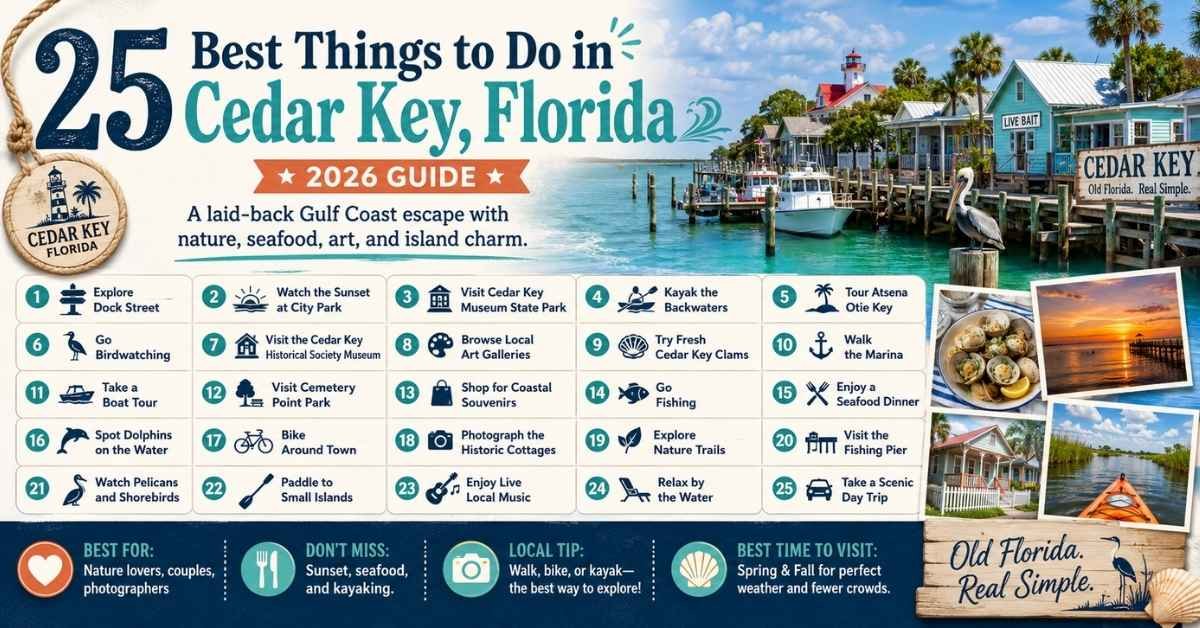
Things to do in Cedar Key Florida include kayaking to historic Atsena Otie Key, taking a wildlife cruise, fishing, exploring coastal museums, walking waterfront trails, browsing local art galleries and tasting the town’s famous farm-raised clams. This small community on Florida’s Nature Coast is ideal for travelers who enjoy wildlife, history, seafood and quiet sunsets—not luxury resorts, packed nightlife or enormous white-sand beaches.
Cedar Key rewards visitors who slow down. Its historic cottages, independent businesses, fishing boats, salt marshes and golf carts create an atmosphere that feels far removed from Florida’s major tourist centers. You can see the highlights in one day, but a two-night weekend gives you enough time to add a boat trip or kayaking adventure without rushing.
2026 travel note: Cedar Key has endured significant hurricane damage in recent years. The community remains welcoming, but rebuilding, relocated businesses, seasonal schedules and temporary closures can affect individual attractions. Confirm museum hours, restaurant locations, tour departures and trail access shortly before your visit.
Cedar Key’s Best Experiences at a Glance
| Experience | Best for | Time needed | Cost | Boat required? |
|---|---|---|---|---|
| Kayak to Atsena Otie Key | Active travelers | 2–4 hours | $$ | Yes |
| Wildlife boat tour | First-time visitors | 1.5–2 hours | $$ | Yes |
| Fishing charter | Anglers and families | 4–8 hours | $$$ | Yes |
| Cedar Key Museum State Park | History lovers | 1–2 hours | $ | No |
| Cemetery Point Boardwalk | Walkers and birders | 45–75 minutes | Free | No |
| Downtown Cedar Key | Food, art and shopping | 2–3 hours | Free–$$ | No |
| Cedar Key Public Beach | Families with young children | 1–2 hours | Free | No |
| Gulf sunset | Couples and photographers | 30–60 minutes | Free | No |
If you have only one day, combine a museum, downtown walk, local seafood lunch, boat tour and sunset. Stay for a weekend if you want to kayak, fish or explore the surrounding wildlife refuges.
Is Cedar Key Worth Visiting?
Cedar Key is worth visiting if you enjoy quiet coastal scenery, historic places, independent restaurants, fishing, kayaking and wildlife. It offers a more relaxed and less commercial experience than Florida’s major beach destinations.
This is not the place for amusement parks, nightclubs, luxury shopping or a packed attractions schedule. Nor is it part of the Florida Keys. Cedar Key sits in Levy County on Florida’s northern Gulf Coast, roughly 50 miles southwest of Gainesville.
You will probably enjoy Cedar Key if you love:
- Birdwatching and nature photography
- Kayaking, boating or fishing
- Small historic towns
- Local seafood
- Peaceful sunsets
- Independent shops and galleries
- Slow, flexible travel
Cedar Key may not suit you if you expect:
- A wide, resort-style beach
- Clear Caribbean-blue water
- Luxury hotels
- Late-night entertainment
- Large shopping centers
- Dozens of indoor attractions
The town’s main appeal is not the number of places you can check off a list. It is the chance to enjoy a working coastal community where salt marshes, clam farms, wildlife and local history remain part of daily life.
What to Know Before Visiting Cedar Key
Cedar Key and the Cedar Keys are not the same thing
The Cedar Keys are a group of islands near Florida’s Gulf Coast. The developed town of Cedar Key sits mainly on Way Key, which you can reach by driving along State Road 24.
Several offshore islands belong to the Cedar Keys National Wildlife Refuge. Those islands cannot be reached by car. You need a kayak, private boat, rental vessel or guided tour.
Cedar Key is not a traditional beach destination
Cedar Key Public Beach is small and family-friendly, but it is not comparable to Clearwater Beach, Destin or Siesta Key. The surrounding environment consists primarily of tidal flats, salt marshes, oyster beds and shallow coastal water.
Come for kayaking, wildlife, fishing and Old Florida atmosphere. Consider the beach a pleasant extra rather than the reason for your trip.
Check opening days carefully
Cedar Key serves a substantial weekend crowd. Some restaurants, museums, galleries and shops keep limited hours or close early on quieter weekdays.
If you are visiting on Monday or Tuesday, confirm your essential stops before driving to the island. You may enjoy fewer people, but you may also find fewer businesses open.
Check the tide, wind and marine forecast
Tides affect kayaking, boating, shoreline walking and fishing. Low water can reveal oyster beds and make shallow channels difficult to navigate. Strong wind can turn an easy outward paddle into a tiring return journey.
Before going onto the water, check:
- Tide time and height
- Wind speed and direction
- Thunderstorm risk
- Marine warnings
- Sunset time
- Local rental-provider advice
Best Things to Do in Cedar Key, Florida
1. Walk Through Downtown Cedar Key
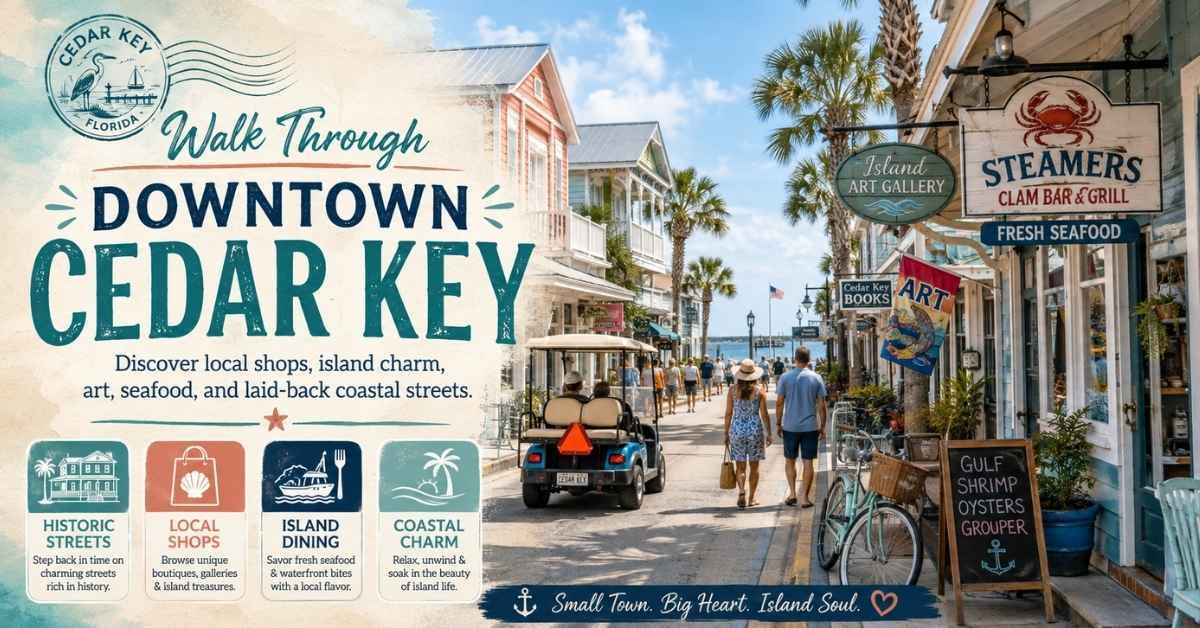
Begin your trip with a slow walk through downtown. Second Street and the surrounding blocks contain historic buildings, independent shops, galleries, cafés and glimpses of the water.
Downtown is compact, so you can cross it quickly. Resist the temptation. Cedar Key becomes more interesting when you notice the painted signs, weathered cottages, local artwork and golf carts moving between small businesses.
The morning is a good time to walk if you want cooler weather and quieter streets. However, some shops may not open until later in the day.
Best for: First-time visitors Time needed: 60–90 minutes Cost: Free, excluding shopping and food
2. Explore Dock Street and the Working Waterfront
Dock Street has long represented the social heart of Cedar Key. Fishing boats, restaurants, shops, docks and Gulf views have traditionally brought visitors to this side of town.
Recent storms and rebuilding have changed parts of the waterfront, so current conditions may not match older travel photographs. That is exactly why you should approach Dock Street as a living community rather than a preserved attraction.
Visit for waterfront views, marina activity and a sense of Cedar Key’s connection to fishing and aquaculture. If you plan to eat there, verify the restaurant’s current location and opening hours.
Best for: Food, photography and waterfront atmosphere Time needed: 45–90 minutes Cost: Free to explore
3. Visit Cedar Key Public Beach and Lil Shark Park
Cedar Key Public Beach is a small, sheltered beach beside the city park and marina. Families appreciate its manageable size, nearby playground and easy access to the center of town.
The water can look brown or green because this is a shallow, tidal environment rather than a clear-water resort beach. Conditions also change with weather and tides.
Bring water shoes, especially if you plan to explore exposed shoreline where oyster shells may be present. Check posted swimming conditions and supervise children closely.
Lil Shark Park makes this one of the better things to do in Cedar Key with young children. Families can combine playground time, a picnic and a short beach visit without committing an entire day.
Best for: Families and short waterfront breaks Time needed: 1–2 hours Cost: Free
4. Watch the Sunset Over the Gulf
Sunset is one of the best free things to do in Cedar Key. As evening arrives, the water, marshes and silhouettes of distant islands soften into oranges, pinks and deep blues.
Choose a legal waterfront viewing area and arrive at least 30 minutes before sunset. That gives you time to find parking, choose a comfortable position and watch the light change.
Bring insect repellent during warm or humid months. Biting insects can become more active near sheltered shorelines, especially around dusk.
Pair the sunset with dinner, but check how late local kitchens remain open. Cedar Key evenings can become quiet much earlier than visitors expect.
5. Take a Wildlife and Island Boat Tour
A guided boat tour is one of the most helpful Cedar Key activities for first-time visitors. It allows you to see the surrounding keys without managing a kayak, reading shallow channels or navigating unfamiliar tides.
Depending on the route and season, you may see:
- Dolphins
- Ospreys
- Pelicans
- Egrets
- Herons
- Ibises
- Roseate spoonbills
- Rays
- Manatees
Wildlife sightings are never guaranteed. The real value lies in seeing the Cedar Keys National Wildlife Refuge, learning about the islands and understanding how water shapes the town.
A boat tour is particularly suitable for families, older visitors, non-paddlers and travelers with limited time. Reserve ahead during weekends, festivals and comfortable-weather months.
Best for: First-time visitors and wildlife watchers Time needed: Around 1.5–2 hours Cost: $$ Reservation: Recommended
6. Kayak to Atsena Otie Key
Kayaking to Atsena Otie Key is one of the most memorable outdoor activities in Cedar Key. The island was once home to the area’s original settlement and a cedar mill connected to Florida’s pencil industry.
Today, visitors come for the paddle, quiet shoreline, historic cemetery and traces of the former community. The experience combines recreation with a tangible sense of Cedar Key’s past.
Although the island appears close, conditions determine the difficulty. Wind, current and tide can make one direction considerably harder than the other. Ask a local outfitter about the safest departure and return windows.
Bring:
- Drinking water
- Sun protection
- Insect repellent
- Dry bag
- Closed-toe water shoes
- Phone in a waterproof case
- Basic navigation backup
- Personal flotation device
Allow at least two to four hours for the round trip and island exploration. Do not enter restricted habitats, disturb wildlife or remove historical objects.
7. Paddle Through Salt Marshes and Tidal Creeks
You do not have to cross open water to appreciate Cedar Key kayaking. Salt marshes, protected shorelines and tidal creeks provide a quieter way to experience the area’s ecology.
A slow paddle may bring you near herons feeding in shallow water, mullet breaking the surface or dolphins moving through broader channels. The landscape can look subtle at first, but it becomes more engaging when you understand how tides control it.
Beginners should consider a guided paddle. A local guide can choose a route suited to the weather, explain coastal habitats and help visitors avoid closed or sensitive areas.
8. Book a Fishing Charter
Fishing is closely connected to Cedar Key’s identity. Local guides know the shallow flats, channels and seasonal patterns far better than a first-time visitor navigating unfamiliar water.
Charters may target inshore or nearshore species depending on the season, regulations and conditions. Before booking, ask:
- Is the trip half-day or full-day?
- Is fishing equipment included?
- Are licenses covered?
- Is bait included?
- What species are currently targeted?
- Is fish cleaning available?
- Can children join?
- What is the weather-cancellation policy?
- Is gratuity expected?
A half-day charter usually works well for beginners and families. Experienced anglers may prefer a longer trip with more time to reach productive water.
Best for: Anglers and hands-on families Time needed: 4–8 hours Cost: $$$ Reservation: Essential
9. Fish From an Open Pier, Bridge or Shoreline
You can enjoy Cedar Key fishing without paying for a charter. Public piers, bridges and shoreline areas may provide access, although storm damage and repairs can affect individual locations.
Verify that your chosen spot is currently open and that fishing is permitted. You should also confirm Florida’s license requirements, size limits, bag limits and seasonal rules.
Early morning and late afternoon often provide more comfortable temperatures. Bring your own tackle or ask a local bait shop what is currently working.
Avoid blocking pedestrian areas, dispose of fishing line responsibly and keep hooks away from birds. Abandoned line poses a serious risk to coastal wildlife.
10. Go Birdwatching Around Cedar Key
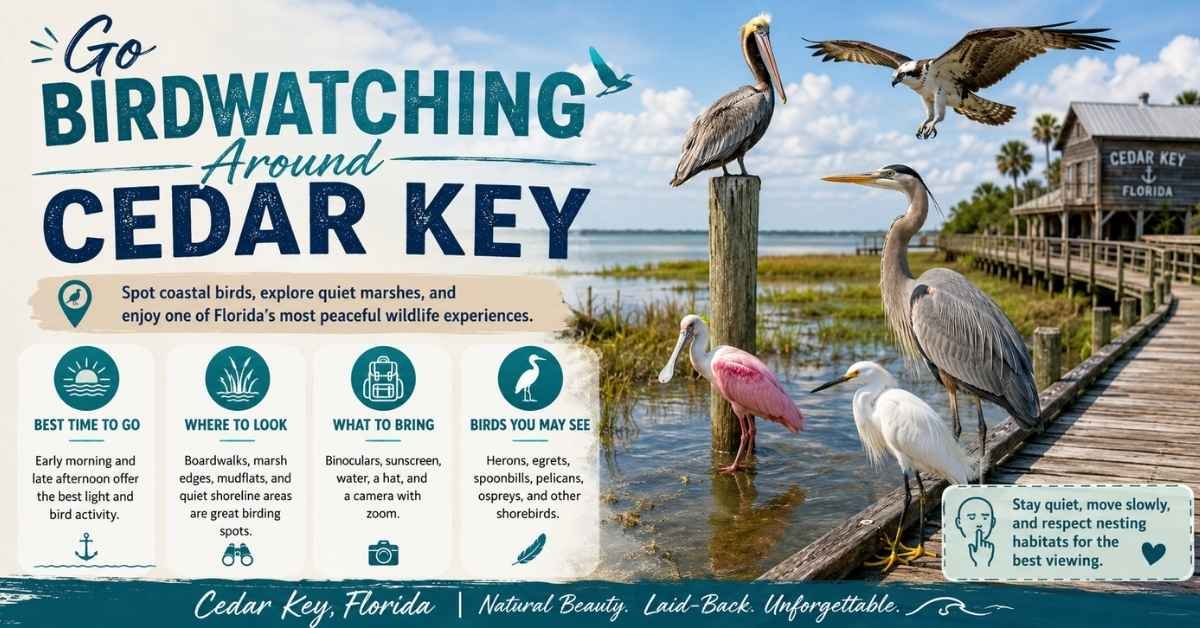
Cedar Key is surrounded by protected islands, salt marshes, mudflats and shallow water. These habitats make birdwatching one of the destination’s defining experiences.
Potential sightings include:
- Brown pelicans
- White pelicans
- Ospreys
- Bald eagles
- Egrets
- Herons
- Ibises
- Roseate spoonbills
- Cormorants
- Migratory shorebirds
Try Cemetery Point, coastal parks, refuge areas or a guided wildlife cruise. Early morning can provide active birds and softer light, while low tide may expose feeding areas for shorebirds.
Bring binoculars and keep a respectful distance. Do not approach nesting colonies for a photograph.
11. Visit Cedar Key Museum State Park
Cedar Key Museum State Park provides an accessible introduction to the town’s layered history. Exhibits explore Indigenous life, the cedar industry, historic trade, natural history and the development of the community.
The park also contains the restored Whitman House and material connected to naturalist John Muir, who visited Cedar Key after his long walk through the American South.
At the time of writing, the museum generally operates Friday through Sunday from 10 a.m. to 5 p.m., with a small admission fee. Verify the schedule before visiting.
Allow one to two hours if you want to read the exhibits and walk the grounds. It is a useful first stop because it gives context to the railroad, pencil industry, offshore islands and historic buildings you will encounter later.
12. Explore the Cedar Key Historical Society Museum
The Cedar Key Historical Society Museum focuses closely on the community’s story. Photographs, documents, maps and artifacts show how railroads, timber, shipping, fishing and storms shaped local life.
Visit this museum if you are particularly interested in:
- Florida railroad history
- Cedar and pencil manufacturing
- Maritime trade
- Historic families
- Hurricanes
- Local architecture
- The Civil War period
The state park museum provides broader context, while the Historical Society offers a more concentrated town-level perspective. History enthusiasts will benefit from visiting both.
13. Walk Cemetery Point Boardwalk
Cemetery Point Boardwalk is one of the best free activities in Cedar Key. The route passes near the historic cemetery before following a shaded shoreline with opportunities to see birds and marsh wildlife.
This is not simply a walk through a burial ground. The boardwalk and surrounding park provide coastal views, seating, exercise stations and recreational space.
Allow about 45 to 75 minutes, depending on how often you stop. Early morning provides cooler temperatures, while late afternoon offers attractive light.
The route is suitable for many families and casual walkers, although current surface and accessibility conditions should be checked if mobility is a concern.
14. Follow the Railroad Trestle Nature Trail
The Cedar Key Railroad Trestle Nature Trail follows part of a former rail route that once connected the Gulf Coast with northeastern Florida.
The short trail ends near the water, where remaining pilings recall the town’s former transportation importance. Native plants and coastal scenery make the walk pleasant even for visitors who are not deeply interested in railroad history.
Wear insect repellent and shoes suitable for damp or uneven ground. Conditions can become muddy after rain.
Because it is short, the trail works well as an early-morning stop, a break before lunch or an addition to a museum visit.
15. Take a Self-Guided Historic District Walk
Cedar Key’s historic district contains old cottages, commercial buildings and streets that reflect different periods of the town’s development.
A self-guided walk allows you to connect several strands of local history:
- Cedar harvesting
- Pencil manufacturing
- Railroad trade
- Fishing
- Clam aquaculture
- Storm recovery
- Tourism
- Local art
Look for walking-tour information at the Welcome Center or historical museum when available. Remember that many historic cottages are private homes, so admire them from public sidewalks.
16. Browse the Cedar Key Arts Center and Local Galleries
Cedar Key has attracted artists who respond to its wildlife, weathered architecture and quiet coastal atmosphere. Local galleries display paintings, pottery, photography, textiles, jewelry and mixed-media work.
The Cedar Key Arts Center supports exhibitions, workshops and community events. Gallery schedules can vary, so confirm hours if a particular exhibition matters to you.
Buying from a local artist makes a more meaningful souvenir than purchasing a mass-produced coastal decoration. It also keeps more of your travel spending within the community.
17. Explore Cedar Key by Golf Cart
Golf carts are part of Cedar Key’s visual identity, but not every visitor needs one. Downtown is compact enough to explore on foot.
A rental becomes more useful when:
- Your accommodation is outside downtown
- You have limited mobility
- You are staying multiple days
- You want to explore residential streets
- Heat makes walking uncomfortable
- Your accommodation includes legal cart use
Confirm rental rules, street restrictions, insurance terms and parking requirements. Never assume a cart can travel on every road simply because locals use them frequently.
18. Ride a Bicycle Around Town
Cedar Key’s compact scale makes cycling an enjoyable alternative to driving. A bicycle allows you to move between downtown, the public beach, residential streets and nearby viewpoints without searching for a full-sized parking space.
Roads generally feel slower than those in a major resort town, but cyclists must still watch for vehicles, golf carts, pedestrians and uneven surfaces. Bright clothing and lights improve visibility.
Avoid the hottest part of a summer afternoon. Carry water and secure your bicycle when visiting shops or museums.
19. Taste Cedar Key’s Locally Farmed Clams
Cedar Key is one of Florida’s important centers for clam aquaculture. Clam farming became especially significant after changes to commercial fishing encouraged local workers to develop a new coastal industry.
Menus vary, but you may find clams served:
- Steamed
- In garlic butter
- In chowder
- With pasta
- In seafood boils
- On specialty pizzas
- In regional sauces
Ask whether the clams are locally sourced and which preparation the restaurant recommends. A simple steamed dish often provides the clearest taste.
Because restaurants can move, rebuild or change schedules, choose them using current local information rather than relying entirely on an older “best restaurants” list.
20. Buy Fresh Seafood From a Local Market

If your vacation rental has a kitchen, buying seafood locally creates a different Cedar Key experience. Ask what is local, fresh and currently in season rather than arriving with one specific species in mind.
Bring an insulated cooler if you will not return directly to your accommodation. Fresh seafood must remain cold, especially during Florida’s warmer months.
Shopping locally also gives you a chance to learn how weather, seasons and regulations affect the working waterfront.
21. Spend Time in a Local Café or Independent Shop
Cedar Key’s lack of large-scale commercial development is part of its charm. A slow breakfast, coffee stop or conversation with a shop owner may become more memorable than another scheduled attraction.
Browse locally made gifts, coastal art, books and practical fishing supplies. Do not expect every business to open early or remain open late.
This is a place where leaving an hour unplanned often works better than trying to fill every minute.
22. Attend a Cedar Key Festival
Festivals bring a very different energy to Cedar Key. Major annual events may celebrate art, seafood, local history or national holidays.
Popular possibilities include:
- Old Florida Celebration of the Arts
- Cedar Key Seafood Festival
- Independence Day activities
- Seasonal community celebrations
- Special Seahorse Key lighthouse open houses
Dates and formats can change annually. Check the current calendar before arranging lodging.
Festival weekends can create traffic, limited parking, longer restaurant waits and higher accommodation demand. Reserve early if the event is the purpose of your visit.
23. Explore Cedar Key Scrub State Reserve
Cedar Key Scrub State Reserve protects a different landscape from the waterfront. Its sandy soils, scrub habitat, flatwoods and trails provide opportunities for hiking, wildlife viewing and quiet nature study.
Heat, limited shade, soft sand and insects can make the walk more demanding than its elevation suggests. Carry more water than you think you need.
Storm impacts have affected trailhead access in the past, so check the current park notice before setting out.
24. Visit Shell Mound and the Lower Suwannee Refuge
Located outside central Cedar Key, Shell Mound and the Lower Suwannee National Wildlife Refuge add archaeological, ecological and cultural depth to a weekend trip.
Shell Mound reflects generations of Indigenous activity rather than being a simple pile of discarded shells. Treat the landscape as a significant cultural site. Stay on designated routes and never remove artifacts.
Depending on current access, visitors may find:
- Boardwalks
- Nature trails
- Birdwatching
- Coastal viewpoints
- Paddling access
- Quiet scenic roads
This area deserves several hours and should not be squeezed into an already crowded day.
25. Take a Regional Day Trip
If you are staying more than two days, add one inland attraction.
Manatee Springs State Park
It offers clear spring water, a boardwalk, paddling, swimming and access to the Suwannee River. Manatee sightings are seasonal and never guaranteed.
Choose it for swimming, spring ecology and a more traditional freshwater Florida experience.
Cedar Lakes Woods and Gardens
Cedar Lakes Woods and Gardens transforms a former limestone quarry into a botanical landscape with ponds, paths, waterfalls and extensive plantings.
It is a strong choice for garden lovers, photographers and travelers who want an alternative to water-based recreation.
These destinations are near Cedar Key, not inside the town. Labeling them correctly prevents visitors from underestimating driving time.
Learn More: 25 Best Things to Do in Hood River, Oregon (2026 Guide)
Boat Tour vs Kayak vs Fishing Charter
Your water activity will shape the rest of your trip, so choose it first.
| Option | Best for | Physical effort | Independence | Weather sensitivity | Cost |
|---|---|---|---|---|---|
| Wildlife boat tour | First-time visitors | Low | Low | Moderate | $$ |
| Independent kayak | Experienced paddlers | High | High | High | $$ |
| Guided paddle | Beginners and nature lovers | Moderate | Medium | High | $$–$$$ |
| Fishing charter | Anglers and families | Low–moderate | Low | High | $$$ |
Choose a wildlife tour if you want local interpretation and a comfortable introduction to the islands. Choose a kayak if you have the ability to read conditions and want more independence. Book a fishing charter when fishing is the main purpose of your day.
Best Cedar Key Key Activities by Traveler Type
| Traveler | Best activities |
|---|---|
| First-time visitor | Museum, downtown, boat tour and sunset |
| Couple | Galleries, waterfront meal and sunset cruise |
| Family | Public beach, Lil Shark Park, museum and wildlife tour |
| Budget traveler | Boardwalks, trails, historic district and sunset |
| Birder | Cemetery Point, refuge areas and boat tour |
| Angler | Shore fishing and fishing charter |
| Non-boater | Museums, downtown, galleries, beach and boardwalk |
| Active traveler | Atsena Otie kayak trip and nature trails |
| Older visitor | Museums, short waterfront walks and guided cruise |
| Pet owner | Confirmed pet-friendly parks, patios and lodging |
Free Things to Do in Cedar Key
You can enjoy Cedar Key without spending heavily. The best free activities include:
- Walking through downtown
- Exploring the historic district
- Watching the sunset
- Visiting the public beach
- Taking children to Lil Shark Park
- Walking Cemetery Point Boardwalk
- Following Railroad Trestle Nature Trail
- Birdwatching
- Browsing galleries
- Photographing historic cottages
- Packing a waterfront picnic
Parking may be free in many areas, but availability changes during festivals and busy weekends.
Things to Do in Cedar Key With Kids
Cedar Key works best for children who enjoy nature, boats and unstructured outdoor time.
Good family choices include:
- Lil Shark Park
- Cedar Key Public Beach
- Cedar Key Museum State Park
- Cemetery Point Boardwalk
- Short wildlife cruises
- Gentle paddling with a guide
- Birdwatching
- Fishing with an experienced captain
- Ice cream or bakery stops
Avoid placing young children in an open-water kayak unless the route, conditions, equipment and supervision match their ability.
Romantic Things to Do in Cedar Key
Cedar Key’s romance comes from quiet moments rather than polished luxury.
Couples can:
- Take a sunset cruise
- Share a waterfront seafood meal
- Browse galleries
- Walk the historic district
- Watch birds at Cemetery Point
- Stay in a small waterfront accommodation
- Paddle together during calm conditions
- Watch sunrise before town becomes active
Staying overnight allows you to enjoy the evening without immediately beginning a long return drive.
What to Do in Cedar Key When It Rains
Cedar Key has limited indoor entertainment, so keep a flexible backup plan.
Depending on opening days, consider:
- Cedar Key Museum State Park
- Cedar Key Historical Society Museum
- Cedar Key Arts Center
- Local galleries
- Independent shops
- A long café stop
- A relaxed seafood lunch
- A safe scenic drive
Do not substitute an open-water activity simply because you have already paid. Thunderstorms, strong winds and marine warnings deserve respect.
One-Day Cedar Key Itinerary
Morning: Begin with history or nature
Arrive early and visit Cemetery Point Boardwalk before the day becomes hot. Alternatively, begin at Cedar Key Museum State Park if it is open.
Continue with a walk through the historic district and downtown.
Midday: Eat local seafood
Have lunch near the waterfront and try locally farmed clams. Browse galleries and independent shops afterward.
Afternoon: Choose one signature experience
Book either:
- A wildlife cruise
- A guided paddle
- A short fishing trip
- A second museum and nature trail
Trying to fit a boat tour, long kayak trip and fishing charter into one day will leave no time to appreciate the town.
Evening: Watch the sunset
Finish at a legal waterfront viewpoint. Allow time for parking and order dinner before local kitchens begin closing.
Two-Day Cedar Key Weekend Itinerary
Day One: Learn the town
- Cedar Key Museum State Park
- Downtown and historic district
- Local seafood lunch
- Cemetery Point Boardwalk
- Galleries
- Sunset
- Relaxed dinner
Day Two: Experience the water
Choose one main activity:
- Kayak to Atsena Otie Key
- Take a wildlife and island cruise
- Book a fishing charter
Afterward, enjoy a café, browse local shops or stop at Railroad Trestle Nature Trail before leaving.
A Cedar Key Itinerary Without a Boat
You can still have a satisfying trip without going onto the water.
Follow this route:
- Cedar Key Museum State Park
- Railroad Trestle Nature Trail
- Downtown Cedar Key
- Local seafood lunch
- Historical Society Museum
- Arts Center and galleries
- Cedar Key Public Beach
- Cemetery Point Boardwalk
- Gulf sunset
You will miss the closest view of the refuge islands, but you can still experience Cedar Key’s history, food, art and coastal atmosphere.
Best Time to Visit Cedar Key
Spring
Spring brings comfortable outdoor weather, active birdlife and popular art events. Temperatures and insect activity rise as the season progresses.
Summer
Summer is hot, humid and storm-prone. Start outdoor activities early, carry water and expect afternoon thunderstorms.
Atlantic hurricane season runs from June through November. Monitor forecasts carefully, especially when booking nonrefundable accommodation or tours.
Fall
Early fall can still be hot and vulnerable to tropical weather. Later fall usually becomes more comfortable for walking, paddling and outdoor dining.
Festival weekends may increase crowds, prices and parking pressure.
Winter
Winter often provides some of the best conditions for hiking, cycling and kayaking. Cooler weather can also reduce insects.
Water temperatures, wind and shorter daylight still require planning. Businesses may keep reduced schedules outside major weekends.
Best overall period
For most first-time visitors, late fall through spring offers the most comfortable balance of temperature, outdoor recreation and lower insect pressure.
See More: 18 Best Things to Do in Lake Las Vegas in 2026
How to Get to Cedar Key
Most visitors reach Cedar Key by driving southwest along State Road 24.
Approximate driving times are:
- Gainesville: About 1 hour
- Crystal River: About 1 hour
- Tampa: Roughly 2.5 hours
- Tallahassee: Roughly 2.5 hours
- Jacksonville: Roughly 2.5 hours
- Orlando: About 3 hours
Actual times depend on your starting point, traffic and road conditions.
George T. Lewis Airport serves small aircraft, not regular commercial passenger service. Gainesville Regional Airport is the closest practical commercial airport for many travelers.
Getting Around Cedar Key
Walking
Downtown, the waterfront, shops and several dining areas are easy to explore on foot.
Driving
A car is useful for reaching the state park, trailheads, accommodation outside downtown and regional attractions.
Golf cart
A golf cart can be convenient and fun, but it is not essential for a short downtown visit.
Bicycle
Cycling works well for travelers comfortable sharing slower local roads with vehicles and carts.
Boat or kayak
A vessel is necessary for direct access to the offshore refuge islands. Follow current refuge regulations and local marine guidance.
Where to Stay in Cedar Key
Choose accommodation according to how you plan to spend your time.
Stay downtown if you want:
- Walkable restaurants
- Easy access to shops
- Waterfront activity
- Less driving
- A lively weekend atmosphere
Stay outside the center if you want:
- Quieter evenings
- More space
- Private outdoor areas
- Easier vehicle parking
- A vacation rental with a kitchen
Choose waterfront accommodation if you want:
- Sunrise or sunset views
- Fishing access
- Birdwatching from your room
- A stronger connection to the coastal setting
Confirm whether a property has stairs, elevators, accessible parking and storm-related renovations before booking.
What to Pack for Cedar Key
Bring:
- Insect repellent
- Reef-conscious sunscreen
- Hat
- Polarized sunglasses
- Refillable water bottle
- Water shoes
- Comfortable walking shoes
- Dry bag
- Light rain jacket
- Binoculars
- Portable phone charger
- Small cooler
- Motion-sickness medication if needed
- Offline map or saved directions
A casual wardrobe is appropriate. Choose practical clothing that can handle sun, spray, humidity and sudden rain.
Mistakes That Can Spoil Your Visit
Expecting a resort-style beach
Cedar Key’s shoreline is small, tidal and ecologically different from Florida’s famous beach resorts.
Arriving without checking hours
Limited weekday schedules can eliminate several planned stops.
Ignoring tides and wind
A route that looks easy on a map can become difficult in shallow water or a strong headwind.
Assuming every refuge island is open
A visible beach does not mean the island’s interior is accessible. Follow current wildlife-refuge rules.
Trusting an old restaurant guide
Storms, rebuilding and seasonal operations can make older lists unreliable.
Scheduling too much
Cedar Key feels disappointing when treated like an amusement park. Choose one major water experience and leave space for exploration.
Forgetting insect repellent
Mosquitoes and biting gnats can become uncomfortable near sheltered water, especially during warm months.
Disturbing wildlife
Never approach nesting birds, enter closed habitat or leave fishing line behind.
Frequently Asked Questions
What are the best things to do in Cedar Key, Florida?
The best things to do in Cedar Key are kayaking to Atsena Otie Key, taking a wildlife boat tour, exploring downtown, visiting the museums, walking Cemetery Point Boardwalk, fishing, tasting local clams and watching the Gulf sunset.
What is Cedar Key best known for?
Cedar Key is known for its Old Florida atmosphere, clam aquaculture, fishing, kayaking, protected wildlife islands, local art, coastal history and seafood.
Is Cedar Key part of the Florida Keys?
No. Cedar Key is on Florida’s Nature Coast in Levy County. It is hundreds of miles from Key West and the island chain commonly called the Florida Keys.
Does Cedar Key have a good beach?
Cedar Key has a small public beach suitable for short visits and families with young children. It is not a wide, clear-water beach comparable to Florida’s major Gulf Coast resorts.
Can you swim at Cedar Key Public Beach?
Swimming may be possible when the designated area is open and conditions are suitable. Check posted notices, current water conditions and local guidance before entering.
How many days do you need in Cedar Key?
One day is enough for downtown, a museum, lunch and sunset. Two days are better if you want to add kayaking, a wildlife cruise or fishing charter.
Can you enjoy Cedar Key without a boat?
Yes. Museums, galleries, downtown streets, local restaurants, the public beach, Cemetery Point and Railroad Trestle Trail can all be enjoyed without a boat.
Is Cedar Key walkable?
Central Cedar Key is highly walkable. You may still need a car, golf cart or bicycle to reach accommodation, parks and trailheads outside downtown.
Do you need to rent a golf cart?
No. A golf cart is enjoyable but unnecessary for a short downtown visit. It becomes more useful for a longer stay or accommodation outside the center.
Can beginners kayak to Atsena Otie Key?
Beginners may be able to make the trip during suitable conditions, but distance alone does not determine difficulty. Wind, current, tide and boat traffic matter. Ask a local outfitter or choose a guided paddle.
Which Cedar Keys refuge islands can visitors enter?
Access depends on the island and current wildlife-protection rules. Atsena Otie generally provides the broadest visitor access. Other islands may allow beach landing while keeping vegetated interiors closed. Seasonal water closures may also apply.
Are mosquitoes bad in Cedar Key?
Mosquitoes and biting gnats can be significant during warm, humid periods. Conditions vary by season, tide, location and wind. Carry repellent throughout the year.
Is Cedar Key good for families?
Yes, especially for children who enjoy boats, wildlife, fishing and outdoor exploration. The public beach, Lil Shark Park, museums and short nature walks work well for families.
What is open in Cedar Key after hurricane recovery?
Many attractions and businesses welcome visitors, but individual conditions can change. Confirm restaurants, museums, waterfront access, tours and trailheads through current official or direct business information.
Come to Cedar Key for the Water, Wildlife and Slower Pace
The best things to do in Cedar Key Florida are not about rushing between major attractions. They are about understanding a historic Gulf community, exploring protected water, eating locally raised clams and giving yourself time to watch the sky change over the marshes.
For a satisfying first visit, choose one museum, one water experience, one local seafood meal and one sunset. Check opening hours, tides and weather before leaving home, then allow Cedar Key’s slower rhythm to shape the rest of your trip.










1 thought on “25 Best Things to Do in Cedar Key, Florida (2026 Guide)”