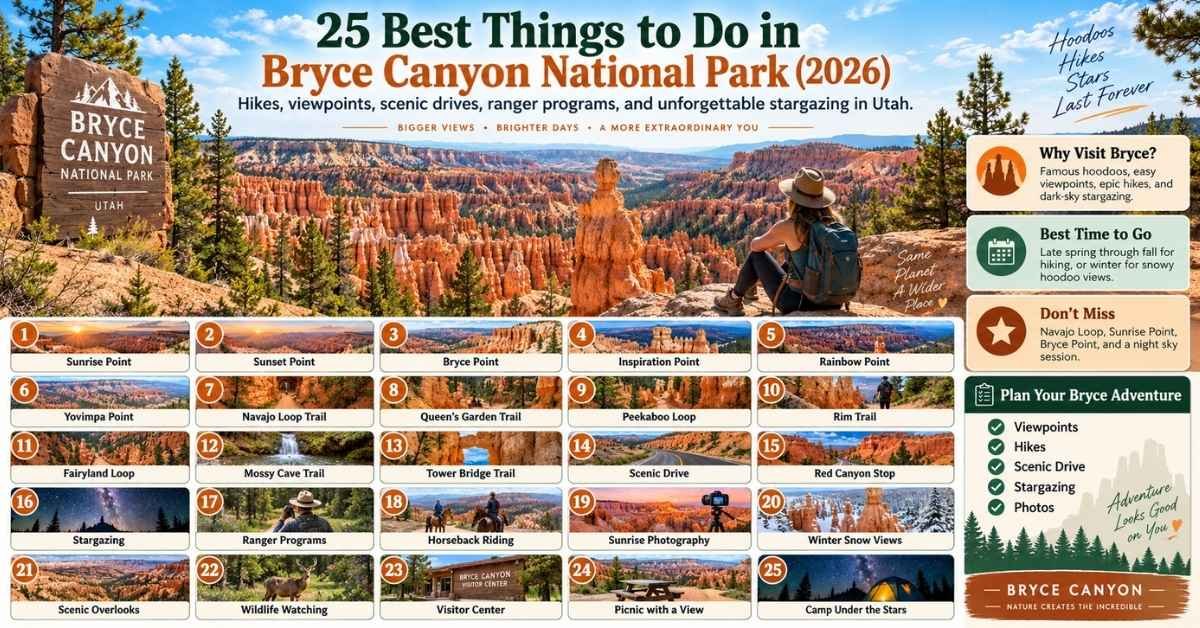
Things to do in Bryce Canyon National Park include seeing Bryce Amphitheater from the rim, hiking among the hoodoos, walking from Sunrise Point to Sunset Point, driving to Rainbow Point, joining a ranger program, and staying after sunset to experience the park’s exceptionally dark sky. If this is your first visit, prioritize one below-rim hike, two contrasting viewpoints, and a few Southern Scenic Drive stops instead of trying to see everything.
Bryce Canyon rewards thoughtful planning. Its main attractions appear close together on a map, but steep trails, elevations above 8,000 feet, unpredictable weather, parking delays, and seasonal closures can quickly change your day. This guide will help you choose the right experiences for your available time, fitness level, and travel style.
Short on time? Visit Sunrise or Sunset Point, walk the paved section of the Rim Trail, continue to Inspiration Point, and choose either a short descent below the rim or a drive to selected southern viewpoints.
Bryce Canyon at a Glance
| Planning detail | What to expect |
|---|---|
| Best for | Hoodoos, hiking, viewpoints, photography and stargazing |
| Minimum useful visit | Two to three hours |
| Better first visit | One full day |
| Ideal stay | Two days |
| Main sightseeing area | Bryce Amphitheater |
| Signature hike | Queen’s Garden–Navajo combination |
| Easiest scenic walk | Sunrise Point to Sunset Point |
| Transportation | Personal vehicle and seasonal park shuttle |
| Main physical challenge | Steep climbs at high elevation |
| Reservations | Not required for general park entry |
| Main variables | Weather, snow, parking and trail closures |
Despite its name, Bryce Canyon is not one continuous canyon. It is a series of natural amphitheaters carved into the edge of a high plateau. Its famous hoodoos are irregular stone pillars created as water, ice, and erosion gradually break rock into walls, windows, fins, and individual spires.
That high-plateau setting explains much of the park’s character. It gives Bryce its far-reaching views and cold, clear nights, but it also makes relatively short hikes feel harder than expected.
Five Questions to Answer Before Choosing Your Activities
A good Bryce Canyon itinerary begins with five decisions:
- How much time do you have? Two hours, half a day, one day, or several days produce very different plans.
- Do you want to hike below the rim? Seeing the hoodoos from inside the amphitheater is dramatically different from looking down on them.
- How comfortable are you with steep climbs? Every descent below the rim requires a climb back out.
- What season are you visiting? Snow, thunderstorms, shuttle schedules, and daylight affect what is practical.
- What is your backup plan? Trail damage, maintenance, ice, or poor weather can close a recommended route without much warning.
Do not let a long online checklist decide your day. Choose activities that fit your energy, interests, and conditions.
Check Current Conditions Before Entering the Park
Bryce Canyon is not a destination where you should rely entirely on an itinerary saved months earlier.
Check Trail and Road Closures
Review the official Bryce Canyon current conditions page on the morning of your visit. Snow, ice, rockfall, maintenance, and wildfire restrictions can affect trails or roads.
Important 2026 update: As of August 2026, the Wall Street side of Navajo Loop is closed because of extensive trail damage and will remain closed until repairs are complete. Do not follow an older itinerary that assumes Wall Street is available. Use the open side of Navajo Loop if permitted, or choose Queen’s Garden and another confirmed route.
Confirm the Shuttle Schedule
The 2026 Bryce Canyon shuttle season runs from April 3 through October 18. The shuttle is free with valid park admission and serves the principal Bryce Amphitheater viewpoints and trailheads. It is optional, but it is often the easiest way to avoid repeatedly searching for parking.
The shuttle does not provide a complete tour of the Southern Scenic Drive. You will generally need a car or approved commercial transportation for viewpoints farther south.
Check the official Bryce Canyon shuttle page for stops and same-day details.
Check the Forecast at Park Elevation
Bryce Canyon’s average elevation is approximately 8,000 feet, while its highest developed areas exceed 9,000 feet. The park can be considerably colder and windier than lower-elevation destinations in Southern Utah.
Summer visitors should also prepare for afternoon thunderstorms. July and August commonly bring brief but dangerous storms with lightning and heavy rain. Move away from exposed overlooks and seek appropriate shelter when thunder approaches.
Best Things to Do in Bryce Canyon National Park
1. See Bryce Amphitheater From the Rim
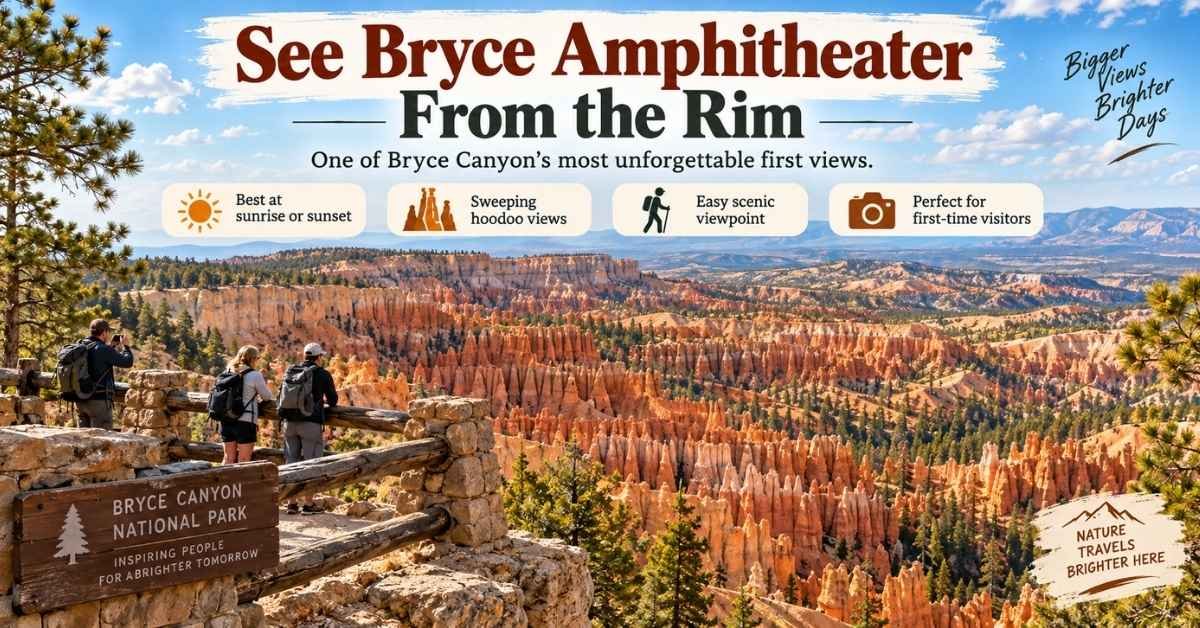
Best for: Every first-time visitor Time needed: 20 minutes to several hours Priority: Essential
Bryce Amphitheater contains the park’s greatest concentration of hoodoos. The formations fill a vast natural bowl below the rim, with layers of orange, pink, white, and red rock extending toward distant plateaus.
You can see the amphitheater from Sunrise Point, Sunset Point, Inspiration Point, and Bryce Point. These viewpoints share the same general landscape, but the angles, hoodoo density, elevation, and walking required are different.
For a short visit, do not rush between all four. Choose:
- Sunrise or Sunset Point for an easy first look
- Inspiration Point for dense hoodoo formations
- Bryce Point for a broad, elevated panorama
Visitors who cannot hike below the rim can still have a satisfying Bryce Canyon experience from these overlooks.
2. Walk From Sunrise Point to Sunset Point
Best for: Beginners, families and mobility-conscious visitors Distance: Approximately one mile round trip Time needed: 30–60 minutes Priority: Essential for non-hikers
The section of the Rim Trail between Sunrise Point and Sunset Point is the easiest scenic walk in Bryce Canyon. It is approximately half a mile each way, paved, and relatively level compared with the park’s other trails.
This is also the park’s principal wheelchair-accessible trail section, although snow, ice, maintenance, and crowding can affect access. It provides almost continuous views into Bryce Amphitheater without requiring a steep descent.
The names can be confusing. Sunrise Point is not useful only at sunrise, and Sunset Point is not necessarily the park’s best sunset location. Both work well throughout the day and provide access to major hiking trails.
3. Hike the Queen’s Garden and Navajo Loop Combination
Best for: Active first-time visitors Distance: Approximately 2.9 miles Elevation change: About 625 feet Time needed: Two to three hours Priority: Best overall hiking experience
The Queen’s Garden–Navajo combination is the classic first hike in Bryce Canyon National Park. It connects Sunrise and Sunset Points while passing through hoodoos, forested pockets, narrow passages, and steep switchbacks.
A commonly recommended direction is to descend Queen’s Garden and climb the open side of Navajo Loop. This direction introduces the amphitheater gradually before ending with Navajo’s dramatic ascent. However, route direction should depend on current trail conditions and your comfort with steep grades.
The most important detail is easy to overlook: the descent is not the difficult part. Every step downward must be regained on the climb to the rim. At Bryce Canyon’s elevation, the ascent may feel considerably harder than the distance suggests.
As of August 2026, Wall Street is closed due to extensive damage. Confirm whether the remaining Navajo route and connecting trails are open before starting.
4. Experience Navajo Loop Without Underestimating It
Best for: Visitors comfortable with steep switchbacks Normal distance: Approximately 1.3 miles Time needed: One to two hours Priority: Conditional on current access
Navajo Loop is short, dramatic, and frequently misunderstood. Its switchbacks descend rapidly from Sunset Point into Bryce Amphitheater, passing near recognizable formations such as Thor’s Hammer.
The trail’s short distance leads some visitors to call it easy. That description ignores:
- A steep descent and ascent
- Loose or uneven surfaces
- High elevation
- Crowds on narrow sections
- Ice and rockfall risks
- Seasonal and maintenance closures
In normal conditions, Navajo Loop has two sides: Wall Street and Two Bridges. Wall Street typically closes during winter and is also closed in 2026 because of trail damage. Never climb around a closure barrier to follow an outdated online route.
5. Hike Queen’s Garden as a Flexible Out-and-Back
Best for: Beginners wanting to enter the hoodoos Time needed: One to two and a half hours Priority: Excellent Navajo alternative
Queen’s Garden is often described as the least difficult way to descend below the rim. It begins at Sunrise Point and winds through colorful formations toward a hoodoo said to resemble Queen Victoria.
Its greatest advantage is flexibility. You do not have to complete the entire trail or connect it with Navajo Loop. Walk down until you have enjoyed the hoodoo landscape, then turn around while you still have enough energy to climb back.
Calling Queen’s Garden the easiest trail below the rim does not mean it is effortless. The return is uphill, and the altitude affects some visitors more than others.
6. Hike Peekaboo Loop
Best for: Experienced and well-prepared hikers Distance: Approximately 5.5 miles Elevation change: About 1,560 feet Time needed: Three to four hours Priority: Best strenuous amphitheater hike
Peekaboo Loop travels through the heart of Bryce Amphitheater. It delivers changing perspectives, repeated groups of hoodoos, the Wall of Windows, and fewer casual walkers than the shortest trails.
The challenge comes from its repeated climbs and descents. This is not a trail that simply goes downhill and then climbs once. The cumulative elevation, exposed sun, altitude, and limited water availability make it a serious outing.
Hikers must travel clockwise on the loop. Horses also use portions of the trail, so hikers should yield appropriately and follow posted instructions.
Peekaboo can connect with Navajo and Queen’s Garden to create longer combination routes. Those routes are rewarding, but they should not be added casually to an already crowded sightseeing day.
7. Spend Half a Day on Fairyland Loop
Best for: Solitude, variety and a full hiking day Distance: Approximately eight miles Elevation change: About 1,900 feet Time needed: Four to five hours Priority: Excellent for experienced hikers
Fairyland Loop is one of the best Bryce Canyon hikes for visitors who want a longer route with fewer crowds. It passes formations such as Tower Bridge and the Chinese Wall while moving between forest, open slopes, and tall hoodoos.
This hike is not merely an extra activity to place between sightseeing stops. It is the main event for the day. Begin early, carry sufficient water, monitor the forecast, and allow time for the final climb.
If eight miles is too much, hike the Fairyland route only as far as Tower Bridge and return the same way. That provides some of the area’s character without committing to the full loop.
8. Explore More of the Rim Trail
Best for: Customizable walks and one-way hikes Distance: One to eleven miles, depending on the section Time needed: One hour to most of a day
The Rim Trail follows Bryce Amphitheater between major viewpoints. It can be treated as a short walk, a moderate hike, or a longer one-way route using the park shuttle.
Only the section between Sunrise and Sunset Points is paved. Other portions include meaningful elevation changes, unpaved surfaces, and exposed edges. Do not assume the entire Rim Trail is as easy as its accessible central section.
A useful approach is to ride the shuttle to one viewpoint and walk to another. This avoids retracing your steps and gives you more continuous scenery.
9. Visit Inspiration Point
Best for: Dense hoodoo views Time needed: 20–45 minutes Priority: Essential viewpoint
Inspiration Point offers one of the most concentrated views across the amphitheater. The hoodoos seem to stack behind one another, making it particularly effective for panoramic photographs.
There are several viewing levels. The higher viewpoints require more climbing, and the upper area can feel exposed. You do not need to reach the highest level to appreciate the landscape.
If you only have time for one viewpoint beyond Sunrise or Sunset Point, Inspiration Point provides the strongest contrast.
10. See the Broader View From Bryce Point

Best for: Wide panoramas and photography Time needed: 20–40 minutes
Bryce Point looks across a broad section of the amphitheater from a higher perspective. While Inspiration Point emphasizes hoodoo density, Bryce Point provides more context and scale.
It is also exposed to wind, cold, and changing weather. Carry an extra layer even if lower areas feel comfortable.
Construction or access changes may affect vehicle movement around Bryce Point in 2026. The park shuttle continues operating its normal route, but visitors should check current conditions before relying on a specific parking or access arrangement.
11. Drive the Southern Scenic Road
Best for: Non-hikers, photographers and half-day sightseeing Time needed: Two to four hours with selected stops Priority: Worthwhile with enough time
The Southern Scenic Drive travels from the developed amphitheater area toward Rainbow Point and Yovimpa Point. Along the way, visitors can stop at Natural Bridge, Farview Point, Swamp Canyon, Agua Canyon, Ponderosa Point, and other overlooks.
You do not need to stop at every pullout. After several viewpoints, the experiences can become repetitive. A more rewarding plan is to drive toward Rainbow Point and select the best stops on your return.
Prioritize:
- Natural Bridge
- Rainbow Point
- Yovimpa Point
- One or two additional viewpoints based on light and visibility
The regular amphitheater shuttle does not cover the complete Southern Scenic Drive.
12. Stop at Natural Bridge
Best for: A quick scenic-drive highlight Time needed: 10–20 minutes
Natural Bridge is one of the easiest high-value stops along the park road. Despite its name, the formation is technically a natural arch created by erosion rather than a bridge formed by flowing water.
The viewpoint requires little walking and gives visitors a close look at the way Bryce Canyon’s rock changes from fins and walls into openings.
If you are limiting your scenic-drive stops, keep Natural Bridge on the list.
13. Continue to Rainbow and Yovimpa Points
Best for: Distant views and a cooler forest environment Time needed: 30–60 minutes
Rainbow Point and Yovimpa Point sit near the southern end of the park road at elevations above 9,000 feet. The landscape feels different from the main amphitheater, with more forest and broad views across Southern Utah.
Temperatures may be noticeably cooler here. Clouds, smoke, or haze can also reduce the long-distance view, so assess visibility before committing substantial time to the drive.
The nearby Bristlecone Loop makes this a useful destination for visitors who want to combine driving with a short walk.
14. Walk Bristlecone Loop
Best for: Scenic-drive visitors wanting a short trail Distance: Approximately one mile Time needed: About one hour
Bristlecone Loop begins near Rainbow Point and passes high-elevation forest, bristlecone pines, and several viewpoints.
The trail has a firm surface, but some grades do not meet accessibility standards. Visitors using wheelchairs or other mobility devices may require assistance. Snow and ice can remain here longer than in lower areas because of the elevation.
This is a worthwhile addition when the southern road is open and visibility is good.
15. Visit Mossy Cave and Water Canyon
Best for: Families and a separate short outing Distance: Approximately 0.8–0.9 miles round trip Time needed: 45–90 minutes Priority: Worthwhile when it fits your route
Mossy Cave lies away from the park’s main entrance and amphitheater area. The trail follows Water Canyon and branches toward a mossy shelter cave and a small waterfall.
The site’s appearance changes with the season. Water flow, moss, ice, heat, and trail conditions are not constant, so photographs from another month may not reflect what you find.
Parking is limited, and adding Mossy Cave can require inefficient backtracking. Visit early or late, avoid parking outside designated spaces, and skip it if the lot is full.
16. Join a Ranger Program
Best for: Geology, wildlife and local knowledge Time needed: Varies by program
Ranger talks transform Bryce Canyon from an attractive landscape into a story about geology, climate, plants, animals, and human history. Depending on the season, the park may offer:
- Geology talks
- Rim walks
- Evening programs
- Astronomy activities
- Family programs
- Guided full-moon hikes
Schedules change, and some activities fill quickly. Check the park calendar or ask at the Visitor Center rather than relying on an old blog schedule.
17. Complete the Junior Ranger and Hike the Hoodoos Activities
Best for: Families with school-age children Time needed: Flexible
The Junior Ranger program helps children engage with the park through observation and educational activities. Families can collect the booklet at the Visitor Center and return after completing the required work.
The Hike the Hoodoos challenge encourages visitors to find designated medallions along park trails. Photographing or making rubbings of the required markers turns a walk into a simple scavenger hunt.
Program rules and reward requirements can change, so confirm the current version with a ranger.
18. Stay After Dark for Stargazing
Best for: Nearly every visitor staying nearby Time needed: One to three hours
Bryce Canyon is an International Dark Sky Park. Its elevation, dry air, and distance from major cities can reveal thousands of stars and, under suitable conditions, the Milky Way.
For a better experience:
- Check the moon phase and cloud forecast.
- Let your eyes adjust for at least 20 minutes.
- Use a red-light setting rather than a bright white flashlight.
- Wear warmer clothing than you expect to need.
- Stand away from moving vehicles.
- Avoid shining lights toward other visitors or photographers.
The NPS recommends Paria View in summer, although dark views can be found throughout the park. Astronomy programs and constellation tours may be offered during selected periods.
19. Watch Sunrise Over the Hoodoos
Best for: Soft light, cooler conditions and a quieter start Time needed: 60–90 minutes
Sunrise can be one of the most memorable things to do in Bryce Canyon National Park, but you do not automatically need to join the largest crowd at Sunrise Point.
Consider:
- Sunrise Point for convenience and classic compositions
- Bryce Point for a broad perspective
- Inspiration Point for layered hoodoos
- Sunset Point for easy access and nearby trailheads
Arrive before first light, dress for wind and cold, and carry a headlamp. In summer, sunrise also helps hikers begin before afternoon storms and peak heat.
Families should consider the trade-off. A very early start may produce tired children and frustrated parents later in the day. Sunrise is optional—not a test of whether you visited Bryce correctly.
20. Choose a Sunset Viewpoint Carefully

Best for: A relaxed end to the day Time needed: 60–90 minutes
Sunset Point is convenient, but its name does not guarantee the strongest evening light. Much of the amphitheater faces east, so the sun may disappear behind you while the hoodoos enter shadow.
Paria View can work well because portions of its cliffs catch evening light. Bryce Point may provide broad twilight views when conditions are clear.
Stay through twilight rather than leaving the moment the sun drops. The softer post-sunset colors can be more interesting than the final direct light. Bring a headlamp for the walk back.
21. Cycle the Shared-Use Path
Best for: Active visitors wanting an alternative to hiking
The paved shared-use path connects Bryce Canyon City with developed areas near the park and provides a practical option for traditional bicycles and permitted e-bikes.
This experience is especially useful for travelers who want to reduce parking stress. However, riders must still account for high elevation, changing weather, pedestrians, road crossings, and construction.
A 2026 construction project may affect portions of the shared-use path or nearby access. Follow temporary signs and verify the current route before setting out.
22. Book a Guided Horseback Ride
Best for: Visitors seeking a guided canyon experience Advance booking: Recommended
Horseback riding offers a different way to enter Bryce Canyon’s landscape. Guided rides may range from shorter introductory experiences to longer routes through the hoodoos.
Before booking, check:
- Minimum age
- Height or weight restrictions
- Riding duration
- Seasonal availability
- Required clothing
- Cancellation terms
- Whether the route fits your comfort level
Horseback riding is not automatically easier than walking. Extended time in the saddle can be uncomfortable for people with certain back, hip, or mobility concerns.
23. Experience Bryce Canyon in Winter
Best for: Snow-covered hoodoos and smaller crowds
Winter changes Bryce Canyon completely. Snow highlights the red and orange formations, producing some of the park’s most striking scenery.
Potential winter activities include:
- Snowshoeing
- Cross-country skiing
- Winter photography
- Ranger programs
- Short hikes using appropriate traction
- Scenic overlooks after roads are cleared
Two trail sections normally close for the entire winter: Wall Street and the Rim Trail between Inspiration Point and Bryce Point. Other temporary closures can follow snowstorms.
The main amphitheater area is generally cleared before the higher Southern Scenic Drive. Do not assume that road access, shuttle service, lodging, or dining will match summer conditions.
24. Watch for Wildlife
Bryce Canyon supports mule deer, Utah prairie dogs, pronghorn, foxes, squirrels, ravens, Steller’s jays, peregrine falcons, and many other species.
Wildlife watching is best treated as a quiet bonus rather than a scheduled attraction. Dawn and dusk can be productive, but no sighting is guaranteed.
Keep a safe distance, never feed animals, and slow down when driving. Feeding wildlife damages natural behavior and can lead to animals being injured or killed.
25. Start at the Visitor Center

Best for: Current information and orientation Time needed: 20–45 minutes
The Visitor Center is the best place to confirm trail conditions, obtain maps, ask about ranger programs, collect Junior Ranger materials, and learn how the hoodoos formed.
Stop first when:
- You are uncertain about trail status.
- Weather is changing.
- You need accessibility information.
- You are planning a backcountry route.
- Children want to join park activities.
If you already checked conditions and are racing to a sunrise viewpoint, visit later in the morning instead.
Learn More: 21 Best Things to Do in Vieques Puerto Rico (2026 Guide)
Bryce Canyon Hiking Comparison
Distances and conditions should always be confirmed with the National Park Service before hiking.
| Trail | Approximate distance | Elevation change | Typical time | Real difficulty | Best for |
|---|---|---|---|---|---|
| Sunrise–Sunset Rim Trail | 1 mile round trip | 40 feet | Up to 1 hour | Easy for most | Beginners and accessible views |
| Queen’s Garden/Navajo | 2.9 miles | 625 feet | 2–3 hours | Moderate | Active first-time visitors |
| Tower Bridge | 3 miles | 760 feet | 2–3 hours | Moderate | A shorter Fairyland experience |
| Swamp Canyon Loop | 4 miles | 800 feet | 3–4 hours | Moderate | Quieter backcountry scenery |
| Peekaboo Loop | 5.5 miles | 1,560 feet | 3–4 hours | Strenuous | Experienced hikers |
| Fairyland Loop | 8 miles | 1,900 feet | 4–5 hours | Strenuous | Solitude and a full hiking day |
| Figure-8 Combination | 6.4 miles | 1,575 feet | 4–5 hours | Strenuous | Strong hikers seeking variety |
Queen’s Garden vs Navajo Loop
Choose Queen’s Garden if you want:
- A more gradual introduction below the rim
- Flexible turnaround points
- A better option when part of Navajo is closed
- A route that many beginners find more manageable
Choose Navajo Loop if you want:
- Dramatic switchbacks
- A shorter but steeper route
- Close views of Thor’s Hammer
- A more intense experience in less distance
Combine them when connecting sections are open and you have sufficient energy. In 2026, verify the route carefully because Wall Street remains closed.
Which Bryce Canyon Viewpoint Is Best?
There is no single best viewpoint for every visitor.
| Viewpoint | Best for | Walking required | Important consideration |
|---|---|---|---|
| Sunrise Point | First view and Queen’s Garden access | Minimal | Busy around sunrise |
| Sunset Point | Navajo access and easy rim views | Minimal | Not always the best sunset light |
| Inspiration Point | Dense hoodoo panoramas | Varies | Upper levels require climbing |
| Bryce Point | Broad amphitheater perspective | Short | Exposed to wind and cold |
| Paria View | Evening light and stargazing | Short | Lighting depends on conditions |
| Rainbow Point | Scenic-drive finale | Short | Far from the main amphitheater |
For most first-time visitors, the best combination is Sunrise or Sunset Point plus Inspiration Point. Add Bryce Point when time and access permit.
Can You Enjoy Bryce Canyon Without Hiking?
Yes. Bryce Canyon is one of the easier national parks to appreciate without completing a major hike. Many signature views are close to parking areas or shuttle stops.
A low-exertion half-day can include:
- Sunrise or Sunset Point
- The paved section of Rim Trail
- Inspiration Point
- Visitor Center
- Natural Bridge
- Rainbow Point, if the road is open
- Sunset or a ranger program
Remember that “short walk,” “paved,” and “wheelchair-accessible” do not mean the same thing. Natural grades, snow, crowding, and maintenance can affect individual access.
Bryce Canyon With Limited Mobility or a Wheelchair
The half-mile Rim Trail section between Sunrise and Sunset Points is the park’s principal wheelchair-accessible trail. Selected overlooks, facilities, restrooms, and shuttle vehicles also provide accessible options.
Bristlecone Loop has a hard surface, but several grades do not meet accessibility standards and assistance may be needed.
Before visiting:
- Review the official accessibility page.
- Ask rangers about temporary barriers.
- Confirm accessible parking and shuttle details.
- Consider snow, ice, wind, and surface conditions.
- Never assume a route is accessible because a blog calls it easy.
Things to Do in Bryce Canyon With Kids
Bryce can be an excellent family destination, but “kid-friendly” depends on age, experience, and attention around exposed terrain.
Visiting With Toddlers
Focus on:
- The Visitor Center
- Sunrise–Sunset Rim Trail
- Short viewpoint stops
- Junior Ranger activities
- Scenic driving
- Early meals and regular breaks
Use a suitable child carrier rather than relying on a stroller for unpaved trails. Keep young children physically close near the rim.
Visiting With School-Age Children
Good choices include:
- Hike the Hoodoos
- Queen’s Garden with a flexible turnaround
- Bristlecone Loop
- Short Rim Trail sections
- Wildlife watching
- Ranger programs
Give children a turnaround rule before descending. Saving energy for the climb out prevents a pleasant walk from turning into a difficult rescue situation.
Visiting With Teenagers
Active teenagers may enjoy:
- Queen’s Garden–Navajo combination
- Peekaboo Loop
- Longer Rim Trail sections
- Cycling
- Sunrise photography
- Stargazing
Do not combine an early sunrise, strenuous hike, complete scenic drive, and late-night astronomy unless the entire family genuinely wants that schedule.
Bryce Canyon for Seniors and Altitude-Sensitive Visitors
Bryce Canyon’s elevation can make visitors feel tired, breathless, or light-headed sooner than expected. Effective oxygen at 8,000 feet is significantly lower than at sea level.
A more comfortable plan may include:
- Slower walking
- Longer rest periods
- Frequent hydration
- Shuttle use
- Staying near the rim
- Dividing sightseeing across two days
- Avoiding a steep hike immediately after arrival
Anyone with relevant heart, lung, or other medical conditions should obtain personal medical advice before undertaking strenuous high-altitude activity.
Bryce Canyon Itineraries for Different Schedules
Two Hours in Bryce Canyon
Use your limited time around the amphitheater:
- See Sunrise or Sunset Point.
- Walk part or all of the paved Rim Trail section.
- Visit Inspiration Point.
- Stop at the Visitor Center if time remains.
Skip the Southern Scenic Drive and long hikes. They will consume too much of a short visit.
Half-Day Bryce Canyon Itinerary
Active Half Day
- Begin at Sunrise Point.
- Hike Queen’s Garden or the confirmed Queen’s/Navajo route.
- Recover at the rim.
- Finish at Inspiration Point.
Relaxed Half Day
- Walk between Sunrise and Sunset Points.
- Visit Inspiration and Bryce Points.
- Stop at the Visitor Center.
- Drive to Natural Bridge if time permits.
One Day in Bryce Canyon National Park
Balanced First-Time Itinerary
Morning
- Begin at Sunrise or Sunset Point.
- Complete one appropriate below-rim hike.
- Take a proper food and recovery break.
Afternoon
- Visit Inspiration Point.
- Drive to Natural Bridge.
- Continue to Rainbow and Yovimpa Points if visibility and time are good.
Evening
- Choose sunset, an evening ranger program, or stargazing.
Do not add Fairyland Loop or Peekaboo Loop to this itinerary unless hiking is the main purpose of your day.
Relaxed One-Day Itinerary
- Sunrise–Sunset Rim Trail
- Inspiration Point
- Visitor Center
- Picnic or lunch
- Southern Scenic Drive
- Sunset or an evening program
This plan provides the park’s essential landscapes without a steep descent.
Strenuous One-Day Itinerary
- Begin early on Fairyland Loop, Peekaboo Loop, or another confirmed long route.
- Rest and eat after the hike.
- Visit one or two contrasting overlooks.
- Add stargazing only if you remain alert enough to drive safely.
Choose one major hike. Do not turn a scenic day into an endurance contest.
See More: 21 Best Things to Do in Blaine WA: 2026 Local Guide
Two Days in Bryce Canyon
Day One: Amphitheater
- Sunrise or an early viewpoint
- Queen’s Garden–Navajo combination if open
- Visitor Center
- Ranger program
- Sunset or stargazing
Day Two: Scenic Drive and Quieter Activities
- Natural Bridge
- Rainbow and Yovimpa Points
- Bristlecone Loop
- Tower Bridge, cycling, or horseback riding
- Flexible evening
Two days allow you to respond to weather and closures without feeling that the trip has failed.
Shuttle or Car: Which Is Better?
| Situation | Better choice |
|---|---|
| Major amphitheater viewpoints in peak season | Shuttle |
| One-way Rim Trail walk | Shuttle |
| Avoiding repeated parking searches | Shuttle |
| Southern Scenic Drive | Car |
| Visiting outside shuttle season | Car |
| Carrying extensive family equipment | Depends on individual needs |
| Temporary parking or construction restrictions | Shuttle, when operating |
The shuttle is not mandatory, but it provides the most predictable access to popular overlooks during busy periods. Park at the shuttle station in Bryce Canyon City when in-park lots are filling.
Best Time to Visit Bryce Canyon
Spring
Spring brings fewer visitors and changing conditions. Snow may remain on trails, while daytime warming creates mud and freeze-thaw cycles.
Best for: Cooler hikes and smaller crowds Main challenge: Unpredictable trail surfaces
Summer
Summer provides the broadest access and full seasonal services. It also brings the most visitors.
Best for: Hiking, ranger programs and long daylight Main challenge: Crowds and afternoon thunderstorms
Start strenuous hikes early and avoid exposed areas when thunder develops.
Fall
Autumn generally offers cooler temperatures, fewer visitors, and clearer hiking conditions before significant snow arrives.
Best for: Comfortable hiking and photography Main challenge: Shorter days and reduced seasonal services
Winter
Snow turns the amphitheater into a high-contrast landscape of white, red, and orange.
Best for: Winter photography, snowshoeing and quiet viewpoints Main challenge: Ice, road closures and limited services
What to Pack for Bryce Canyon
Essentials in Every Season
- Water
- High-energy snacks
- Sun protection
- Layered clothing
- Supportive footwear
- Park map
- Portable charger
- Basic first-aid supplies
- Headlamp if staying near sunset
Below-Rim Hikes
- Additional water
- Weather protection
- Reliable tread
- Trekking poles if you normally use them
- Route and closure information
- A realistic turnaround time
Sunrise and Stargazing
- Warm jacket
- Hat and gloves
- Red-light headlamp
- Charged camera batteries
- Tripod where permitted and practical
Winter
- Waterproof footwear
- Insulating layers
- Gloves
- Traction devices when recommended
- Emergency supplies
- Current road information
Food, Water and Practical Facilities
Food and other visitor services are concentrated around developed areas and nearby Bryce Canyon City. Availability changes seasonally, so do not begin a long trail expecting to find water or meals below the rim.
Before hiking:
- Fill water bottles.
- Carry food.
- Use the restroom.
- Download or photograph the trail map.
- Tell someone your route when hiking alone.
- Confirm when the last shuttle operates.
Include meal and recovery time in your itinerary. A schedule that works only when nobody needs food, water, or a restroom is not a realistic schedule.
Common Bryce Canyon Mistakes
Trying to Visit Every Viewpoint
Several overlooks reveal the same amphitheater from slightly different angles. Choose two or three distinctive viewpoints and spend time enjoying them.
Assuming a Short Trail Is Easy
Navajo Loop is the classic example. Its mileage is short, but its switchbacks, elevation gain, and altitude create a meaningful physical challenge.
Forgetting About the Climb Out
Every below-rim hike ends uphill. Turn around before using more than half your energy.
Ignoring Current Conditions
Wall Street’s 2026 closure shows why old itineraries can be unreliable. Official alerts always override travel articles.
Starting a Long Hike Too Late
Afternoon storms, darkness, falling temperatures, and missed shuttle service can create avoidable problems.
Planning Sunrise Through Stargazing With No Break
A sixteen-hour sightseeing day may sound efficient, but exhaustion reduces enjoyment and makes evening driving less safe.
Expecting the Shuttle to Reach Every Viewpoint
The main shuttle serves the amphitheater area. It does not replace transportation along the complete Southern Scenic Drive.
Treating Mossy Cave as a Guaranteed Add-On
It sits away from the main park route and has limited parking. Include it only when it fits your direction and the lot has space.
What to Skip When Time Is Limited
You can safely remove the following without diminishing a first visit:
- Repetitive scenic-road pullouts
- A second long hike
- Mossy Cave when it requires backtracking
- Both sunrise and sunset if the schedule becomes exhausting
- Every amphitheater viewpoint
- Distant attractions marketed as part of Bryce Canyon
A focused visit with one excellent hike and two meaningful viewpoints usually feels better than a rushed checklist of twenty stops.
Nearby Places Worth Adding
These destinations are near Bryce Canyon, not substitutes for its essential experiences.
Red Canyon
Located along Scenic Byway 12, Red Canyon offers red-rock scenery, trails, and cycling opportunities. It works well before entering or after leaving Bryce Canyon.
Kodachrome Basin State Park
Kodachrome Basin is known for colorful rock layers and unusual stone spires. Give it at least half a day rather than treating it as a quick viewpoint.
Grand Staircase–Escalante
This enormous landscape offers remote trails, scenic roads, waterfalls, and slot-canyon experiences. Route conditions and driving requirements vary widely.
Zion National Park
Zion and Bryce are often combined on Southern Utah road trips, but visiting both properly in one day is rushed. Give each park its own day when possible.
Capitol Reef National Park
Capitol Reef works naturally with a longer journey along Scenic Byway 12. Allow enough time for overlooks, historic sites, and hiking rather than using it as a drive-through stop.
Where to Stay Near Bryce Canyon
Stay Inside or Near the Park for Sunrise
Nearby accommodation reduces early-morning driving and makes it easier to return for a midday rest. This is particularly valuable if sunrise photography is important.
Stay in Bryce Canyon City for Convenience
Bryce Canyon City provides quick park access, shuttle connections during the operating season, dining, and visitor services.
Stay Along Highway 12 for a Longer Road Trip
Travelers combining Bryce with Escalante, Capitol Reef, or Red Canyon may prefer accommodation positioned along their next route.
Camp Near the Park
North Campground normally remains open year-round, while Sunset Campground closes during winter. Availability, reservation rules, and services can change, so confirm details before arrival.
Frequently Asked Questions
What are the best things to do in Bryce Canyon National Park?
The best activities are seeing Bryce Amphitheater, hiking Queen’s Garden or another below-rim trail, walking the Rim Trail, visiting Inspiration and Bryce Points, driving to Natural Bridge and Rainbow Point, and staying for stargazing.
What should first-time visitors not miss?
Do not miss the main amphitheater, one appropriate below-rim experience, and at least two contrasting viewpoints. If you cannot hike, walk the paved Rim Trail and use the shuttle or car to reach additional overlooks.
Is one day enough for Bryce Canyon?
One day is enough for the major highlights. You can complete one moderate hike, see the main viewpoints, and visit selected scenic-road stops. Two days allow for a longer hike, ranger program, or more relaxed pace.
How many hours do you need at Bryce Canyon?
Allow at least two to three hours for basic overlooks. A half day works for a short walk and several viewpoints. A full day is better if you want to hike below the rim.
Can you see Bryce Canyon without hiking?
Yes. Many major views are located near roads, parking areas, or shuttle stops. The paved path between Sunrise and Sunset Points provides an accessible amphitheater experience.
What is the easiest hike in Bryce Canyon?
The Sunrise Point–Sunset Point section of the Rim Trail is the easiest official park hike. Queen’s Garden is often considered the least difficult route below the rim, but it still requires an uphill return.
Is Navajo Loop difficult?
Navajo Loop is short but steep. Its switchbacks, loose surfaces, altitude, and required climb make it moderate or strenuous for many visitors. Wall Street is closed as of August 2026.
Should I hike Queen’s Garden or Navajo Loop?
Choose Queen’s Garden for a more gradual and flexible descent. Choose Navajo for steep switchbacks and dramatic terrain when the desired section is open. Combine them if conditions and your ability permit.
Is sunrise or sunset better at Bryce Canyon?
Sunrise often produces attractive light across the east-facing amphitheater. Sunset is more convenient for many visitors and can work well at Paria View or Bryce Point. Weather matters more than the viewpoint’s name.
Do you need the Bryce Canyon shuttle?
No. The shuttle is optional, but it reduces parking stress and works particularly well for amphitheater viewpoints and one-way Rim Trail walks.
Can you drive to Bryce Canyon’s viewpoints?
Yes. Roads reach the main amphitheater area and Southern Scenic Drive viewpoints, subject to closures and restrictions. Parking near popular overlooks can fill during busy periods.
Is Bryce Canyon suitable for children?
Yes, if activities match the child’s age and experience. Short rim walks, Junior Ranger activities, the Visitor Center, scenic viewpoints, and carefully chosen trails work well for families.
What should you do if Wall Street is closed?
Check whether the Two Bridges side and connecting routes are open. Consider Queen’s Garden as an out-and-back, the Queen’s Garden–Navajo combination using the confirmed open side, or a Rim Trail walk. Follow current NPS signs rather than an older map.
Can you visit Zion and Bryce Canyon in one day?
It is physically possible from some locations, but it produces a rushed experience with substantial driving. Give each park a separate day whenever your schedule allows.
Plan a Bryce Canyon Day You Will Actually Enjoy
The most rewarding things to do in Bryce Canyon National Park are not necessarily the longest or most difficult. See the amphitheater from above, enter the hoodoos if your ability and current conditions permit, choose a few distinctive viewpoints, and leave enough time to notice how the landscape changes with the light.
A focused plan with one excellent hike, two contrasting viewpoints, and one evening experience will usually create a better memory than an exhausting attempt to complete every activity. Check official conditions, respect your energy at high elevation, and allow Bryce Canyon to feel like a place—not a checklist.