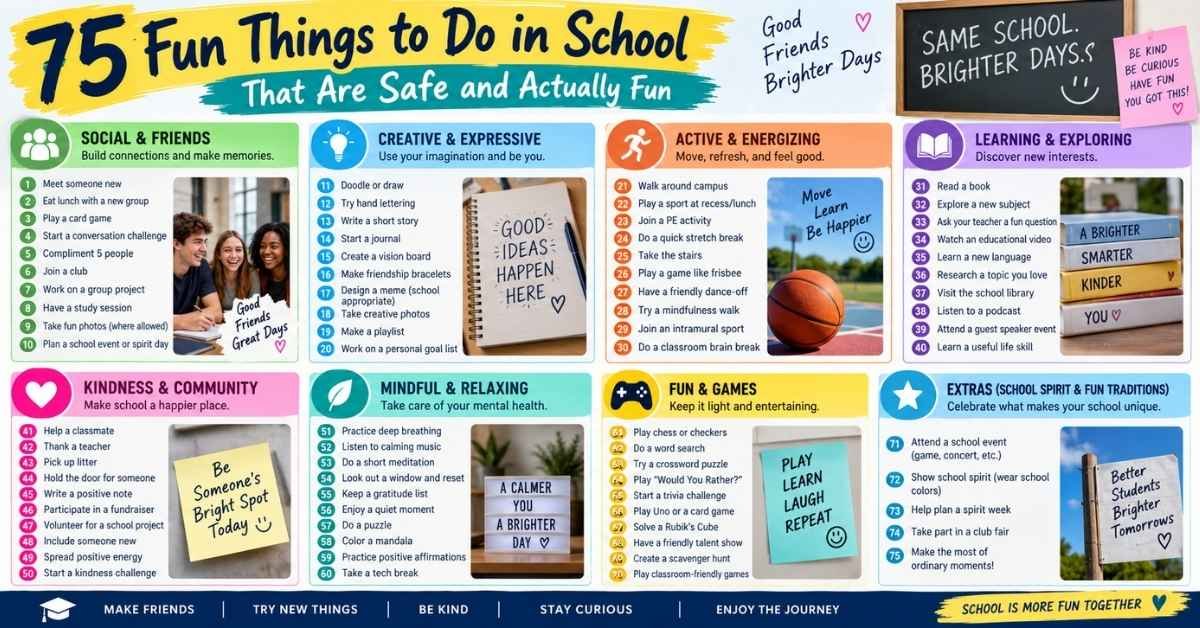
Fun things to do in school include playing paper games with friends, creating a comic strip, holding a lunch-table trivia challenge, solving a quiet puzzle, joining a club, or suggesting a teacher-approved classroom game. The best choice depends on whether you are in class, at lunch, outside for recess, or enjoying a free period. You do not need a phone, money, or a large group to make the school day more enjoyable—you simply need an activity that fits the time, place, and rules.
Some school days seem to move painfully slowly. You may finish your work early, feel awkward during lunch, or want something more interesting than scrolling on your phone. The ideas below include quiet activities, games with friends, screen-free challenges, indoor-recess games, outdoor activities, and no-prep classroom games.
These suggestions are designed for permitted downtime. If your teacher is explaining a lesson or you still have work to complete, focus on that first.
Find the Right School Activity in 30 Seconds
Use this table to find an activity that fits your situation.
| Your situation | Activities to try |
|---|---|
| You have five minutes | Word ladder, doodle challenge, category race |
| You finished your work early | Create a quiz, read, organize notes |
| You are with one friend | Dots and Boxes, Twenty Questions, fold-over story |
| You are at lunch | Table trivia, story chain, drawing challenge |
| Phones are not allowed | Paper games, observation challenges, word games |
| You have no materials | Memory chain, alphabet game, mental math duel |
| You want something quiet | Journaling, sketching, reading, logic puzzle |
| You want to move | Walking conversation, movement circuit, Four Square |
| You are alone | Visit the library, write, draw, plan a project |
| Your teacher needs a game | Four Corners, Hot Seat, question roulette |
Use the SCHOOL Check Before Starting
An activity can sound perfect online and still be wrong for the moment. Before you begin, use this simple check.
- S — Situation: Are you in class, at lunch, at recess, or in a free period?
- C — Consent: Can you begin independently, or should you ask a teacher?
- H — How many people: Are you alone, with one friend, or in a group?
- O — Objects: Do you have paper, pencils, cards, or no materials?
- O — Outcome: Do you want to create, relax, socialize, move, or learn?
- L — Length: Do you have five minutes or an entire lunch period?
The most exciting idea is not always the best choice. A good school activity fits the space, respects other people, and can stop quickly when the bell rings.
Quiet Things to Do During Classroom Downtime
These quiet classroom activities work best after you have completed your assignment or when your teacher allows independent time.
1. Turn a Random Doodle Into a Picture
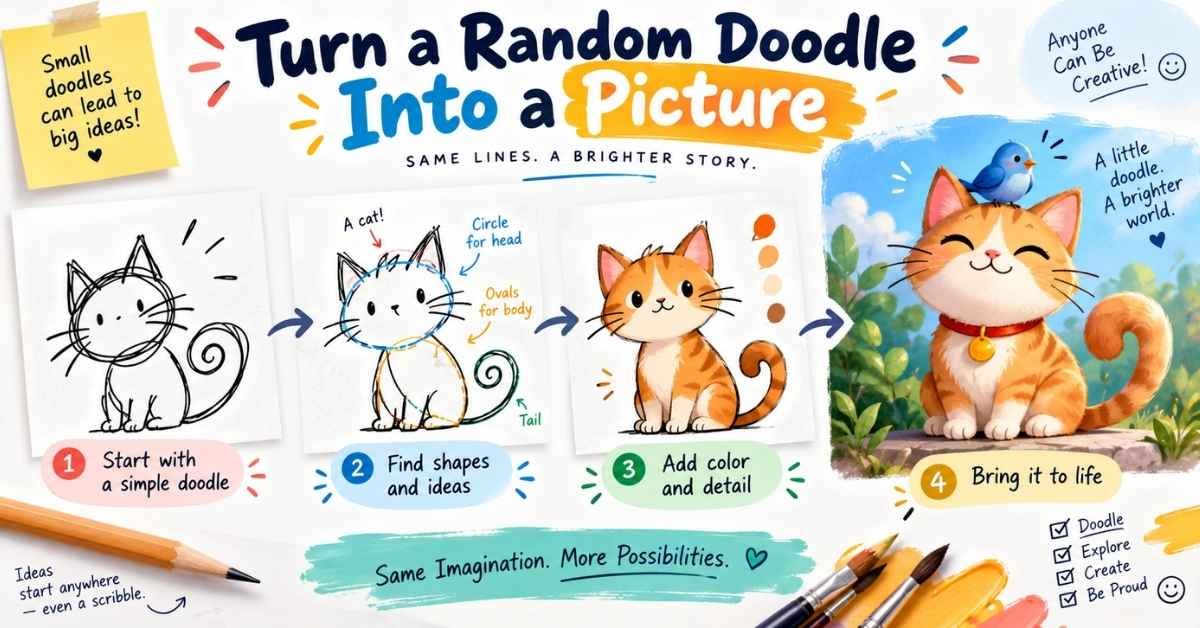
Time: 5–10 minutes Materials: Paper and pencil Best for: Solo creative time
Draw a random curved line or scribble without planning it. Look at the shape from different angles and turn it into a person, animal, machine, landscape, or fictional creature.
If you are playing with a friend, create a scribble for each other. The challenge is not to produce perfect artwork—it is to see two completely different possibilities in an ordinary line.
2. Write a Six-Sentence Story
Create a complete story using only six sentences:
- Introduce a character.
- Give the character a goal.
- Create a problem.
- Add an unexpected complication.
- Solve the problem.
- Finish with a memorable final line.
For an extra challenge, include three objects you can see in the classroom. This is one of the easiest creative writing activities for students because it has clear limits and takes only a few minutes.
3. Create a Mini Comic Strip
Divide a page into four or six panels. Build a short scene around an unusual prompt:
- The school bell refuses to ring.
- A backpack begins giving advice.
- The class discovers a hidden door.
- A student accidentally becomes principal for a day.
- The library books start changing their endings.
Keep speech bubbles short so the story remains easy to follow.
4. Build a Word Ladder
Start with one word and change a single letter at each step until you reach a completely different word.
For example:
CAT → COT → DOT → DOG
You can also choose a subject-related starting word and see how far you can move from it without creating a nonexistent word.
5. Start a Five-Minute Journal
“Write in a journal” is not useful advice when you have no idea what to write. Try one of these prompts instead:
- What was the strangest moment of my week?
- What is one thing I understand better than I did last month?
- If I could add one class to the school schedule, what would it be?
- What is something small I am looking forward to?
- What would make tomorrow easier?
Your journal does not need to sound impressive. It only needs to be honest enough to be useful to you.
6. Turn Your Notes Into a Visual Page
Take completed class notes and convert them into:
- A timeline
- A labeled diagram
- A cause-and-effect chart
- A mind map
- A comparison table
- A set of symbols or icons
This is more engaging than copying the same notes again and can help you see connections you missed the first time.
7. Design a Fictional Product
Invent a product that solves a small school problem. Give it:
- A name
- A logo
- A target customer
- A short slogan
- A price
- Three features
Your invention could be a self-organizing backpack, a pencil that finds spelling mistakes, or a lunchbox that keeps hot and cold foods separate.
8. Write to Your Future Self
Write a note that you will read at the end of the term or school year. Include:
- What life feels like right now
- What you hope will improve
- Something you do not want to forget
- A prediction about the future
- One goal you want to complete
Date the page and store it somewhere safe.
9. Solve a Silent Logic Challenge
Keep a small collection of Sudoku puzzles, riddles, number patterns, word searches, or logic grids in your folder. They work well during short periods of approved downtime because you can stop without losing much progress.
If puzzles make you more frustrated than relaxed, choose an easier level. Free time does not need to become another test.
10. Rewrite a Familiar Ending
Choose a book, movie, historical event, or classroom story and imagine a different ending.
Consider:
- What decision would need to change?
- How would other characters respond?
- What new problem would the ending create?
- Would the alternative actually be better?
This can be a simple paragraph or a full scene.
Productive Things to Do After Finishing Your Work
Finishing early should not mean receiving meaningless extra work. These early-finisher activities help you use the time without feeling punished for working efficiently.
11. Make a One-Page Review Sheet
Reduce a completed lesson to one page containing:
- Essential terms
- Important dates or formulas
- One worked example
- A common mistake
- Three possible test questions
The goal is not to decorate every inch. It is to identify what matters most.
12. Create a Mini Quiz
Write five questions about the topic you just completed:
- Two easy questions
- Two moderate questions
- One challenging question
Add an answer key. If your teacher permits it, exchange quizzes with a classmate.
13. Read Something You Chose
Keep a short book, magazine, comic, or approved article available. Reading is easier to enjoy when you choose the subject yourself.
If you struggle to select a book, ask the librarian for something short in a genre you already like.
14. Build a Personal Vocabulary Bank
Record unfamiliar words using four details:
- The word
- Its meaning
- A sentence from the original context
- Your own example
You can collect words from class, books, conversations, or signs around school.
15. Plan a Personal Project
Use the extra time to develop something you genuinely care about, such as:
- A blog
- A short story
- An art series
- A school podcast
- A photography theme
- A coding project
- A small business idea
- A science experiment proposal
Break the project into the smallest possible first step.
16. Organize Your Planner or Backpack
You do not need to empty your entire bag onto the floor. Use a two-minute method:
- Remove obvious rubbish.
- Put loose papers in the correct folder.
- Check upcoming deadlines.
- Write down one priority for later.
This is not exciting, but finding what you need tomorrow feels much better than searching through crushed papers five minutes before class.
17. Help Someone—If They Want Help
You can offer to explain a question or compare answers, but do not assume someone wants assistance.
A respectful way to ask is:
“Would it help to work through this together?”
If they say no, accept the answer without making the situation uncomfortable.
18. Request an Extension Challenge
If the regular task feels too easy, ask:
“I finished the assignment. Is there a harder example or a related problem I can try?”
A specific request is more useful than simply telling the teacher that you are bored.
Fun Things to Do in School With Friends
The best activities to do at school with friends are easy to start, easy to stop, and enjoyable even when you have only a few minutes.
19. Play Twenty Questions
One person secretly chooses an animal, object, place, fictional character, or famous person. Everyone else asks yes-or-no questions and tries to identify the answer within 20 questions.
Avoid selecting a person from the school if the game could turn into gossip or embarrassment.
20. Start a Category Race
Choose a category and take turns naming answers without repeating anything.
Try:
- Countries
- Foods
- Sports
- Book characters
- Animals
- Songs
- School subjects
- Things beginning with a chosen letter
Add a five-second limit if the normal version becomes too easy.
21. Build a One-Sentence Story
One player begins with a single sentence. Each person adds one new sentence to continue the story.
The fun comes from responding to what other people contribute instead of forcing the story toward your original plan.
22. Ask Better “Would You Rather?” Questions
Try questions that produce an actual conversation:
- Would you rather master every language or every musical instrument?
- Would you rather have a three-day school week with longer days or five shorter days?
- Would you rather explore the deep ocean or outer space?
- Would you rather be known for creativity or courage?
- Would you rather take every test orally or in writing?
Ask people to explain their choices instead of moving immediately to the next question.
23. Hold a Lunch-Table Trivia Round
Choose one quizmaster for each round. Use a mixture of:
- General knowledge
- Films and television
- Sports
- Music
- Science
- Geography
- School memories
Questions should not depend entirely on one person’s interests. Rotate categories so more people have a chance to contribute.
24. Play Two Truths and a Lie
Each player shares three statements, two true and one false. The group guesses the false statement.
Keep the game light. No one should feel pressured to reveal private family information, health details, relationships, or embarrassing experiences.
25. Make a Shared School Bucket List
Write down realistic things you would like to do before the term or school year ends:
- Attend a school game
- Join a club meeting
- Visit the library
- Participate in spirit week
- Thank a helpful teacher
- Try a different lunch option
- Enter a competition
- Contribute to a school project
Choose one item that your group can complete this month.
26. Hold a Five-Minute Drawing Challenge
Select one prompt and give everyone five minutes to draw it.
Good prompts include:
- The classroom 100 years in the future
- The world’s least useful invention
- An animal with an unusual job
- A superhero whose power is inconvenient
- A school designed by students
Compare the ideas, not the artistic ability.
27. Give a Meaningful Compliment
Challenge each person to give someone a specific, sincere compliment. Focus on:
- Kindness
- Effort
- Humor
- Creativity
- Reliability
- Courage
- Patience
A thoughtful compliment about someone’s actions usually means more than a generic comment about appearance.
28. Invent a Friendly Group Challenge
Create a challenge everyone can attempt without spending money or breaking rules.
Examples include:
- Learn five words in another language.
- Read one short book this month.
- Complete a daily sketch.
- Bring one interesting fact to lunch.
- Perform one quiet act of kindness.
Avoid challenges involving dangerous behavior, food restrictions, public embarrassment, or secret recording.
Paper-and-Pencil Games to Play at School
These paper games for students are useful when phones are prohibited and you have only basic supplies.
29. Dots and Boxes
Draw rows of evenly spaced dots. Players take turns connecting two neighboring dots with one line. When someone completes a box, they write their initial inside it and take another turn.
The player who claims the most boxes wins.
30. Fold-Over Story

Divide a page into sections for:
- Character
- Action
- Location
- Problem
- Unexpected object
- Ending
Each person completes one section, folds the page to hide it, and passes it on. Unfold the paper at the end and read the strange result.
31. Fold-Over Drawing
Fold a page into four sections. Different players draw the head, torso, legs, and feet without seeing the earlier sections.
Add small guide marks at the folds so the body parts connect.
32. Make a Paper Fortune Teller
Fold a square sheet of paper into a fortune teller. Instead of embarrassing predictions, fill it with:
- Trivia questions
- Positive challenges
- Conversation starters
- Drawing prompts
- Compliments
This keeps the activity playful without targeting anyone.
33. Play Name, Place, Animal, Thing
Choose a letter. Every player writes a name, place, animal, and object beginning with that letter.
Give full points for a unique answer and fewer points when two players write the same one. Add categories such as food, profession, book, or sport for a harder round.
34. Create a Paper Maze
One person designs a maze while another attempts to solve it. Add:
- False paths
- Checkpoints
- Keys
- Locked doors
- A short story explaining the goal
Keep the pathways wide enough for a pencil to follow.
35. Run a Tic-Tac-Toe Tournament
Ordinary tic-tac-toe becomes repetitive after several draws. Try variations:
- Play on a larger grid.
- Require four in a row.
- Use three connected boards.
- Allow each player to move one existing mark per turn.
Write down the rules before starting so they do not change when someone is about to win.
36. Play Word Squares
Choose a short word and build new words using its letters. You can compete for:
- Most words
- Longest word
- Most unusual valid word
- Most words connected to one topic
Agree on whether names, abbreviations, and plural forms are allowed.
Fun Activities That Need No Phone or Materials
These screen-free school activities work when you have nothing except a few willing participants.
37. Play the Alphabet Category Game
Choose a topic and move through the alphabet:
- A is for apple.
- B is for banana.
- C is for cherry.
Skip extremely difficult letters or give each player one pass.
38. Build a Memory Chain
The first person says, “I went on a trip and packed a book.” The next repeats the sentence and adds another item.
The list grows until someone forgets an item or changes the order. Use a school, space, mystery, or survival theme to keep later rounds interesting.
39. Try a Silent Observation Challenge
Without touching anything, notice:
- Five colors
- Four shapes
- Three sounds
- Two textures
- One detail you have never noticed before
This is especially useful when you want a quiet reset rather than another competitive game.
40. Play “Who or What Am I?”
One player thinks of a person, place, object, or character. The others ask yes-or-no questions until someone finds the answer.
Unlike Twenty Questions, this version can continue until the answer is found, making it better for a relaxed lunch period.
41. Hold a Mental Math Duel
One person creates a calculation and another solves it mentally. Begin at a level that feels manageable and gradually increase the challenge.
Friendly competition stops being fun when one player deliberately chooses questions the other person has never learned.
42. Connect Three Random Objects
Choose three things you can see and create a story connecting them.
For example, connect a clock, backpack, and window in one believable or ridiculous explanation.
43. Try the One-Minute Expert Challenge
Choose a harmless topic and speak about it for one minute without repeating the same point.
Topics might include:
- Your favorite sport
- A useful app
- A place you want to visit
- A skill everyone should learn
- The best school lunch
- A fictional character
Public speaking should always be optional. A student can be the timer or topic selector instead.
44. Play the Last-Letter Word Game
One player says a word. The next word must begin with the final letter of the previous word.
School → Library → Yellow → Window
Use categories if the open version is too easy.
Things to Do Alone at School
Being alone does not automatically mean something is wrong. Some students enjoy a quiet break, while others are still finding people they feel comfortable around.
45. Visit the Library
Ask the librarian for:
- A short mystery
- A graphic novel
- A book about a hobby
- A magazine
- A beginner-friendly nonfiction book
Librarians are usually better at recommendations when you mention something you already enjoyed.
46. Take an Approved Walk
If school rules allow it, walk around a designated area of the campus. Movement can offer a useful change after sitting for several lessons.
Remain in supervised areas and return before the next class begins.
47. Begin a Small Personal Challenge
Choose something measurable but not exhausting:
- Read ten pages a day.
- Learn five new words each week.
- Make one small sketch every school day.
- Record one interesting fact.
- Write one paragraph of a story.
Small challenges are easier to maintain than ambitious plans that disappear after two days.
48. Create a Fictional Character
Give your character:
- A name
- A strength
- A fear
- A private goal
- A difficult decision
- An unusual habit
- A person they trust
Then write a scene that forces the character to make a choice.
49. Plan Something to Look Forward To
Plan a weekend activity, reading list, creative project, fitness goal, or skill you want to learn.
Focus on one realistic next step rather than designing a perfect six-month schedule.
50. Study the School Environment
Observe the building as if you were visiting it for the first time:
- Which spaces are busiest?
- Where does sound travel?
- What colors appear most often?
- Which areas feel calm?
- What would you redesign?
Turn your observations into a sketch, description, or school-improvement idea.
51. Take a Calming Reset
Sit comfortably and slowly notice your breathing. Relax your shoulders, hands, and jaw. You do not need to force your mind to become completely empty.
If closing your eyes feels uncomfortable or is inappropriate in the setting, focus on one stationary object instead.
52. Join a Low-Pressure Activity
If you want company but do not know how to approach a group, try:
“That looks fun. Is there room for one more person?”
Not every invitation will work, and that does not mean you did anything wrong. Libraries, supervised lunch groups, clubs, and recurring activities can make social connection easier because everyone already has a shared purpose.
If loneliness at school is persistent or upsetting, speak with a trusted teacher, counselor, or family member.
Learn More: Things to Do in Guatape: 21 Best Activities for 2026
Indoor-Recess and Rainy-Day Activities
Good indoor school activities use limited space without turning the classroom into chaos.
53. Run a Board-Game Rotation
Create several stations and set a short time for each round. Choose games with simple rules so students spend more time playing than setting up.
Display the rotation order to prevent everyone from asking where to go next.
54. Hold a Silent Puzzle Challenge
Teams complete a jigsaw puzzle without speaking. Players must communicate through gestures and shared attention.
This is cooperative, surprisingly difficult, and quieter than a normal race.
55. Play Classroom Charades
Use categories such as:
- Animals
- Jobs
- Books
- Historical figures
- Scientific processes
- Vocabulary words
Allow students to pass if they are uncomfortable performing.
56. Try Pictionary
One player draws while teammates guess the word. Do not allow letters, numbers, or spoken clues.
For an academic variation, use lesson vocabulary. For a relaxed round, use films, foods, animals, or everyday objects.
57. Build the Tallest Paper Structure
Give each group the same number of sheets and a fixed time. The structure must stand independently for at least ten seconds.
Measure height only after hands are removed. Add a second round so teams can improve their designs.
58. Create a Mini Escape Puzzle
Connect three simple challenges:
- Solve a riddle.
- Use its answer to find a hidden number.
- Use that number to decode a final message.
Test every clue before giving the puzzle to someone else. A puzzle is not challenging in a satisfying way if the instructions are broken.
59. Organize a Rock-Paper-Scissors Tournament
Players compete in short rounds. Instead of making eliminated students sit down, let them support the person who defeated them until one large group remains behind each finalist.
Set a noise limit before the tournament begins.
60. Create a Collaborative Mural

Choose one theme and assign each student a small section.
Possible themes include:
- Life under the ocean
- A city of the future
- Favorite books
- A shared school garden
- One image representing every subject
Agree on colors and connecting elements so the finished mural feels unified.
Outdoor and Recess Activities
These outdoor school activities offer movement, conversation, and a break from the classroom.
61. Play Four Square
Four players stand in separate squares and bounce a ball between them. A player rotates out after missing the ball or breaking an agreed rule.
Keep the rules simple and establish boundaries before beginning.
62. Create a Nature Scavenger Hunt
Search for observable items such as:
- A rough surface
- Something shaped like a triangle
- Three shades of green
- Evidence of an insect
- A natural pattern
- Something moved by the wind
Do not pick plants, disturb animals, or leave supervised areas.
63. Take a Walking Conversation
Walking and talking can feel less awkward than sitting face-to-face. Use prompts such as:
- What is one skill you would like to learn?
- Which class would you redesign?
- What is the best place you have visited?
- What is one small thing that improved your week?
Stay within approved areas and return on time.
64. Design a Movement Circuit
Create short stations for balancing, walking, stretching, stepping, or throwing a soft ball at a safe target.
Provide seated and low-impact alternatives so more students can participate.
65. Play Shadow Tag
Instead of touching another player, step on their shadow. Set clear boundaries and avoid crowded spaces.
If the sun is directly overhead and shadows are too small, save the game for another time.
66. Hold a Playground Observation Challenge
Choose a category and see who can find the most examples:
- Geometric shapes
- Different textures
- Symmetry
- Natural versus human-made objects
- Evidence of weather
- Safe design features
This combines movement with close observation.
67. Invent a New Playground Game
Build the game around five questions:
- What is the goal?
- How do players score?
- Where are the boundaries?
- How does a round end?
- What rules keep everyone safe?
Test it, notice what causes confusion, and revise the rules.
No-Prep Classroom Games Teachers Can Use
The following fun classroom games for students require little preparation and can be adapted for different subjects.
68. Four Corners
Label four corners with possible answers. Students move to the corner matching their choice and explain their reasoning.
It can be used for:
- Multiple-choice review
- Predictions
- Opinion questions
- Vocabulary categories
- Story analysis
Include a seated response option for students who cannot or do not want to move.
69. Hot Seat
One student faces away from the board while a word appears behind them. Classmates give clues without saying the word itself.
Allow students to pass or take a nonperforming role. A game should not depend on public embarrassment.
70. Question Roulette
Students write lesson-related questions on separate slips of paper. Mix the questions and answer them one at a time.
Review the questions before play to remove duplicates, unclear wording, or inappropriate content.
71. Stand Up or Sit Down
Read a statement. Students stand for one response and remain seated for another.
Use it for:
- True or false
- Agree or disagree
- Category sorting
- Predictions
- Quick knowledge checks
Do not use personal questions that reveal private information.
72. Classroom Mystery Object
Choose an object or concept. Students ask yes-or-no questions until they identify it.
For older students, use historical figures, scientific terms, geographical locations, or literary characters.
73. One-Minute Team Challenge
Give groups one minute to produce as many valid responses as possible.
Examples:
- Words connected to photosynthesis
- Reasons a historical event occurred
- Synonyms for a chosen word
- Fractions equivalent to one-half
- Questions about a reading
Accuracy should matter more than shouting first.
74. Silent Line-Up
Students arrange themselves without speaking according to:
- Birthday month
- Alphabetical first name
- Height
- Distance traveled to school
- Number of letters in their name
Avoid categories involving grades, money, health, popularity, or other sensitive information.
75. Pass the Story

Each student writes one sentence and passes the page to the next person. Set a clear genre, length, and content rule before starting.
For a subject-based version, require the story to include vocabulary or facts from the lesson.
See More: 21 Best Things to Do in Mendoza: Wine, Andes & City Guide
How to Make Activities Work for Teenagers
Many fun activities for high-school students fail because the presentation feels childish, not because the activity itself is bad.
Use Better Prompts
Replace basic prompts with subjects teenagers can examine seriously:
- School improvement
- Technology
- Music
- Careers
- Media
- Sport
- Business ideas
- Ethical choices
- Travel
- Real-world problems
Give Students Control
Let students select categories, write questions, lead rounds, create rules, or design harder variations.
Add Strategy
Instead of making games louder, make them more thoughtful. Add evidence, time limits, creative restrictions, or competing solutions.
Avoid Forced Enthusiasm
Not everyone wants to perform, dance, or speak in front of the class. Offer roles such as:
- Scorekeeper
- Designer
- Timekeeper
- Researcher
- Question writer
- Judge
- Team organizer
Teenagers are more likely to participate when the activity respects their independence and does not demand fake excitement.
Make School Activities More Inclusive
A game is not successful if several students have no realistic way to participate.
Support Shy Students
Allow written responses, partner discussion, optional speaking, and time to observe the first round.
Consider Noise Sensitivity
Use visual instructions, smaller groups, quieter spaces, and nonverbal alternatives.
Adapt Movement Activities
Replace speed with accuracy, strategy, coordination, or leadership. Provide seated and low-impact options.
Help English-Language Learners
Demonstrate one full round before beginning. Use simple instructions, visual examples, flexible response methods, and supportive partners.
Offer Noncompetitive Versions
Turn individual winning into a shared goal:
- Beat the class’s previous total.
- Complete a puzzle together.
- Create one combined story.
- Find ten correct answers as a team.
- Improve the design in a second round.
Respect Personal Space
Do not require handshakes, tagging, or physical contact. A no-contact version should always be available.
School Activities That Create Lasting Memories
Quick games improve a slow afternoon. Larger activities can improve the whole school experience.
Start a Student Club
Possible after-school activities include:
- Book or manga club
- Chess club
- Creative writing group
- Coding club
- Photography club
- Trivia club
- School podcast
- Walking club
- Volunteer group
- Film discussion club
A successful club needs a clear purpose, a staff adviser, a meeting schedule, and a simple first activity.
Organize a Lunch Tournament
Choose a short game such as chess, trivia, cards, or Rock-Paper-Scissors. Ask permission, create written rules, plan sign-ups, and decide how long each round will last.
Start with a small group before attempting a school-wide event.
Suggest a Student Showcase
A showcase can include:
- Art
- Photography
- Writing
- Music
- Inventions
- Research
- Coding projects
- Cultural presentations
Students who do not want to perform can help with design, organization, promotion, or setup.
Create a School Time Capsule
Include copies or photographs of items such as:
- School event programs
- Popular book lists
- Student artwork
- Predictions about the future
- A description of an ordinary school day
- Messages to future students
Do not include private student information.
Plan a School Improvement Challenge
Identify one realistic problem and propose a solution.
Examples include:
- Reducing lunch waste
- Making the library easier to use
- Creating quieter lunchtime spaces
- Improving club awareness
- Welcoming new students
- Adding student artwork to shared spaces
A strong proposal explains the problem, cost, people involved, and first step.
How to Suggest an Activity to Your Teacher
Teachers are more likely to consider an idea when you have already thought about time, materials, safety, and cleanup.
You can say:
“Could we try a ten-minute trivia game after the review? It only needs paper, and I can prepare the questions and clean up afterward.”
Include:
- The purpose
- Time required
- Materials
- Number of participants
- Supervision needed
- Safety rules
- Cleanup plan
- A simpler alternative
Begin with one class or lunch group. Ask what worked, improve the activity, and respect the answer if permission is not granted.
What Not to Do When You Are Bored at School
Some older lists recommend disruptive pranks or ways to avoid paying attention. A joke stops being harmless when it affects someone’s learning, safety, property, or privacy.
| Avoid | Try instead |
|---|---|
| Interrupting the teacher | Write down a funny thought for later |
| Secretly using your phone | Try a paper puzzle or word game |
| Throwing paper planes | Suggest an approved design contest |
| Pranking classmates | Create a harmless shared challenge |
| Leaving the classroom | Ask for an approved movement break |
| Recording people secretly | Create a written or drawing challenge |
| Making loud noises | Play a quiet guessing game |
| Targeting someone with a joke | Use humor that includes everyone |
Also avoid:
- Leaving supervised areas
- Damaging school property
- Sharing private information
- Food challenges involving allergies
- Physical dares
- Games that humiliate losing players
- Activities that continue after instruction resumes
When School Feels Boring Every Day
Occasional boredom is normal. Constant boredom may be telling you something more specific.
Ask yourself:
- Is the work too easy?
- Is it too difficult or confusing?
- Am I tired?
- Do I need movement?
- Do I understand why the subject matters?
- Do I feel disconnected from classmates?
- Am I worried about something unrelated to the lesson?
Before distracting yourself, try one small method of re-engaging:
- Turn the notes into questions.
- Look for one detail you did not know.
- Connect the lesson to one of your interests.
- Ask for clarification.
- Request a harder example.
- Set a ten-minute focus goal.
- Write down what is confusing you.
If boredom is affecting your attendance, performance, mood, or ability to function at school, speak with a teacher, counselor, or trusted family member. The solution may involve better support, a different level of challenge, or help with something happening outside the lesson.
Frequently Asked Questions
What are the best fun things to do in school?
The best activities include paper games, trivia, drawing challenges, creative writing, puzzles, reading, outdoor games, classroom challenges, clubs, and student-led events. Choose an activity based on your available time, location, materials, group size, and whether teacher permission is required.
What can I do when I am bored in class?
If instruction is underway, try re-engaging by turning notes into questions, looking for key ideas, or asking for clarification. During permitted downtime, you can draw, write a short story, solve a puzzle, read, organize notes, or play a quiet paper game.
What can I do after finishing my work early?
Create a review sheet, write quiz questions, read, build a vocabulary list, organize your planner, work on a personal project, or ask for an extension challenge. Select something that can stop quickly when the next activity begins.
What are fun things to do at school with friends?
Try Twenty Questions, Dots and Boxes, a fold-over story, table trivia, Would You Rather, category games, drawing challenges, or a shared school bucket list. Save louder activities for lunch, recess, or teacher-approved breaks.
What can I do at school without a phone?
You can read, draw, write, solve puzzles, play paper games, make a comic strip, start a word challenge, hold a conversation game, visit the library, or join a supervised activity. Many enjoyable school activities require no technology.
What are some quiet things to do at school?
Quiet options include journaling, visual note-making, reading, Sudoku, word ladders, sketching, creating a comic, writing to your future self, and designing a fictional product. Use them only after completing required work or receiving permission.
What can I do alone during lunch?
Visit the library, read, take an approved walk, draw, work on a personal project, write, or join a structured lunchtime activity. If you want company, ask whether you can join a game or speak with a counselor about available clubs and lunch groups.
What are fun activities for high-school students?
Good options include debates, trivia tournaments, creative challenges, strategy games, photography projects, school podcasts, student showcases, coding clubs, school-improvement projects, and event planning. Teen activities work best when students have meaningful choices and leadership roles.
What are good indoor-recess activities?
Try board games, puzzles, Pictionary, charades, paper-building challenges, collaborative murals, escape puzzles, trivia, or a quiet tournament. Establish rules for movement, noise, personal space, and cleanup before beginning.
Which classroom games require no preparation?
Four Corners, Twenty Questions, stand up or sit down, category games, story chains, mental math challenges, silent line-up, and classroom mystery object can all begin with little or no preparation.
How can shy students join school activities?
Choose partner or small-group activities, allow written responses, observe the first round, or take a supporting role such as scorekeeper or timekeeper. Participation should not require revealing personal information or performing publicly.
How can students start a school club?
Choose a clear purpose, find a teacher or staff adviser, learn the school’s approval process, propose a meeting schedule, and plan a simple first activity. Start with a manageable group and demonstrate that the club can operate safely and consistently.
Make the Next Slow School Moment Better
You do not need an expensive game, unlimited phone access, or dozens of friends to enjoy your free time at school. A sheet of paper can become a story, puzzle, game, invention, or piece of art. A simple question can begin a friendship. A small idea can eventually become a club or school tradition.
Choose something that matches your mood, respects the people around you, and fits the time available. Save this guide so you have a safe, genuinely fun activity ready for your next lunch break, free period, indoor recess, or early-finisher moment.










1 thought on “75 Fun Things to Do in School That Are Safe and Actually Fun”