things to do at the last day of school should be simple enough for a tired teacher to run, fun enough to hold students’ attention, and meaningful enough to give the school year a proper ending. The best last day of school activities usually combine a short reflection, something active or social, practical classroom cleanup, and a clear goodbye. Whether you have 10 minutes, one class period, a half-day, or a full final day, the goal is not to squeeze in one more complicated lesson. It is to help students leave feeling that the year was noticed, celebrated, and finished well.
By the final day, normal classroom conditions may already be gone. Chromebooks might be returned. Books may be boxed. Half the bulletin boards may be down. Students know summer break is close, and attention spans can disappear fast.
That is why the best things to do on the last day of school are not necessarily the most creative-looking ideas on Pinterest. They are the activities that fit your grade level, time available, preparation limits, classroom energy, materials, and emotional goal.
This guide gives you practical ideas for elementary, middle school, high school, seniors, ESL learners, device-free classrooms, packed-up rooms, half-days, full days, and those final awkward 15 minutes before dismissal.
Best Last Day of School Activities at a Glance
If you need something quickly, start here.
| Activity | Best Grades | Time | Prep | Energy | Devices |
|---|---|---|---|---|---|
| Six-Word School Year | 5–12 | 10 min | None | Calm | No |
| Class Trivia | 3–12 | 20–30 min | Low | Social | Optional |
| Advice to Next Year’s Students | 3–12 | 15–30 min | None | Calm | No |
| Memory Wall | 2–12 | 20 min | Low | Social | No |
| Classroom Cleanup Challenge | K–12 | 15–30 min | None | Active | No |
| Yearbook or Signing Time | 5–12 | 20–40 min | None | Social | No |
| Summer Bucket List | K–8 | 20 min | Low | Calm | No |
| Board Game Tournament | 3–12 | 30–60 min | Low | Active | No |
| Future-Self Letter | 5–12 | 20–30 min | None | Reflective | No |
| Student Choice Stations | 3–12 | 30–60 min | Low | Flexible | Optional |
A useful rule for almost any classroom is:
one calm activity + one active activity + one meaningful goodbye
That is usually better than planning ten different things students rush through.
Choose the Right Activity Before You Pick the Funniest One

A common mistake is choosing an activity because it sounds exciting without asking whether it fits the actual room.
Before deciding what to do, ask seven questions.
1. What grade am I teaching?
A great first-grade activity may feel childish to eighth graders.
A thoughtful high-school reflection may be too abstract for younger students.
2. How much time do I really have?
There is a huge difference between:
- 8 minutes before dismissal;
- a 45-minute class period;
- a half-day;
- a full final day.
3. How much prep can I tolerate?
On the last day, “low prep” should actually mean low prep.
If an activity needs:
- laminating;
- 25 printed packets;
- parent donations;
- six stations;
- special supplies;
it may be better suited to the last week of school, not the actual final day.
4. What materials are still available?
Your classroom might already be packed.
If the markers, books, manipulatives, or devices are gone, choose something that only needs:
- paper;
- pencils;
- a whiteboard;
- conversation;
- movement.
5. What is the class energy like?
Are students:
- bouncing off the walls;
- social and talkative;
- tired;
- emotional;
- completely checked out?
Match the activity to the energy instead of fighting it.
6. Do students still have devices?
Many schools collect Chromebooks or laptops before the final day.
A device-dependent plan can fail before class even begins.
7. What do I want students to feel when they leave?
Do you want them to leave feeling:
- proud;
- appreciated;
- excited;
- calm;
- connected;
- ready for the next grade?
This question often matters more than the activity itself.
No-Prep Last Day of School Activities
When you are searching the night before—or five minutes before class—you need ideas that actually require zero prep.
Six-Word School Year
Best for: Grades 5–12 Time: 10–15 minutes Prep: None Materials: Paper or whiteboard Energy: Calm
Ask students to describe the year in exactly six words.
Prompts might include:
- “Describe this school year in six words.”
- “Describe this class in six words.”
- “What six words will you remember?”
Students can be funny, thoughtful, sarcastic, sincere, or all four.
That makes this a particularly strong middle school and high school last day activity because it feels mature without becoming heavy.
One-Word Reflection
Ask every student to choose one word for:
- the school year;
- their personal growth;
- the class;
- what they hope next year feels like.
You can put the words on the board, have students write privately, or invite optional sharing.
This works especially well when you only have 5–10 minutes.
Advice to Next Year’s Students
This is one of the most useful and meaningful end-of-year reflection activities because it gives students a purpose beyond simply remembering.
Ask:
- What should next year’s students know?
- What should they start early?
- What should they not worry about?
- What helped you succeed?
- What would you do differently?
You can save the responses and show them to your next class.
Students often enjoy feeling like the experienced group giving insider advice.
Class Would-You-Rather
Use school-related prompts.
Examples:
- Field trip or class party?
- Extra recess or no homework?
- Group project or solo project?
- Science experiment or class debate?
- Morning class or afternoon class?
This works well when students are social and want to talk.
Favorite Memory Quick Round
Ask:
“What is one moment from this school year you think you will remember?”
Let students answer in different ways:
- aloud;
- on paper;
- anonymously on the board;
- privately.
Not everyone wants public emotional sharing.
Giving a written option keeps the activity inclusive.
Teacher vs Students Challenge
This works extremely well for students who are too old for craft-heavy activities.
Try:
- trivia;
- riddles;
- Pictionary;
- charades;
- subject challenges;
- general knowledge.
Make it the class versus the teacher rather than student versus student.
That creates shared energy without turning the last day into a popularity contest.
What to Do If You Only Have 5–10 Minutes
Sometimes the final schedule gets shortened by:
- assemblies;
- early dismissal;
- locker cleanup;
- yearbook distribution;
- announcements.
If only a few minutes remain, do not start anything complicated.
One-Word Year
Students choose one word that captures the year.
Final Class Photo
Take one normal photo and one funny one.
Quick Compliment Cards
Students write one positive note to someone else.
One Thing I Learned
Prompt:
“What is one thing you learned this year that you think you will actually remember?”
Prediction for Next Year
Students write one prediction about:
- themselves;
- school;
- the class;
- the world.
Funniest Classroom Moment
Keep it school-appropriate and avoid embarrassing individual students.
Final Teacher Question
Ask:
“What is one thing from this class you think you will remember five years from now?”
That one question can produce surprisingly meaningful answers.
Last Day Activities for 15–20 Minutes
If you have around 20 minutes, choose something with a clear beginning and end.
Good options include:
- Six-Word School Year
- mini class trivia;
- advice cards for next year;
- paper-airplane reflection;
- classroom scavenger hunt;
- summer bucket list.
Paper-Airplane Reflection
Students write a school-year memory or piece of advice on paper, fold it into an airplane, and fly it only if classroom rules and space allow.
A quieter alternative is simply exchanging folded notes.
Quick Summer Bucket List
Students list:
- something fun;
- something they want to learn;
- somewhere they want to go;
- someone they want to spend time with;
- one thing they want to do away from screens.
For younger students, drawing works well.
Activities That Fill 30–45 Minutes
When you have enough time for something substantial but not enough for a major project, use activities with structure.
Class Trivia Tournament
Class trivia works because it combines:
- nostalgia;
- competition;
- humor;
- shared memories.
Possible categories:
- funny classroom moments;
- lessons;
- school events;
- field trips;
- teacher habits;
- class traditions.
Avoid questions designed to embarrass or single out students.
The best trivia feels like “remember when?”, not “who messed this up?”
Memory Wall
Give students sticky notes or scraps of paper.
Use categories such as:
- something funny;
- something I learned;
- something I am proud of;
- someone who helped me;
- something I will miss.
Students place responses on the wall or board.
This turns reflection into something visual and social.
Board Game Rotation
Board games are useful after devices have been collected.
Use simple games students already know.
Keep competition light, and avoid games with rules so complicated that half the class period disappears into explanation.
Advice Poster for Next Year’s Class
Create headings like:
- Things We Wish We Knew
- How to Survive This Class
- Best Advice
- Do This Early
- Do Not Stress About This
- Ask for Help When…
You can keep the poster for next year.
That gives the activity a real purpose.
Class Awards
Awards can be wonderful when they celebrate growth and contribution.
Safer categories include:
- Creative Problem Solver
- Most Curious
- Thoughtful Contributor
- Reliable Teammate
- Biggest Growth
- Positive Energy
- Quietly Dependable
- Helpful Leader
Avoid turning awards into a popularity vote.
Teacher-curated recognition is usually safer than student voting.
What to Do With a Full Class Period
For a 45–60-minute final class, use multiple short segments rather than one long activity.
First 10 Minutes: Reflection
Try:
- six-word memoir;
- one-word reflection;
- favorite memory.
Next 20 Minutes: Active or Social Activity
Use:
- trivia;
- team challenge;
- Pictionary;
- board games.
Next 15 Minutes: Yearbook or Memory Time
Students can:
- sign yearbooks;
- exchange notes;
- write advice;
- add to a memory wall.
Final 10 Minutes: Goodbye
End with:
- a class photo;
- short teacher message;
- private reflection;
- optional sharing.
Alternating energy levels helps prevent the final period from becoming chaotic.
Half-Day Last Day of School Schedule
A half-day can feel long if you have no structure and incredibly short if you over-plan.
Try this sequence.
8:00–8:20 — Calm Start
Use:
- future-self letters;
- memory prompts;
- six-word year.
8:20–9:00 — Active Team Activity
Try:
- trivia tournament;
- scavenger hunt;
- team challenge.
9:00–9:30 — Classroom Cleanup Challenge
Assign clear jobs.
9:30–10:00 — Social Block
Allow:
- yearbook signing;
- conversation;
- quiet music;
- board games.
10:00–10:30 — Celebration
Use:
- awards;
- approved snacks;
- games.
Final 15 Minutes — Closure
Finish with:
- class photo;
- goodbye message;
- final reflection.
Ending calmly is usually better than finishing with the loudest game of the day.
Full-Day Last Day of School Plan
If you have students all day, think in terms of energy management.
A strong rhythm is:
calm → active → productive → social → meaningful closure
Morning: Calm and Reflective
Begin with:
- memory book;
- favorite moments;
- advice for next year;
- future-self letter.
Students are usually easier to settle in the morning.
Mid-Morning: Movement
Move into:
- outdoor games;
- scavenger hunt;
- team competition;
- movement challenge.
Before Lunch: Productive Reset
Use this time for:
- classroom cleanup;
- desk organization;
- supply sorting;
- returning materials.
Afternoon: Social Choice
Allow:
- yearbooks;
- drawing;
- board games;
- student choice stations;
- quiet music.
Final 20 Minutes: Slow Things Down
Use:
- final reflection;
- teacher message;
- goodbye;
- class photo.
The last emotional memory students take from the classroom should not be everyone screaming over a game.
“Chromebooks Are Already Gone” Activities
If technology has already been returned, that does not make the final day harder.
It can actually simplify it.
Good last day of school activities without devices include:
- Human Bingo
- Four Corners
- whiteboard Pictionary
- class trivia
- paper challenges
- memory notes
- silent line-up
- advice to future students
- yearbook time
- classroom cleanup
Human Bingo
Students find classmates who match prompts such as:
- read more than five books this year;
- joined a club;
- learned something new;
- went on the class field trip;
- is excited for summer.
Keep prompts inclusive.
Four Corners
Label four parts of the room with choices.
Example:
Favorite part of the year:
- projects;
- friends;
- field trips;
- sports/events.
Students move to the corner matching their answer.
This creates movement and conversation without technology.
What to Do When the Classroom Is Already Packed
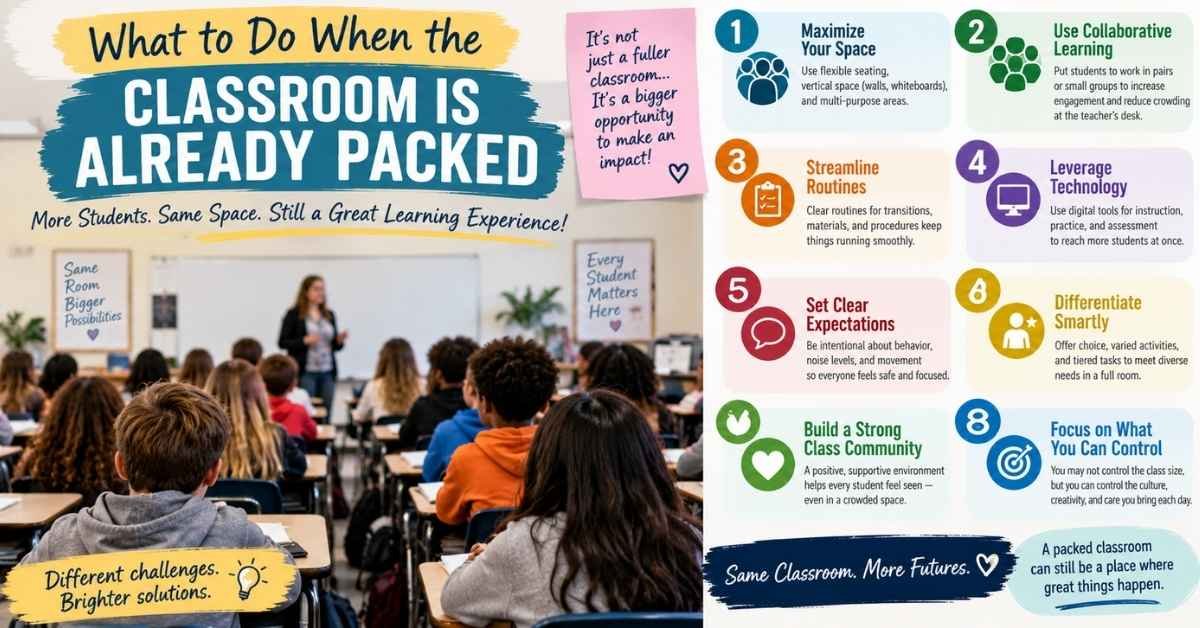
A half-empty classroom can still support great activities.
Human Bingo
Requires only paper.
Four Corners
Requires almost nothing.
Class Story
Go around the room and let each student add one sentence.
Make the story about:
- summer;
- a fictional school;
- the class going on an impossible adventure.
Memory Circle
Students can answer one prompt aloud or privately.
Whiteboard Games
Use:
- drawing;
- categories;
- riddles;
- word games;
- trivia.
Outdoor Walk and Talk
If school rules allow, pair students and give them reflection prompts.
Cleanup Challenge
If the room is packed because you still have work to do, make that the activity.
Turn Classroom Cleanup Into a Game
Classroom cleanup is one of the most practical last day of school activities for teachers because it solves a real problem.
The trick is making it feel like shared responsibility rather than punishment.
Team Cleanup Challenge
Divide the room into zones:
- books;
- desks;
- supplies;
- floor;
- wall displays.
Give each team a clear task.
Mystery Jobs
Write jobs on slips of paper.
Students draw one.
Examples:
- straighten chairs;
- organize pencils;
- wipe tables;
- return books;
- check floor areas.
Beat-the-Clock Cleanup
Set a timer and play music.
Challenge students to finish correctly before time runs out.
Speed should never matter more than safety or quality.
Before-and-After Challenge
Assign a small area and let students compare how it looked before and after.
Quiet Cleanup Mission
For overstimulated groups, try a silent challenge.
Students work without talking until the room is ready.
It turns calm into part of the game.
Student Choice Stations for the Last Day
Choice stations are one of the strongest options for mixed-energy classrooms.
Not every student wants to do the same thing.
Create stations such as:
Station 1: Yearbook or Signing
Students sign yearbooks or exchange notes.
Station 2: Memory Prompts
Students respond quietly.
Station 3: Board Game
Keep choices simple.
Station 4: Drawing or Coloring
Good for students who need calm.
Station 5: Advice to Next Year’s Students
Students write helpful tips.
Station 6: Cleanup Jobs
Give useful jobs to students who want something active.
Station 7: Quiet Reading
Useful for introverted or tired students.
Station 8: Class Trivia
A social option.
Choice stations work because they allow students to regulate their own energy while the teacher still maintains structure.
Learn More: Things to Do in South Padre Island for Adults: 21 Best Ideas
Last Day of School Activities for Elementary Students
Elementary students usually respond well to activities involving:
- creativity;
- movement;
- recognition;
- memory;
- anticipation of summer.
Memory Book
Keep the book short enough to finish.
Possible pages:
- favorite subject;
- favorite memory;
- funniest moment;
- proudest moment;
- something I learned;
- what I want to do this summer.
Summer Bucket List
Students can write or draw things they hope to do during summer break.
Class Compliment Chain
Each student writes a kind note to another classmate.
The teacher can assign names to make sure everyone receives something.
Classroom Awards
Recognize every student for something genuine.
Avoid comparing children publicly.
Outdoor Games
Use simple games students already understand.
The final day is not the best time to teach 12 complicated new rules.
Read-Aloud and Reflection
Choose a book about:
- friendship;
- change;
- growing up;
- transition;
- summer.
Then ask one or two short questions.
Last Day of School Activities for Middle School
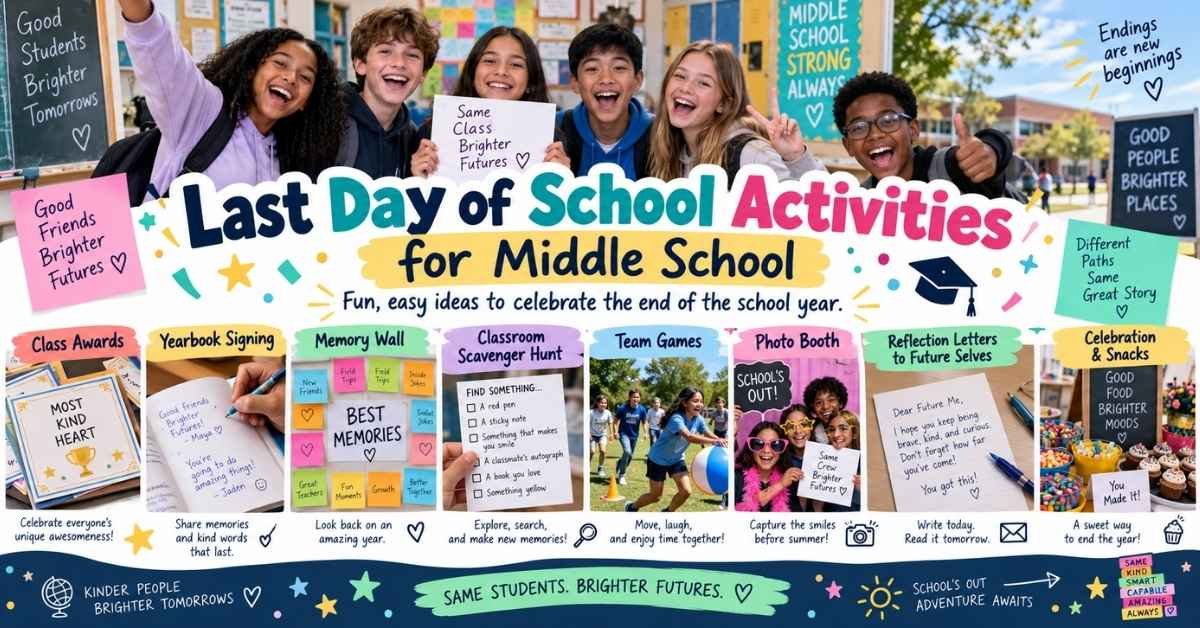
Middle school is where many generic final-day articles fail.
Students still want to have fun, but they quickly reject anything that feels childish.
Class Trivia
Include safe inside jokes and shared experiences.
Avoid targeting individual students.
Playlist of the Year
Students suggest songs that remind them of:
- school events;
- study sessions;
- sports;
- field trips;
- the general mood of the year.
Make sure selections follow school policy.
Would-You-Rather Tournament
Use funny school scenarios.
Examples:
- give a presentation every week or take a quiz every day?
- sit in the front row forever or never choose your seat again?
- group project or oral presentation?
Meme Caption Challenge
Use teacher-approved images or fictional classroom scenarios.
Students create funny captions.
Never build the activity around embarrassing classmates.
Survival Guide for Next Year’s Students
This is one of the best middle school last day activities because it gives students status and purpose.
Prompt:
“What should next year’s students know to make this year easier?”
Team Challenge
Use:
- tower building;
- riddles;
- escape-style puzzles;
- trivia;
- logic problems.
Yearbook and Social Time
Middle-school students want to talk to their friends.
Rather than fighting that, schedule a controlled social block.
Last Day of School Activities for High School
The best last day of school activities for high school should feel mature, flexible, and not overly sentimental.
Six-Word Course Memoir
Ask students to describe the course in six words.
Examples:
- “Group projects were somehow worth it.”
- “I understood more than I expected.”
- “Late work nearly ended my career.”
Humor is welcome if it stays respectful.
Course Survival Guide
Ask:
- What should next year’s students know?
- What should they start early?
- What assignment matters most?
- What should they not overthink?
- What helped them succeed?
Letter to Future Self
Students write about:
- where they hope to be;
- what they are proud of;
- what they want to remember;
- what they want to improve.
Course Feedback Students Will Actually Give
Ask specific questions:
- What should stay?
- What should change?
- What helped you learn?
- What wasted time?
- Which lesson do you remember most?
- What would make this class better?
Specific questions get better answers than “Any feedback?”
Class Trivia
Keep it course-specific and memorable.
What Will You Actually Remember?
Ask:
“When you think about this class years from now, what do you think will still be there?”
Students can answer seriously or humorously.
Last Day Activities for Seniors
For seniors, the final school day can carry more emotional weight.
It may be the last ordinary classroom experience of their school career.
Advice to Your Younger Self
Ask:
“What would you tell yourself on your first day of high school?”
Five-Year Prediction Card
Students predict:
- where they may live;
- what they may study;
- what job they may have;
- what they hope has changed.
Gratitude Notes
Students write to:
- a teacher;
- classmate;
- coach;
- staff member;
- friend.
Favorite School Memory
Keep sharing optional.
Final Class Photo
Take a normal photo and one less formal one.
Advice to Underclassmen
Collect practical advice.
Letter to Open Later
Students write something to read after graduation or several years later if the school has a safe process for storing it.
Fun Last Day of School Games
Games are useful when students need movement and social energy.
Good options include:
- Class Bingo
- Pictionary
- Charades
- Four Corners
- Trivia
- Scavenger Hunt
- Minute-to-Win-It challenges
- Rock-Paper-Scissors tournament
- Silent Line-Up
- Paper-Airplane challenge
Before choosing, consider:
- noise level;
- classroom space;
- age;
- cleanup;
- safety.
A game that works perfectly outdoors may be a disaster in a crowded classroom.
Better Alternatives to Movie Day
A movie can work, but it is not automatically the easiest option.
On the final day, highly social students may spend the entire movie:
- talking;
- walking around;
- asking to leave;
- using phones.
If you want something low-prep but more interactive, try:
Board Game Tournament
Works best for small groups.
Student Choice Stations
Good for mixed energy levels.
Class Trivia
Requires minimal preparation if you already know your class well.
Yearbook and Music Block
Give students controlled social time.
Reflection Walk
If school rules and weather allow, let students walk in pairs with prompts.
Team Competition
Use puzzles, drawing, or trivia.
When a Movie Does Make Sense
A movie works when:
- students actually want a calm activity;
- the title is school-approved;
- it connects to the class or school year;
- you need low-energy downtime.
Meaningful Last Day of School Activities
A great last day does not need to be serious, but some form of reflection gives the year emotional closure.
Favorite Memory Reflection
Ask students to describe:
- one funny memory;
- one proud moment;
- one challenge;
- one person who helped them.
Growth Reflection
Prompts:
- What can you do now that you could not do at the beginning of the year?
- What became easier?
- What are you most proud of?
- What challenge did you overcome?
Advice to Future Students
This combines reflection with usefulness.
Gratitude Notes
Let students thank someone who mattered.
Future-Self Letter
This connects the present school year with what comes next.
Class Timeline
List major moments from the year on the board.
Students add:
- events;
- projects;
- field trips;
- funny moments;
- accomplishments.
“What I’m Taking With Me”
Ask students to finish:
“One thing I am taking with me from this year is…”
The answer can be academic, social, or personal.
Help Students Handle Mixed Emotions About School Ending
Not every student is simply excited for summer.
Some feel:
- relieved;
- sad;
- anxious;
- nostalgic;
- uncertain;
- proud;
- lonely.
School may also provide:
- routine;
- friendships;
- supportive adults;
- meals;
- activities;
- predictability.
That means the last day should leave room for more than celebration.
Normalize Different Reactions
Instead of saying:
“Everyone is excited for summer!”
Try:
“Some of you are excited, some may feel sad, and some may feel both.”
That small change makes room for everyone.
Offer Private Reflection
Do not require students to discuss personal emotions publicly.
Allow:
- written reflection;
- anonymous notes;
- drawing;
- optional sharing.
Let Students Say Goodbye in Different Ways
Options include:
- cards;
- notes;
- conversation;
- drawing;
- class photo;
- quiet reflection.
The Reflect–Celebrate–Connect–Look Ahead–Goodbye Framework
A strong final day can be built around five simple goals.
Reflect
What happened this year?
What did students learn?
And What changed?
Celebrate
What did they achieve?
What are they proud of?
Connect
Who helped them?
What friendships or classroom relationships mattered?
Look Ahead
What are they excited about?
What are they nervous about?
And What comes next?
Say Goodbye
Create an actual ending.
Do not let the final bell be the first moment anyone acknowledges that the year is over.
You do not need an elaborate activity for every stage.
A few minutes for each can be enough.
See More: Things to Do in Foxborough MA: 20 Best Attractions & Ideas
How to Keep Students Calm on the Last Day
The final day is still a school day.
Students often behave better when structure remains visible.
Keep Normal Expectations
You can loosen the academic intensity without abandoning:
- respect;
- safety;
- movement rules;
- voice levels;
- school policies.
Explain the Schedule
Put the day’s plan on the board.
Students are less likely to constantly ask:
“What are we doing next?”
when they can see it.
Alternate Energy Levels
Do not schedule:
active game → active game → active game
and then wonder why the class cannot settle.
Try:
calm → active → calm → social → goodbye
Give Students Controlled Social Time
They want to talk.
Plan for it.
Structured social time is easier to manage than pretending they are not interested in socializing.
Make Activities Easy to Stop
The final day can be interrupted by:
- announcements;
- parent pickup;
- assemblies;
- schedule changes;
- yearbook distribution.
Choose activities that can pause without ruining everything.
End Calmly
Try not to make your loudest activity the final five minutes before dismissal.
A quieter ending makes departure smoother.
Activities for Students Who Do Not Like Public Sharing
Some students dislike:
- circles;
- speeches;
- public compliments;
- emotional discussions.
Give alternatives.
Private Gratitude Card
Students write privately.
Anonymous Memory Wall
No names required.
Written Reflection
Students respond on paper.
Quiet Drawing
Especially useful for younger students.
Future-Self Letter
No sharing necessary.
Independent Summer List
Students work quietly.
Choice improves emotional safety.
Inclusive Classroom Awards That Do Not Become a Popularity Contest
Awards can create connection or embarrassment depending on how they are handled.
Safer categories include:
- Persistent Problem Solver
- Curious Thinker
- Thoughtful Listener
- Reliable Teammate
- Creative Contributor
- Growth Mindset
- Kind Classmate
- Helpful Leader
- Quiet Strength
- Positive Energy
Avoid awards based on:
- appearance;
- popularity;
- humor at someone’s expense;
- academic comparison.
Recognition should make students feel seen, not ranked.
Last Day Activities for ESL and ELL Students
The best last day of school activities for ESL students should support language without feeling like another formal lesson.
Picture Memory Prompts
Use images representing:
- school;
- summer;
- friends;
- sports;
- books;
- projects.
Students choose one and explain why it matters.
Sentence Starters
Provide supports such as:
- “My favorite moment was…”
- “This year I learned…”
- “I am proud of…”
- “Next year I want to…”
Partner Interview
Students interview each other about:
- favorite memory;
- best lesson;
- summer plan;
- next-year goal.
This supports speaking and listening.
Vocabulary Year-in-Review
Students choose words that describe the year.
Then explain their choices.
Advice to Next Year’s Students
Advanced learners can write longer responses.
Language-focused activities can support:
- speaking;
- listening;
- vocabulary;
- confidence;
- low-pressure communication.
Adapt Activities for Mixed-Ability and Inclusive Classrooms
Not every student needs to participate in the same way.
Replace Writing With Drawing
Useful for younger students and some learners with writing difficulties.
Offer Speaking or Written Choice
A student can share aloud or write privately.
Use Partner Responses
Some students speak more comfortably with one partner than in front of the class.
Provide Sentence Starters
Reduce cognitive load.
Offer Seated Alternatives
Movement games should have options for students with mobility needs.
Avoid Forced Competition
Turn competitions into team or collaborative challenges where appropriate.
Food, Party and Celebration Ideas
A class celebration can work well if school policies allow it.
Options include:
- class snack;
- picnic;
- ice cream or approved treat;
- music and social time.
Always check:
- food allergies
- dietary restrictions
- school policies
- parent permissions where required
- classroom cleanup needs
A fun activity becomes a problem quickly if food safety is ignored.
Outdoor Last Day of School Activities
Outdoor time can help students release energy.
Possible activities:
Field Games
Use familiar rules.
Chalk Memories
Students write or draw favorite memories outside where permitted.
Scavenger Hunt
Use safe school grounds.
Walk-and-Talk Reflection
Pair students with simple prompts.
Picnic
If school rules allow.
Team Challenges
Use relay-style or cooperative tasks.
Always have an indoor backup plan for:
- rain;
- extreme heat;
- poor air quality;
- scheduling changes.
Last Day Emergency Activity Kit
An experienced teacher knows the final day rarely goes exactly as planned.
Keep a small backup kit ready.
Useful items:
- blank paper;
- index cards;
- pencils;
- markers;
- tape;
- timer;
- speaker;
- deck of cards;
- simple board game;
- printed trivia;
- backup reflection sheet;
- classroom cleanup jobs;
- class roster.
The point is not to prepare for every possibility.
It is to have enough flexibility that a schedule change does not leave 30 students staring at you.
What to Skip on the Actual Last Day of School
Some activities are good end-of-year ideas but poor actual last-day activities.
Multi-Day Projects
There is no time.
Save them for the final week.
Activities With Complicated Cleanup
If the classroom is already packed, do not create a new mess.
Forced Emotional Speeches
Not every student wants to speak publicly.
Popularity-Based Awards
Avoid social ranking.
New Academic Content
Unless required, the last day is rarely the best time to introduce a major new concept.
Three Hours of Unstructured Free Time
That sounds relaxing.
It often becomes a classroom-management problem.
Device-Based Activities When Devices Are Gone
Verify what technology students actually have.
Mini Classroom Scenarios
Sometimes the easiest way to choose an activity is to see how it fits a real situation.
Grade 2, Full Day
Try:
morning: memory book mid-morning: movement game before lunch: classroom cleanup afternoon: summer bucket list later: read-aloud final minutes: goodbye circle
This balances movement, calm, and closure.
Grade 7, 45 Minutes, No Chromebooks
Try:
10 minutes: class trivia 20 minutes: student choice/social activity 10 minutes: advice to next year’s class 5 minutes: teacher goodbye
This works because nothing feels childish and no technology is required.
Grade 10, 30 Minutes
Try:
- six-word course memoir;
- short class trivia;
- useful course feedback;
- a few minutes of social time.
High school students generally appreciate being treated like young adults.
Senior English Class
Try:
- future-self letter;
- advice to younger students;
- favorite school memory;
- final teacher message.
Keep emotional sharing optional.
Teacher Who Still Needs to Pack
Use:
- cleanup teams;
- board games;
- advice cards;
- independent memory prompts;
- yearbook time.
Your final-day activity can help you finish the room.
What Teachers Can Say on the Last Day of School
A good final message does not need to sound like a graduation speech.
Keep it brief and genuine.
A simple framework is:
I noticed… I appreciated… I hope…
For example:
You might acknowledge:
- how the class grew;
- something difficult they handled;
- their humor;
- their effort;
- their kindness;
- your hopes for what comes next.
Avoid making the goodbye entirely about your own emotions.
The students are the ones moving forward.
Frequently Asked Questions About the Last Day of School
What are the best things to do at the last day of school?
The best activities combine fun, low preparation, reflection, social time, and a meaningful ending. Strong options include class trivia, memory activities, advice to future students, student choice stations, cleanup challenges, yearbook time, and short games.
What are fun things to do on the last day of school?
Try:
- trivia;
- Pictionary;
- scavenger hunts;
- board games;
- Four Corners;
- class awards;
- yearbook signing;
- student choice stations;
- team challenges.
What should teachers do on the final day?
Plan a simple sequence that includes:
reflection + movement + social time + classroom cleanup + goodbye
You usually do not need a complicated academic lesson.
What are good no-prep last day of school activities?
Good no-prep last day of school activities include:
- six-word school year;
- one-word reflection;
- class trivia;
- advice to next year’s students;
- favorite memory round;
- Four Corners;
- Pictionary;
- teacher-versus-students challenges.
What can I do with students for 10 minutes?
Try:
- one-word year;
- six-word school year;
- class photo;
- quick compliment cards;
- one thing I learned;
- prediction for next year.
What can I do for 30 minutes?
Use:
- class trivia;
- memory wall;
- advice poster;
- board games;
- mini awards;
- student choice stations.
What if students already turned in their Chromebooks?
Use device-free activities such as:
- Human Bingo;
- Four Corners;
- trivia;
- whiteboard games;
- paper reflection;
- yearbook signing;
- cleanup challenges.
What if my classroom is already packed up?
Choose activities requiring minimal materials:
- class story;
- Four Corners;
- Human Bingo;
- memory circle;
- trivia;
- outdoor walk;
- classroom cleanup.
What works for elementary students?
Elementary students usually enjoy:
- memory books;
- summer bucket lists;
- awards;
- outdoor games;
- read-alouds;
- drawing;
- compliment activities.
What works for middle school students?
Good last day of school activities for middle school include:
- class trivia;
- survival guides for next year;
- playlist discussions;
- meme caption challenges;
- team competitions;
- yearbook/social time;
- would-you-rather games.
What can high school students do that does not feel childish?
Try:
- six-word course memoir;
- future-self letter;
- course survival guide;
- class trivia;
- meaningful course feedback;
- advice to future students;
- yearbook time.
What should seniors do on their last school day?
Strong senior activities include:
- advice to younger self;
- future predictions;
- gratitude notes;
- favorite school memories;
- final class photo;
- advice to underclassmen;
- letter to open later.
Is watching a movie a good last-day activity?
It can be, especially for a calm class that wants downtime. However, highly social or energetic students may stay more engaged with trivia, games, stations, yearbooks, or team activities.
How do you keep students calm on the last day?
Keep a visible schedule, maintain basic classroom expectations, alternate active and calm activities, give students controlled social time, and end the day with a quieter activity.
How can I make the final day meaningful?
Use at least one activity that encourages:
- reflection;
- gratitude;
- recognition;
- looking ahead;
- saying goodbye.
How do you help students who feel sad about school ending?
Acknowledge that students may feel differently. Offer private reflection, optional sharing, gratitude notes, and clear opportunities to say goodbye without forcing emotional disclosure.
What should teachers say before students leave?
Keep it genuine and brief.
A useful structure is:
what you noticed → what you appreciated → what you hope for them next
What activities work without supplies?
Try:
- Four Corners;
- verbal trivia;
- class story;
- memory circle;
- teacher-versus-students quiz;
- silent line-up;
- conversation prompts.
What can students do while the teacher cleans the classroom?
Use:
- board games;
- yearbook signing;
- quiet reflection;
- advice cards;
- independent drawing;
- assigned cleanup teams.
Final Last-Day Planning Checklist
Before students arrive, confirm:
- how much time you actually have
- early dismissal;
- assemblies;
- device availability;
- materials still unpacked;
- outdoor weather;
- food and allergy rules;
- cleanup needs;
- social/yearbook time;
- backup activity;
- final closure plan.
Then use the simplest rule in this guide:
one calm activity + one active activity + one meaningful ending
You do not need to entertain students every second.
You just need enough structure to make the final day feel enjoyable instead of chaotic.
The Bottom Line
The best things to do at the last day of school are not necessarily the activities with the most supplies, the prettiest printable, or the longest Pinterest tutorial. They are the activities that fit the students’ age, the minutes you have left, the energy in the room, the materials still available, and the kind of ending you want students to remember.
For most classrooms, a strong final day combines:
- a short reflection
- something active or fun
- controlled social time
- practical classroom cleanup
- a clear goodbye
Students do not need another exhausting project on the final day.
They need a chance to laugh, remember, connect, look forward, and realize that the year they just lived through actually mattered.
And teachers need something that works even when the Chromebooks are gone, the boxes are packed, everyone is tired, and the final bell is getting closer.