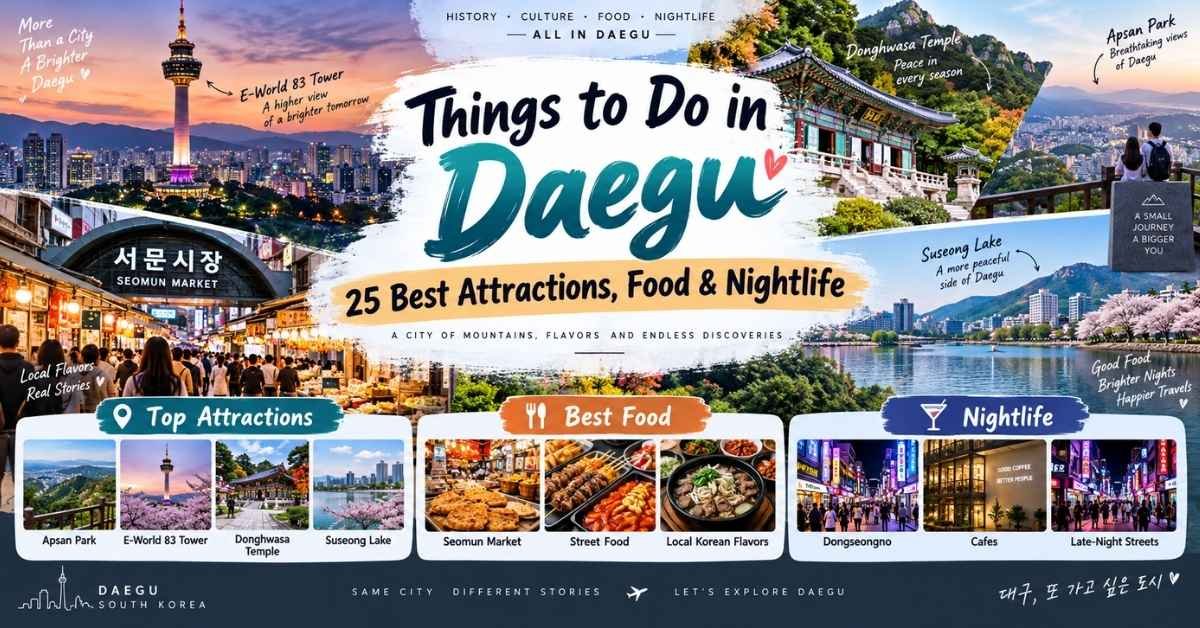
things to do in daegu include eating your way through Seomun Market, watching the city light up from Apsan Observatory, exploring the historic alleys around Yangnyeongsi, shopping and café-hopping on Dongseong-ro, walking around Suseongmot Lake after dark, and taking a slower day trip to Palgongsan National Park and Donghwasa Temple. Daegu does not have Seoul’s huge collection of headline landmarks or Busan’s beaches, but that is exactly part of its appeal: it gives you regional food, mountains, markets, contemporary Korean city life, and a noticeably more local atmosphere.
The mistake many first-time visitors make is trying to work through a random list of 20 or 30 Daegu attractions. The city makes much more sense when you group places by neighborhood, save outdoor activities for cooler hours, and prioritize experiences that match the amount of time you actually have.
If this is your first visit, start with Seomun Market, the old downtown area, Dongseong-ro, and Apsan. Add Suseongmot for an easy evening, then save Palgongsan and Donghwasa for a second or third day.
Best Things to Do in Daegu at a Glance
| Place | Best For | Time Needed | Best Time | Priority |
|---|---|---|---|---|
| Seomun Market | Food, local culture | 1–2 hours | Lunch or evening | Essential |
| Apsan Observatory | City views | 2–3 hours | Late afternoon | Essential |
| Dongseong-ro | Shopping, cafés, nightlife | 2–4 hours | Evening | Essential |
| Modern Culture Alley | History, walking | 1–2 hours | Morning | Essential |
| Suseongmot Lake | Couples, night views | 1–2 hours | Evening | High |
| Palgongsan | Hiking, nature | Half/full day | Morning | High with 2+ days |
| Donghwasa Temple | Culture, Buddhism | 1–2 hours | Morning | High with Palgongsan |
| E-World & 83 Tower | Families, night views | Half day | Late afternoon | Optional |
| Kim Gwangseok-gil | Music, murals, cafés | 1–2 hours | Afternoon | Optional |
If you only have one day, do not try to visit all of them. Daegu rewards good sequencing more than aggressive sightseeing.
Is Daegu Worth Visiting?
Yes, Daegu is worth visiting if you enjoy food, markets, neighborhoods, mountains, cafés, Korean everyday life, and destinations with fewer international tourists.
It is different from the Korean cities most first-time visitors already know.
Seoul gives you enormous scale, royal palaces, museums, nightlife, and trend-driven neighborhoods.
Busan gives you beaches, dramatic coastline, seafood, and port-city energy.
Gyeongju gives you ancient Korean history, royal tombs, temples, and archaeological sites.
Daegu sits somewhere else entirely. Its strength is regional identity.
You come here to eat makchang late at night, wander through a traditional market, walk streets tied to modern Korean history, hike or ride toward a mountain viewpoint, spend an afternoon in a huge café, and finish the evening beside a lake surrounded by locals rather than tour groups.
Who Will Enjoy Daegu Most?
Daegu is especially rewarding for:
- food travelers
- repeat visitors to South Korea
- café lovers
- hikers
- couples
- solo travelers
- travelers interested in modern Korean culture
- people who prefer cities that feel lived-in rather than heavily staged for tourism
Who Might Put Daegu Lower on the List?
If this is your first trip to South Korea and you only have five or six days, Seoul, Busan, and Gyeongju may deserve priority first.
Daegu becomes much more attractive when you have enough time to appreciate regional differences rather than rushing from landmark to landmark.
How Many Days Do You Need in Daegu?
For most first-time visitors, two days is the sweet spot.
One Day in Daegu
One day is enough for a strong introduction if you stay geographically focused.
Prioritize:
Seomun Market → Modern Culture Alley → Dongseong-ro → Apsan
That gives you food, history, contemporary city life, and a panoramic view without spending the day crossing Daegu repeatedly.
Two Days in Daegu
Two days lets you slow down.
Use the second day for either:
- Palgongsan + Donghwasa
- museums + Suseongmot
- E-World + 83 Tower
- deeper food and café exploration
Three Days in Daegu
Three days gives you space to experience the city rather than simply check it off.
Add:
- Palgongsan
- Donghwasa
- cafés
- art museums
- neighborhoods
- seasonal events
- nightlife
For travelers interested in local Korea rather than only iconic Korea, three days can feel surprisingly easy to fill.
Explore Daegu by Neighborhood, Not by Random Attraction Lists
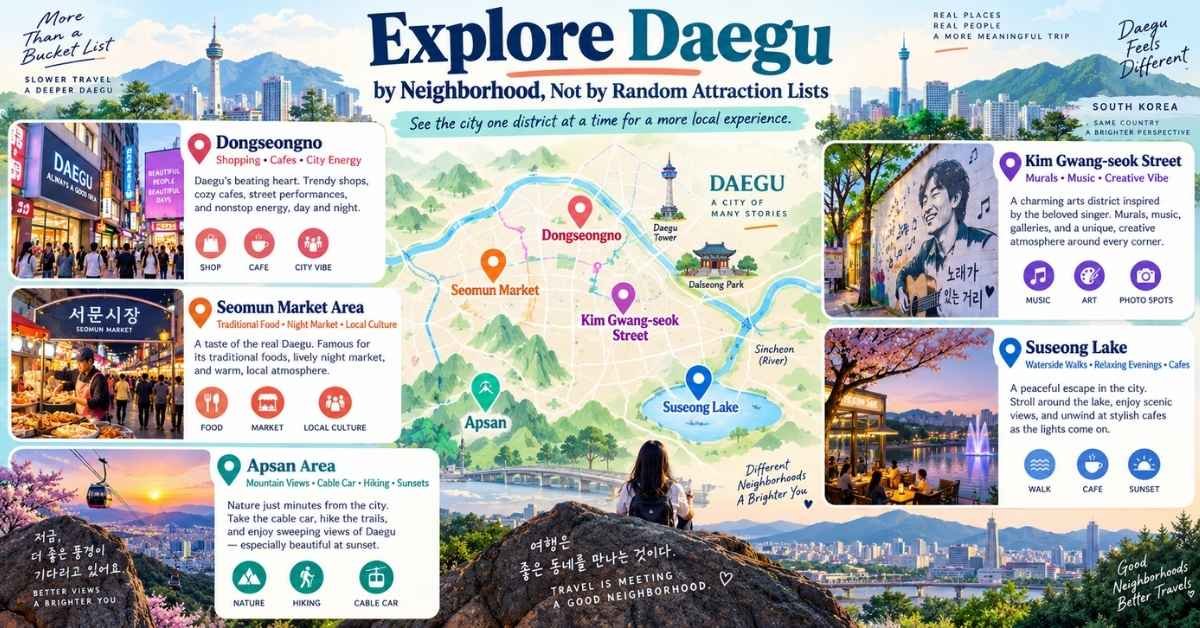
Daegu becomes much easier when you think in clusters.
The strongest first-time combinations are:
Old Downtown
Seomun Market → Yangnyeongsi → Gyesan Cathedral → Modern Culture Alley → Dongseong-ro
Southern Daegu
Apsan → café stop → Anjirang Gopchang Alley
Suseong Area
art museum → café → Suseongmot
Palgongsan Day
Palgongsan → Donghwasa → Gatbawi or cable-car area
This approach saves transport time and gives each day a natural rhythm.
Eat Your Way Through Seomun Market
Seomun Market is one of the best places to start a Daegu trip because it introduces you to several sides of the city at once: food, textiles, local commerce, and everyday culture.
This is not the kind of market where you should rush through taking photos.
Come hungry.
Look for dishes and snacks such as:
- napjak mandu
- hotteok
- fish cakes
- tteokbokki
- noodles
- fried snacks
- Korean market sweets
What Is Napjak Mandu?
Napjak mandu literally means flat dumplings.
Unlike plump dumplings filled heavily with meat or vegetables, these are thin, lightly filled, and usually served with seasoning, vegetables, or sauce.
They are one of the easiest local foods to try because they work as a snack rather than a full meal.
Is the Seomun Night Market Worth Visiting?
Yes, when it is operating.
The atmosphere becomes more social after dark, with street food, lights, and younger crowds mixed with the traditional market environment.
Because night-market schedules can change seasonally, check the current operating days before building your evening around it.
Who Should Prioritize Seomun Market?
Go if you care about:
- local food
- street photography
- traditional markets
- Korean everyday life
If you dislike crowds and have only a few hours in Daegu, visit earlier in the day rather than during the busiest evening period.
Walk Through Daegu’s Modern Culture Alley
The Modern Culture Alley area is one of the best ways to understand Daegu beyond restaurants and shopping.
Rather than one huge monument, you move through a network of historic streets, churches, old homes, medicine districts, and buildings linked to Daegu’s modern development.
That makes this area ideal for travelers who like context more than spectacle.
You can combine several nearby stops without much transit.
Visit Gyesan Cathedral
Gyesan Cathedral is one of Daegu’s recognizable historic landmarks and fits naturally into a walk through the old downtown district.
Its value is not that you should cross the city solely to photograph it.
Its value comes from seeing it as part of a larger historical route.
Explore Yangnyeongsi
Yangnyeongsi connects Daegu with Korea’s traditional herbal-medicine history.
This is one of the city’s more distinctive semantic identities:
Daegu → traditional medicine → Yangnyeongsi
Even travelers with little interest in medicine may enjoy the contrast between herbal shops, historic streets, museums, and modern downtown blocks nearby.
Finish the Downtown Route on Dongseong-ro
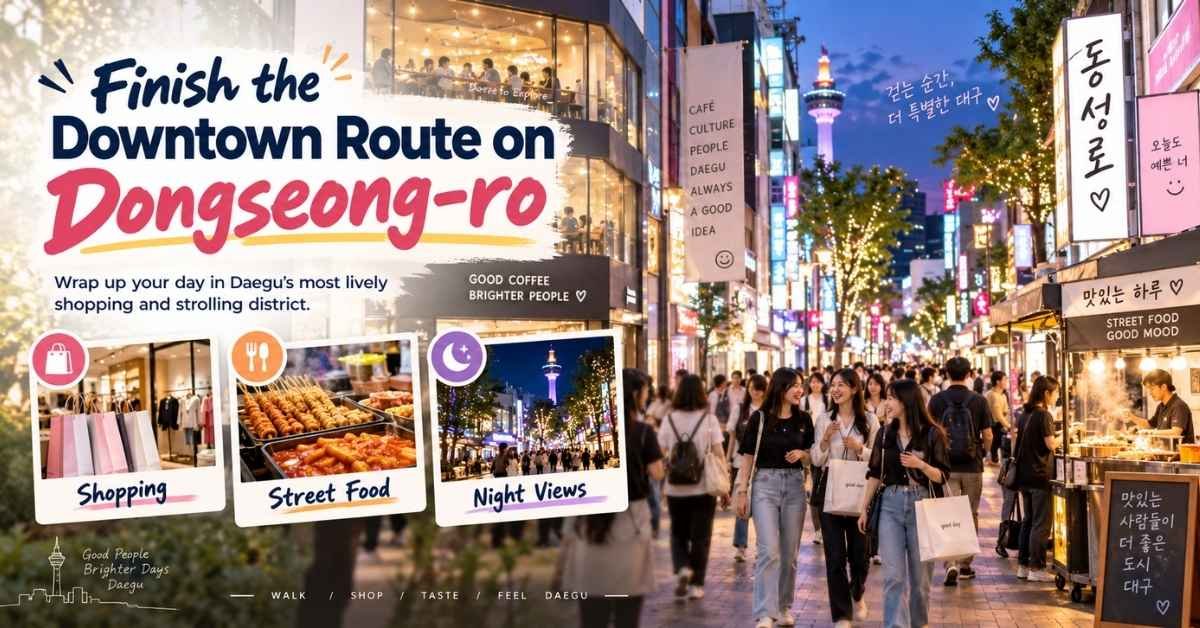
Dongseong-ro is where Daegu shifts from historical city to modern Korean city.
This central shopping and entertainment district is filled with:
- fashion stores
- restaurants
- beauty shops
- cafés
- entertainment venues
- bars
- young crowds
Come in the late afternoon and stay into the evening.
During the day, it is useful for shopping. After dark, it becomes one of the easiest places to experience Daegu nightlife without committing to a specific club or bar scene.
For first-time visitors, Dongseong-ro is important because it stops the trip from becoming a sequence of temples and museums.
See Daegu From Apsan Observatory
If you only choose one panoramic experience, make it Apsan.
The mountain rises immediately south of central Daegu, and the observatory gives you a broad perspective over the city and surrounding basin.
Cable Car or Hike?
Both work, but they create very different experiences.
Take the Cable Car If:
- your time is limited
- you are traveling as a couple
- you are with family
- you want the view without a long hike
- summer heat is intense
Hike If:
- you want exercise
- mountain walking is part of your Korea trip
- the weather is comfortable
- you have several hours
Best Time to Visit Apsan
Late afternoon is ideal.
You can see Daegu in daylight, watch the light change around sunset, and stay long enough to see the city begin glowing after dark.
This is much more satisfying than arriving in the middle of a hot summer afternoon.
Pair Apsan With Anjirang Gopchang Alley
One of the smartest Daegu evening combinations is:
Apsan sunset → Anjirang dinner
You get scenery first, then one of the city’s most recognizable food experiences without unnecessary backtracking.
Eat Makchang or Gopchang at Anjirang

Daegu is one of South Korea’s strongest destinations for makchang and gopchang.
If you are unfamiliar with them:
Gopchang generally refers to grilled intestines.
Makchang refers to a particular section of the intestine and is commonly grilled until smoky and chewy.
It is not a dish everyone will immediately love, but for food-focused travelers it is one of the most memorable things to eat in Daegu.
Why Anjirang Gopchang Alley?
The attraction is not one famous restaurant.
It is the concentration of restaurants and the social atmosphere of grilling meat at the table with drinks and side dishes.
This works best as a group dinner or late-evening meal.
What If You Don’t Eat Offal?
Do not force the experience just because it appears on travel lists.
Daegu has plenty of alternatives including:
- jjim-galbi
- Korean barbecue
- soups
- noodles
- fried chicken
- market food
Food tourism works better when curiosity replaces obligation.
Walk Around Suseongmot Lake After Dark
Suseongmot Lake is one of Daegu’s easiest evening experiences.
You do not need to plan a complicated sightseeing stop.
Walk around the lake, stop for coffee or dessert, watch the lights reflect on the water, and slow down after a busy day.
Why Visit in the Evening?
During daylight, Suseongmot is pleasant.
After dark, it becomes more atmospheric.
The surrounding cafés, restaurants, city lights, and local couples make it feel less like an attraction and more like part of everyday Daegu.
Best for Couples
If you are looking for romantic things to do in Daegu, Suseongmot is one of the easiest recommendations.
It works particularly well after:
- an art museum visit
- dinner
- a café stop
- a low-energy sightseeing day
Spend Half or a Full Day at Palgongsan
Palgongsan National Park is one of the best things to do in Daegu if you have two or more days.
This is where Daegu’s urban character gives way to mountains, hiking trails, Buddhist heritage, and seasonal foliage.
Who Should Visit Palgongsan?
Prioritize it if you like:
- hiking
- temples
- autumn scenery
- nature
- photography
- slower travel
Who Should Skip It?
If you only have one day in Daegu, Palgongsan is often too large a time commitment unless mountain scenery is your main reason for visiting.
Use that time downtown instead.
Best Seasons for Palgongsan
Spring brings comfortable walking and fresh greenery.
Autumn is arguably the strongest season because of foliage.
Summer can be hot and humid, so start early.
Winter can be beautiful but requires more preparation.
Visit Donghwasa Temple
Donghwasa Temple is one of the most important cultural stops around Palgongsan.
The mountain setting changes the experience completely compared with an urban temple.
Instead of treating Donghwasa as an isolated attraction, combine it with a wider Palgongsan half-day or full-day trip.
Why Donghwasa Is Worth Your Time
It gives you:
- Buddhist history
- traditional architecture
- mountain scenery
- a quieter pace than downtown
Allow roughly one to two hours for the temple itself, then longer if you are hiking or exploring the surrounding mountain.
Climb Toward Gatbawi If You Want a More Demanding Experience
Gatbawi is associated with a famous stone Buddha and pilgrimage route in the Palgongsan area.
This is not the right stop for every visitor.
The climb requires more effort and makes sense primarily for:
- strong walkers
- hikers
- Buddhist-cultural travelers
- people with enough time
If mobility is limited or you are trying to see Daegu in one day, skip it without guilt.
Walk Kim Gwangseok-gil Street
Kim Gwangseok-gil is a mural and cultural street dedicated to Korean singer-songwriter Kim Gwang-seok.
International travelers unfamiliar with Korean music sometimes visit and wonder why the street matters.
Understanding the context improves the experience.
Kim Gwang-seok remains a respected figure in Korean popular music, and the street celebrates his songs and cultural legacy through:
- murals
- sculptures
- music installations
- cafés
- small shops
Is Kim Gwangseok Street Worth It?
Yes if you enjoy Korean music, street art, photography, or café neighborhoods.
If you are spending only one day in Daegu, it is less important than Seomun Market, downtown history, or Apsan.
That does not make it bad. It simply makes it optional rather than essential.
Experience Modern Daegu, Not Only Traditional Daegu
One weakness in many English-language Daegu guides is that they make the city feel far more traditional than it actually is.
Modern Daegu is full of:
- large cafés
- department stores
- beauty shops
- Korean lifestyle stores
- stationery shops
- design shops
- rooftop attractions
- youth-oriented entertainment
These are not side distractions.
For many Korean weekend travelers, they are part of the trip itself.
Browse Small Design and Lifestyle Shops
Korean sopum shops sell everything from stationery and home accessories to character goods, handmade products, and small gifts.
They are especially worth browsing around modern commercial neighborhoods.
If you want souvenirs that feel more personal than airport merchandise, these small shops are often better than conventional souvenir stores.
Learn More: Things to Do Near Bar Harbor Maine: 25 Best Places & Day Trips
Spend Time in Daegu’s Café Culture
Do not underestimate café hopping as part of modern Korean travel.
Some cafés function almost like attractions, with:
- huge interiors
- rooftop terraces
- industrial architecture
- garden spaces
- elaborate desserts
Instead of chasing one supposedly “secret” café that may close within six months, choose a café near the neighborhood you are already exploring.
That keeps your itinerary flexible.
Visit Spark Land
Spark Land gives downtown Daegu a more playful, youthful feel.
The rooftop amusement attractions are particularly appealing for:
- younger travelers
- couples
- social-media photography
- travelers spending the evening around Dongseong-ro
It is not a cultural essential, but it adds variety to a trip that might otherwise become heavily focused on markets and history.
E-World and 83 Tower: Are They Worth It?
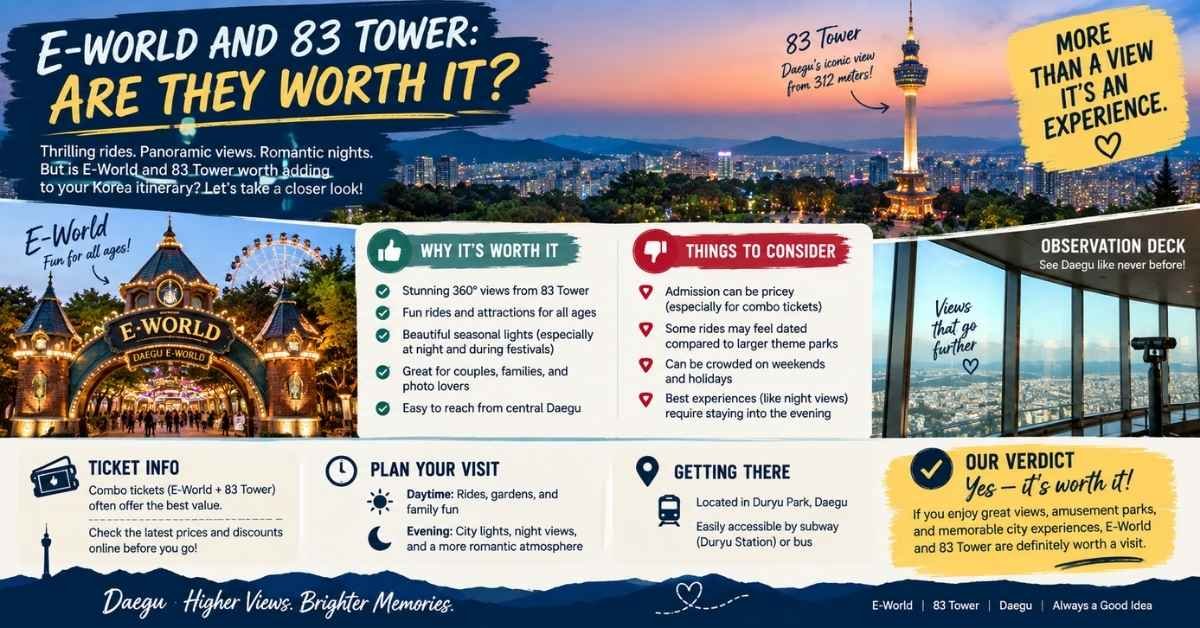
It is Daegu’s major theme-park experience, while 83 Tower gives you another elevated city view.
E-World Is Best For:
- families
- couples
- theme-park fans
- travelers visiting during seasonal illumination periods
83 Tower Is Best For:
- city views
- night photography
- travelers already visiting E-World
Apsan or 83 Tower?
If you only want one viewpoint, Apsan is usually the better Daegu-specific experience because it combines a mountain setting with the city panorama.
Choose 83 Tower when convenience, family attractions, or a theme-park evening matters more.
Explore Daegu’s Art Scene
Daegu’s contemporary cultural side deserves more attention than it receives in older travel guides.
Daegu Art Museum
The Daegu Art Museum works particularly well on:
- rainy days
- very hot afternoons
- slower cultural itineraries
Check the current exhibitions before visiting rather than assuming the same permanent experience year-round.
Kansong Art Museum Daegu
Kansong Art Museum Daegu adds another important dimension to the city’s current art landscape.
For travelers interested in Korean visual culture, history, and museum design, this is a much stronger addition than simply repeating the same attractions that have appeared in Daegu guides for a decade.
Build an Art and Suseong Evening
A low-stress cultural day can look like:
museum → café → Suseongmot → dinner
This is especially effective during summer heat or bad weather.
What to Eat in Daegu
Food is one of the strongest reasons to visit Daegu.
Do not reduce it to one market paragraph.
Napjak Mandu
Thin, flat dumplings commonly eaten as a snack.
Best place in your itinerary: Seomun Market or casual snack stop.
Makchang
Grilled intestine with a chewy texture and smoky flavor.
Best time: dinner or late evening.
Gopchang
Another grilled-intestine specialty, often enjoyed socially with drinks.
Best context: Anjirang Gopchang Alley.
Jjim-Galbi
Daegu-style spicy braised beef ribs.
This is a better option if you want a substantial regional meal without eating offal.
Ttarogukbap
A traditional beef soup served with rice separately.
Comforting, straightforward, and useful when you want something less trendy than café food.
Mungtigi
Fresh raw beef served in thick pieces.
This is more adventurous and should be eaten at a reputable restaurant specializing in it.
Pressed Noodles
Daegu’s noodle traditions give you another inexpensive, comforting local meal that works well for lunch.
Best Things to Do in Daegu at Night
Daegu improves after dark.
Walk Dongseong-ro
Best for:
- shopping
- nightlife
- bars
- casual food
- people-watching
Visit Seomun Night Market
Best for:
- street food
- evening atmosphere
- casual grazing
Check current operating days first.
Walk Around Suseongmot
Best for:
- couples
- quiet evenings
- cafés
- lakeside walking
Watch Daegu Light Up From Apsan
Best for:
- photography
- panoramic city views
- sunset-to-night transitions
Visit E-World and 83 Tower
Best for:
- families
- theme-park fans
- colorful night views
| Night Experience | Best For |
|---|---|
| Apsan | Panoramic views |
| Dongseong-ro | Shopping and nightlife |
| Suseongmot | Couples |
| Seomun Market | Food |
| E-World | Families |
Things to Do in Daegu When It’s Too Hot
Daegu is famous within Korea for very hot summers, so timing can completely change your experience.
Do not plan an exposed afternoon hike simply because the attraction appears near the top of a list.
Morning
Use cooler hours for:
- Apsan
- Palgongsan
- Modern Culture Alley
- outdoor markets
Midday
Move indoors:
- Daegu Art Museum
- Kansong Art Museum
- cafés
- department stores
- Yangnyeongsi cultural attractions
Evening
Return outside for:
- Suseongmot
- Dongseong-ro
- Seomun Night Market
- Apsan views
This outdoor → indoor → evening rhythm is one of the easiest ways to improve a summer Daegu itinerary.
What to Do in Daegu When It Rains
Rain does not need to destroy your trip.
Good rainy-day options include:
- Daegu Art Museum
- Kansong Art Museum
- Daegu National Museum
- Yangnyeongsi
- Daegu Aquarium
- cafés
- department stores
- Korean barbecue or makchang dinner
Keep Palgongsan, Apsan hiking, and long outdoor walks flexible when conditions are poor.
Free Things to Do in Daegu
Daegu is relatively easy to explore on a budget.
Good free things to do in Daegu include:
- walking Modern Culture Alley
- exploring Dongseong-ro
- browsing Seomun Market
- walking Kim Gwangseok Street
- relaxing at Suseongmot
- exploring public parks
- walking selected mountain routes
Some attractions, cable cars, museums, transit, and activities may still charge separate fees, so “free” refers to the core experience rather than the entire outing.
Things to Do in Daegu With Kids
Families should prioritize attractions that are enjoyable without turning every outing into a difficult cultural lesson or mountain trek.
E-World
One of the easiest family choices.
Daegu Aquarium
Useful for:
- younger children
- rainy weather
- summer heat
Suseongmot
Good for a relaxed family evening.
Parks and Easy Walks
Use family-friendly parks and shorter urban walks rather than assuming every mountain attraction is suitable for children.
Romantic Things to Do in Daegu
For couples, Daegu works best when you mix scenery with food rather than overplanning.
Try:
- Apsan at sunset
- Suseongmot after dark
- café hopping
- E-World night lights
- art museum + dinner
- late-night food around Dongseong-ro
The strongest couple experiences are usually simple ones where the city provides the atmosphere.
Things to Do in Daegu for K-Pop and Korean Music Fans
Music-focused travelers can add a different layer to the trip.
Kim Gwangseok Street
The clearest music-related cultural attraction.
BTS-Related Locations
Daegu has connections to Korean pop culture and artists, but only include specific sites in your itinerary if they are currently accessible and verifiable.
Do not spend half your day crossing the city for a wall or location that has changed.
Dongseong-ro
Even without a formal K-pop attraction, the area gives you a better feel for contemporary Korean youth culture through music shops, fashion, beauty, cafés, and entertainment.
Festivals Worth Planning Around
Daegu Chimac Festival
Daegu’s Chimac Festival combines two of Korea’s favorite things:
chicken + beer
The event has become one of the city’s most recognizable summer festivals and typically centers around Duryu Park.
If you are visiting during the festival period, expect:
- huge crowds
- music
- food stalls
- nightlife
- outdoor events
Do not add old festival dates automatically. Always verify the current year before booking hotels around it.
Seasonal Events
Daegu also hosts:
- spring blossom events
- autumn cultural festivals
- art exhibitions
- market events
- nighttime programming
Seasonal events can turn an ordinary Daegu weekend into a much stronger trip.
How to Get Around Daegu
Daegu is easier to navigate than Seoul.
Metro
The metro works well for much of urban Daegu, particularly:
- downtown
- Dongseong-ro
- Suseong areas
- major commercial districts
Walking
Walking is best once you arrive inside a cluster.
For example, old downtown contains several attractions close enough to combine on foot.
Buses
Buses are more important for outlying attractions and mountain areas.
Taxis
Taxis can be useful when:
- several people share the fare
- you want to save time
- public transport involves multiple transfers
- traveling toward mountain attractions
Use Naver Map or KakaoMap
In South Korea, Naver Map and KakaoMap are generally more useful for local navigation than relying exclusively on Google Maps.
Save important attractions in advance.
Searching with Korean names can also make navigation easier.
Examples:
- Seomun Market — 서문시장
- Dongseong-ro — 동성로
- Suseongmot — 수성못
Things to Do in Daegu Without a Car
You do not need a rental car for most first-time sightseeing.
A strong no-car route is:
Dongdaegu Station → Seomun Market → Modern Culture Alley → Dongseong-ro → Suseongmot
Urban Daegu works well with:
- metro
- walking
- buses
- occasional taxis
A car becomes more useful only if you plan to explore mountain areas extensively.
See More: 27 Best Free Things to Do in Lisbon for Every Traveler
Best Things to Do in Daegu by Season
Spring
Excellent for:
- walking
- blossoms
- Palgongsan
- outdoor cafés
- city neighborhoods
Summer
Best for:
- Chimac Festival
- night markets
- nightlife
- museums during midday
But prepare for significant heat.
Autumn
Arguably the strongest season for:
- Palgongsan
- hiking
- foliage
- comfortable urban walking
Winter
Winter works well for:
- cafés
- museums
- Korean food
- indoor attractions
- clear city views
Build shorter outdoor periods into the day.
Best Daegu Experiences by Traveler Type
| Traveler | Best Experiences |
|---|---|
| First-time visitor | Seomun, Apsan, Modern Culture Alley, Dongseong-ro |
| Food lover | Seomun, Anjirang, jjim-galbi, local dishes |
| Couple | Apsan, Suseongmot, cafés |
| Family | E-World, aquarium, parks |
| Hiker | Palgongsan, Apsan, Gatbawi |
| Culture traveler | Donghwasa, Yangnyeongsi, Modern Culture Alley |
| Music/K-pop fan | Kim Gwangseok Street, Dongseong-ro |
| Rainy-day traveler | museums, shopping, cafés |
What to Skip If You’re Short on Time
A trustworthy guide should tell you what not to prioritize.
Palgongsan on a One-Day Trip
Skip it unless hiking or temples are your top priority.
It requires too much time compared with central Daegu.
E-World If You Don’t Enjoy Theme Parks
It is fun, not compulsory.
83 Tower If You Already Have Apsan Planned
Both give elevated city views. You probably do not need both on a short trip.
Kim Gwangseok Street on an Extremely Tight Schedule
It is enjoyable, but Seomun, old downtown, and Apsan provide a stronger first-time introduction.
One-Day Daegu Itinerary
Morning: Seomun Market
Arrive hungry and try local snacks.
Late Morning: Yangnyeongsi and Modern Culture Alley
Walk rather than taking repeated taxis.
Afternoon: Dongseong-ro
Eat lunch, shop, or stop for coffee.
Late Afternoon: Apsan
Head up before sunset.
Dinner: Anjirang Gopchang Alley
Finish with one of Daegu’s signature food experiences.
Optional Evening
If you still have energy, go to Suseongmot.
Do not feel required to add it. A good one-day itinerary should still leave time to enjoy dinner.
Two-Day Daegu Itinerary
Day 1: Classic Daegu
Seomun Market → Modern Culture Alley → Dongseong-ro → Apsan → Anjirang
Day 2: Choose Your Style
Culture
Daegu Art Museum → Kansong Art Museum → Suseongmot
Nature
Palgongsan → Donghwasa
Family
Daegu Aquarium → E-World → 83 Tower
This makes your second day fit your interests rather than forcing everyone into the same itinerary.
Three-Day Daegu Itinerary
Day 1
Downtown essentials.
Day 2
Palgongsan and Donghwasa.
Day 3
Museums, cafés, Suseongmot, shopping, or family attractions.
Three days gives you enough time to stop treating Daegu as a checklist.
Common Daegu Planning Mistakes
Visiting Apsan at Midday in Summer
The heat can make a beautiful place unnecessarily uncomfortable.
Crossing the City Repeatedly
Cluster attractions.
Your day should move naturally rather than zigzagging between neighborhoods.
Treating Every Top Attraction as Essential
It is not.
Your interests matter more than somebody else’s ranking.
Leaving Without Trying Regional Food
Food is part of Daegu’s identity, not filler between attractions.
Ignoring Korean Navigation Apps
Save Naver Map or KakaoMap locations before heading out.
Spending Too Much of a One-Day Visit at Palgongsan
Palgongsan deserves time. Give it a separate day or skip it.
Daegu Planning Checklist
Before heading out, check:
- weather
- current attraction hours
- museum exhibitions
- Seomun Night Market schedule
- Palgongsan transport
- festival dates
- Naver or Kakao Map locations
- comfortable shoes
- summer heat or rain backup
- restaurant closing days
A flexible Daegu itinerary will almost always outperform a rigid one.
Frequently Asked Questions About Things to Do in Daegu
What are the best things to do in Daegu?
The best first-time experiences are Seomun Market, Apsan Observatory, Modern Culture Alley, Dongseong-ro, and Suseongmot. With more time, add Palgongsan and Donghwasa Temple.
Is Daegu worth visiting?
Yes, particularly if you enjoy food, markets, Korean neighborhoods, cafés, mountains, and cities with fewer international tourists.
What is Daegu famous for?
Daegu is known for its regional food, traditional markets, textiles, mountains, herbal-medicine history, makchang, Chimac Festival, and hot summer climate.
How many days do you need in Daegu?
Two days is ideal for most first-time visitors. One day covers highlights, while three days lets you add Palgongsan and slower neighborhood exploration.
Is one day enough for Daegu?
Yes, if you stay central.
Focus on Seomun Market, old downtown, Dongseong-ro, and Apsan.
What should you not miss in Daegu?
For a first trip, do not miss Seomun Market and Apsan. Together they show you two of Daegu’s strongest identities: local food and mountain-framed city views.
What food is Daegu famous for?
Look for napjak mandu, makchang, gopchang, jjim-galbi, ttarogukbap, mungtigi, and local noodle dishes.
What should you eat at Seomun Market?
Try napjak mandu, hotteok, fish cakes, noodles, tteokbokki, and whatever busy local stalls are serving fresh.
What are the best things to do in Daegu at night?
Good evening choices include Dongseong-ro, Suseongmot, Apsan Observatory, Seomun Night Market, and E-World.
Is Apsan worth visiting?
Yes. For most first-time visitors, Apsan is one of Daegu’s highest-priority attractions, particularly around sunset.
Is Palgongsan worth visiting?
Yes if you have at least two days or enjoy hiking, temples, and mountain scenery. It is less practical during a very short visit.
Can you get around Daegu without a car?
Yes. Metro, buses, walking, and taxis are enough for most city attractions.
What can you do in Daegu when it rains?
Visit Daegu Art Museum, Kansong Art Museum, Yangnyeongsi, the aquarium, cafés, shopping centers, or indoor food districts.
What are the best free things to do in Daegu?
Walk Modern Culture Alley, Dongseong-ro, Kim Gwangseok Street, Suseongmot, markets, and public parks.
Is Daegu good for couples?
Yes. Apsan sunset, Suseongmot, cafés, E-World at night, and food-focused evenings make Daegu particularly easy for couples.
Which is better for tourists, Daegu or Gyeongju?
Choose Gyeongju for ancient Korean history and major historic landmarks.
Choose Daegu for food, modern city culture, nightlife, cafés, markets, and mountains.
What is the best area to stay in Daegu?
For most first-time visitors, staying near Dongseong-ro or central Daegu makes restaurants, shopping, metro access, and downtown attractions easier.
The Bottom Line
The best things to do in Daegu are not about completing the longest attraction list. Daegu becomes much more rewarding when you experience its different personalities: Seomun Market for food, Modern Culture Alley for history, Dongseong-ro for contemporary city life, Apsan for views, Suseongmot for a relaxed evening, and Palgongsan for nature when you have more time.
If your schedule is short, stay central. If you have two or three days, expand outward.
Most importantly, group attractions by neighborhood, save outdoor sightseeing for cooler hours, try the food Daegu is actually known for, and leave enough free time to experience the city rather than simply photograph it.